
Jon Miltimore was concerned when a report from his son’s school indicated that his son was lagging behind in reading compared to his classmates:
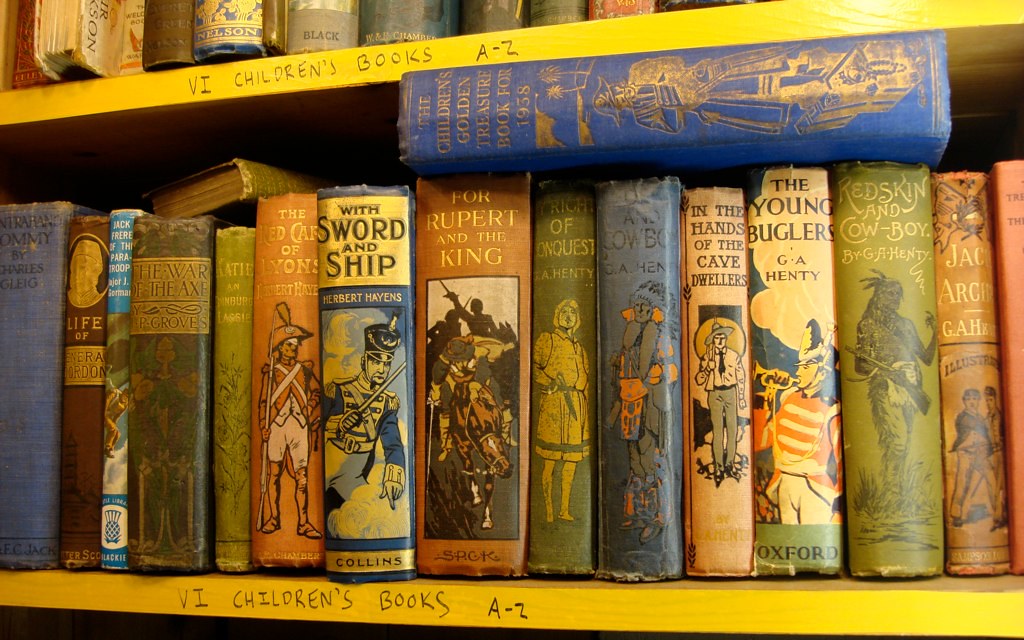
“Old Victorian Childrens’ Books” by pettifoggist is licensed under CC BY-SA 2.0 

 .
.
So the fact that my own son — who is quite bright and scores extremely high in math — was struggling hit me a little, but it was not a surprise. Like many children, he had fallen behind in reading during the pandemic, and our efforts to get him caught up at home were pretty ineffective. Part of the problem was that as parents we did not do a good enough job of finding the right books to naturally kindle his interest and curiosity, but another issue was that at some point he began to feel self-conscious about this reading, which created an aversion to books.
[…]
A few months later, I had just finished reading a story to my 6-year-old son, who shares a bedroom with his older brother. I went to flick the light off when my older son said something I’d never heard before.
“Can I read for just ten more minutes,” he pleaded, showing me his book on pro football players.
I quickly gave my approval, then went downstairs to tell my wife. She was not as surprised as I was.
“They’re doing a reading competition at school. It’s boys against girls,” she said. “Every minute he reads is now added to their score. So now he wants to read — because it’s a competition.”
My wife did not say this disapprovingly, but she said it in a way that said of course he wants to read now. (My son is competitive.)
Over the next several weeks I watched as my son made a point of reading every night. Oftentimes he’d ask — just like on that first night — if he could read just 10 more minutes. Many nights he’d fall asleep with a book on his chest.
I have to admit that at first I found this strategy a tad cynical, but then I got the results. Over the span of seven weeks, my son leapt nearly two reading levels. He’s reading comfortably at the third-grade level and we’re now focusing more on reading comprehension than reciting sentences. He’s asking for books on World War I, World War II, and Vietnam for Christmas.
“His fluency has improved so much! I am so proud of him,” his teacher later told me.
Competition as a Virtue
I don’t doubt that some will look on this strategy with disdain.
We’re taught today that competition is crass, even harmful. George Soros, in a highly read piece from the 1990s published in The Atlantic, could have been speaking for many when he wrote that competition can “cause intolerable inequities and instability”. For many, competition is a dirty word, a sinister force to be suppressed and controlled.
This is nonsense, of course. Competition isn’t just innate to humans; it brings out the best in us.
It’s the force that drove Roger Bannister to break the four-minute mile. It’s given us the achievements of Michael Phelps and Michael Jordan. Socially, competition is what prompted the Brooklyn Dodgers to do the unthinkable and sign Jackie Robinson, breaking the color barrier and forever changing sports and America.


