
Like many people, I was generally not a good student and in primary and middle school, I was notorious for reading the “wrong” parts of books because they were closer to my interests than the assigned readings, but I generally was able to scrape together enough marks to pass the tests on the stuff I skimmed or ignored. This is hardly the way to make an academic career — not that I would ever have done so, unless they just let me study what I wanted to learn about. A useful Substack for my fellow autodidacts [Wiki] is a side project of military historian Bruce Ivar Gudmundsson called Extra Muros, and his latest post provides some information on tools for online research that you may find helpful:
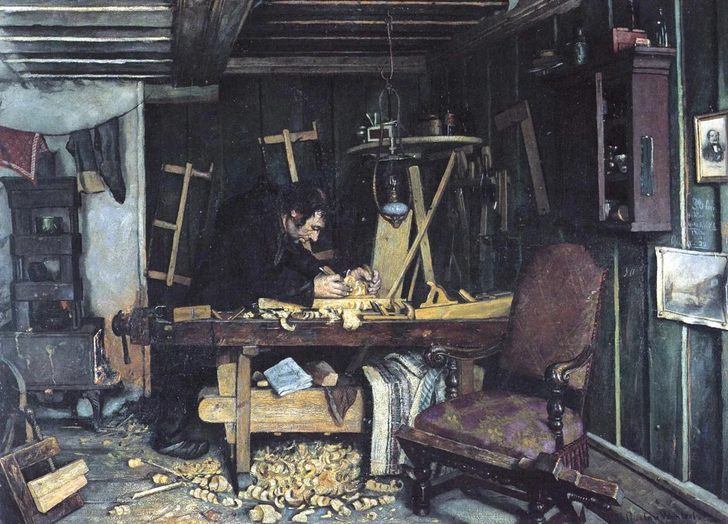
Gustav Wenzel – “A Carpenter’s Workshop” (1881)
The “advanced search” page of the Internet Archive allows you to …
- download copies, in various electronic formats, of
– books and magazines published before 1929
– works (such as those created by the US Federal Government) that have always belonged to the public domain
– relatively recent works uploaded by people in countries (such as India) with less restrictive copyright laws
- examine books that you might want to acquire for enjoyment the old-fashioned way
- find higher-quality copies of items that you found on Google Books
- obtain an overview of the works (to include foreign language translations)
– of a particular author
– on a particular subject
The “advanced search” page on the website of the Hathi Trust allows you to do many of the things you might otherwise do on the Internet Archive. Alas (and, indeed, alack), the interface restricts the direct download of complete volumes to “participating institutions”. As a result, mere mortals must either seek the PDF in question on Google Books (to which Hathi provides a direct link) or use a bit of freeware called Hathi Download Helper.
The Hathi Trust search engine also makes it easy for you to search within books for specific words and phrases, as well as the mention of particular places and personalities. Doing the former turns the Hathi Trust database into a kind of dictionary, a way of discovering ways that people in various climes and times have used the expression. Doing the latter converts that cornucopia into an encyclopedia.
The NGram Viewer performs a similar service. However, as it sits atop a smaller collection and suffers from a number of irritating defects, it has proved less useful to me than the website of the Hathi Trust.


