Forgotten Weapons
Published 22 Jul 2017In 1940, Switzerland began a series of trials to replace their Luger service pistols with something equally high quality, but more economical. They had squeezed as much simplification out of the Luger as they could in 1929, and by this time the guns just needed to be replaced. The first 1940 trial had only two entrants (a Petter prototype from SIG and an Astra 900), but a second trial in 1941 included a large assortment of modern handguns, including a French 1935A, a Polish Vis-35, and prototypes from both SIG and W+F Bern.
One of the most tenacious competitors (aside form the winning SIG/Petter design) was the Bern factory’s series of Browning High Power copies. In this video, we will be looking at three progressive versions of this gun as they were modified through the course of the trials (which would last until 1949). While they are all mechanically very similar to the High Power, they will get progressively less visually similar as the trials progressed. In addition, we will see features like the slide lock, manual safety, and magazine release evolve and change.
(more…)
November 22, 2022
W+F Bern P43: A Swiss Take on the Browning High Power
October 27, 2022
Tamara Keel reviews the new FN High Power pistol
These days, thanks to both financial and legal limitations, there’s no chance I’ll ever own either an original Browning Hi Power or the new FN High Power, but I can still dream about ’em:
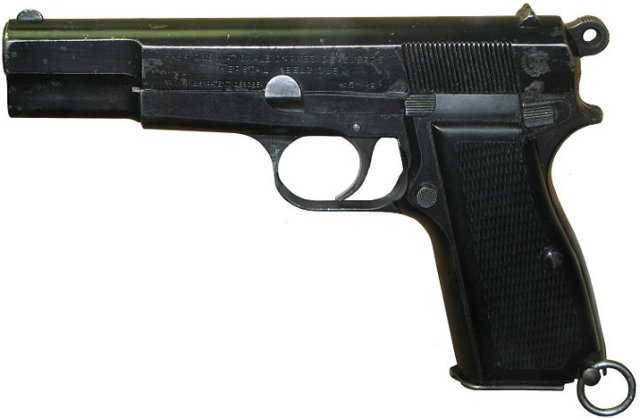
Browning High Power 9mm, the standard side-arm of the Canadian army from WW2 until its replacements start to arrive some time in 2023.
Let me state this up front: I’m a proud American. I love baseball and apple pie. If you cut me, I bleed red, white and blue. Whichever Detroit automaker you think is best, I think they are, too. And, therefore, I am a loyal fan of John Moses Browning’s M1911.
But, with that out of the way, it pains me to admit that the 1911 wasn’t Browning’s most important or influential pistol design. The 1911 is largely an American obsession, and when the rest of the world thinks about JMB’s martial handguns, the one that springs to mind is the Fabrique Nationale GP35, better known as the FN Hi Power.
Actually the result of a collaboration between Browning and his successor at FN, the great Dieudonné Saive, the Hi Power is one of the most prolific service pistols ever created, being used by the militaries of half a hundred countries.
Though it had some features that made it cheaper and easier to produce than the M1911, such as the fixed, under-barrel cam that replaced the swinging link on the older design, the Hi Power was still expensive to produce compared to newer designs. Even the change to a simpler external extractor in the 1960s wasn’t enough to keep it competitive, cost-wise, for budget-conscious militaries, and its double-stack, 13-round mag — a revelation in the 1930s — was by now commonplace.
Browning (an FN subsidiary) finally ended production a few years ago, but it turned out that demand for the Hi Power still existed.
EAA began selling a Turkish-made clone recently, and Springfield Armory upped the ante with the SA-35, which offered some minor tweaks to the original design.
Early this year, though, FN America went nuclear on the Hi Power market by offering the all-new, American-made High Power.
Note the spelling change, because this isn’t your granddad’s Hi Power.
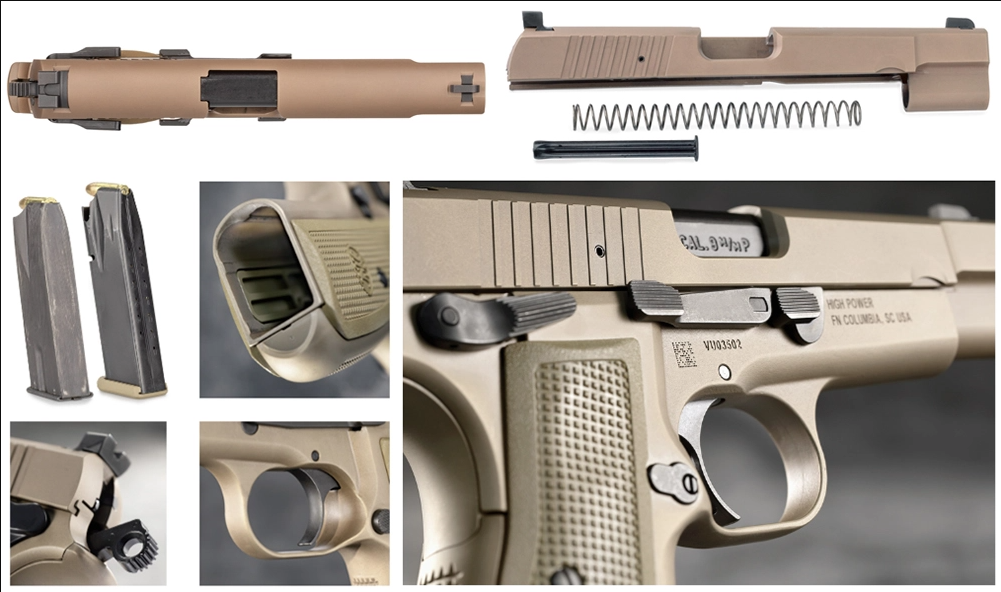
“Controls are ambidextrous. A thumb-safety lever and a slide-stop lever can be found on either side of the new High Power, and the magazine release is reversible • While not interchangeable with the older unit on the left, the new magazines are more capacious • The mag well is expectedly wide and promotes fast reloads • The topstrap is smooth, but the semi-matte PVD finish prevents glare • The trigger is a great improvement over the original, thanks in part to the absence of a magazine-disconnect safety • Removing the slide is simple, but you have to control it against the tension of the recoil spring.”
Photos from Shooting Illustrated, most likely by Tamara Keel.
September 21, 2022
Radom’s Vis 35: Poland’s Excellent Automatic Pistol
Forgotten Weapons
Published 9 Feb 2016In the 1920s Poland began looking for a new standard military pistol, and tested a variety of compact .380s. The representative from FN brought along an early iteration of the High Power (along with their other entry) even though it was much too large and heavy to meet the Polish requirements. After a couple iterations of testing, it became clear to the Polish Ordnance officers that the High Power was a much more effective service pistol than the compact guns they had been instructed to look for.
Lo and behold, the ultimate choice was a domestic design based largely on the High Power (a direct deal with FN was not an option after Poland’s relationship with FN had suffered through problems with the wz.28 version of the BAR). Toss in a delay to redesign the early decocking mechanism to satisfy the Cavalry (who didn’t realize that the decocker wasn’t actually meant to be used, but rather to just add another claim to the patent), and by 1935 the pistol was finished and formally adopted.
The Vis 35 is one of the best automatic pistols of WWII in terms of both handling and quality. In total 46,000 were made pre-war for Poland’s military, and German occupation forces built another 300,000+ during the war.
(more…)
August 8, 2022
FN-DA1: The BAR for NATO
Forgotten Weapons
Published 13 Apr 2022After World War Two, FN put the BAR back into production. This was initially the FN-D version with a quick-change barrel, but with NATO’s adoption of the 7.62mm cartridge, there was a demand for the BAR in that chambering. The Belgian Army adopted this new round, and plenty of other nations did as well. This prompted FN to release a new version of the FN-D for it, designated the FN-DA1.
In addition to the new chambering, the DA1 also had these three changes:
– Larger bipod feet and a wider bipod stance
– A rear aperture sight instead of an open notch
– A more protected barrel release latchThe FN-DA1 would remain in production until 1967, when it was finally discontinued.
(more…)
April 24, 2022
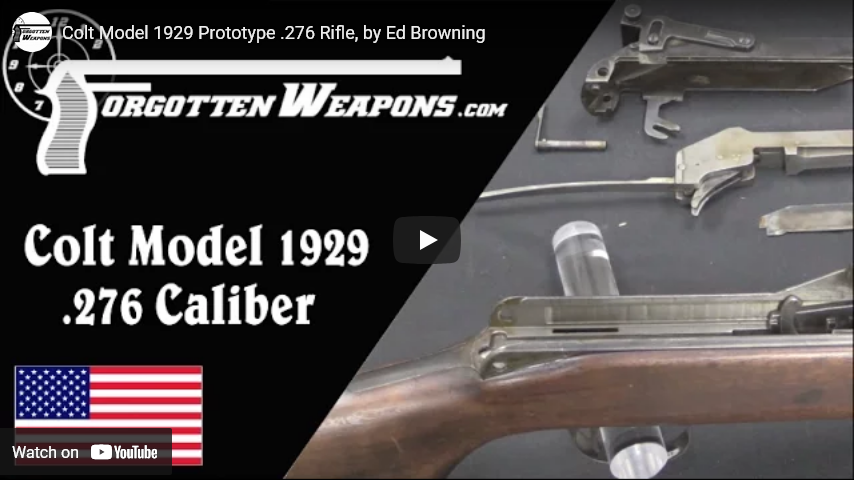
Colt Model 1929 Prototype .276 Rifle, by Ed Browning
Forgotten Weapons
Published 22 Jul 2016http://www.patreon.com/ForgottenWeapons
https://centerofthewest.org/explore/f…On October 1, 1928, the US War Department published a request for semiautomatic rifle designs. The Colt company submitted this .276 caliber rifle to the ensuing trials in 1929. It was designed by Jonathan Edward “Ed” Browning (half brother of John Moses Browning) and was a recoil-operated, tilting bolt design weighing 9lb 9oz and using 108 parts. The tilting bolt system was derived from the 1911 pistol system as designed by John Moses Browning, and the operating system also used an accelerator reminiscent of JMB’s Model 1917 and 1919 machine guns.
After the trials, the Colt 1929 rifle was deemed unfit for further testing by the Ordnance Department because of poor feeding, poor cooling ability, an overly long receiver and short barrel, too many parts, and being too heavy overall. Ed Browning would take the design back to his workshop and continue working on it, eventually replacing the short recoil operating system with an annular gas piston, and bringing it to the Winchester company in the late 1930s.
December 27, 2021
Great Celebrity Breakups: Winchester and John Browning
Forgotten Weapons
Published 26 Aug 2021http://www.patreon.com/ForgottenWeapons
https://www.floatplane.com/channel/Fo…
Cool Forgotten Weapons merch! http://shop.forgottenweapons.com
In August 1903, Thomas Bennett (head of the Winchester company) wrote a letter to his many distributors and agents explaining how Winchester had decided to part ways with the Browning Brothers, and how the company would certainly be better off as a result. The gun at the heart of the breakup was Browning’s new self-loading shotgun, the Auto-5. Browning would end up taking the design to FN, where it became a massive commercial success — but the whole story is really much more nuanced than most people recognize.
This isn’t simply a matter of Browning demanding a royalty arrangement, but rather much more …
Nathan Gorenstein’s biography of John Browning is available on Amazon: https://amzn.to/37Sx9XS
Contact:
Forgotten Weapons
6281 N. Oracle 36270
Tucson, AZ 85740

October 10, 2021
Book Review: The Guns of John Moses Browning, by Nathan Gorenstein
Forgotten Weapons
Published 24 Jun 2021http://www.patreon.com/ForgottenWeapons
https://www.floatplane.com/channel/Fo…
Cool Forgotten Weapons merch! http://shop.forgottenweapons.com
John Moses Browning is, without argument, the greatest firearms designer in history. While we have had many brilliant designers who had their names forever connected to guns (Maxim, Luger, Kalashnikov, …), Browning invented whole *categories* of firearms. Gorenstein’s new book The Guns of John Moses Browning is a welcome biography of the man, giving great insight into Browning’s life and work. The book is well researched, well written, and thoroughly engaging. It is also worth noting that Gorenstein is himself a competitive shooter, and understands the world that Browning operated in.
I think my back-cover blurb for the book (for which I received no compensation; full disclosure) sums it up well:
Following Browning from his birth in rural Utah to his death in urban Belgium, we see how a changing world shaped his inventions and how, in turn, his inventions shaped a changing world.
Browning began in the last years of the Wild West inventing lever action rifles, then became a major part of the blossoming of the automatic pistol, then invented the semiauto shotgun before designing the modern machine guns that become iconic to the United States’ involvement in two world wars. It is a tremendous story, and Gorenstein’s book lays it all out for the reader.
Available from Amazon here:
https://amzn.to/355eMxeContact:
Forgotten Weapons
6281 N. Oracle 36270
Tucson, AZ 85740

July 5, 2021
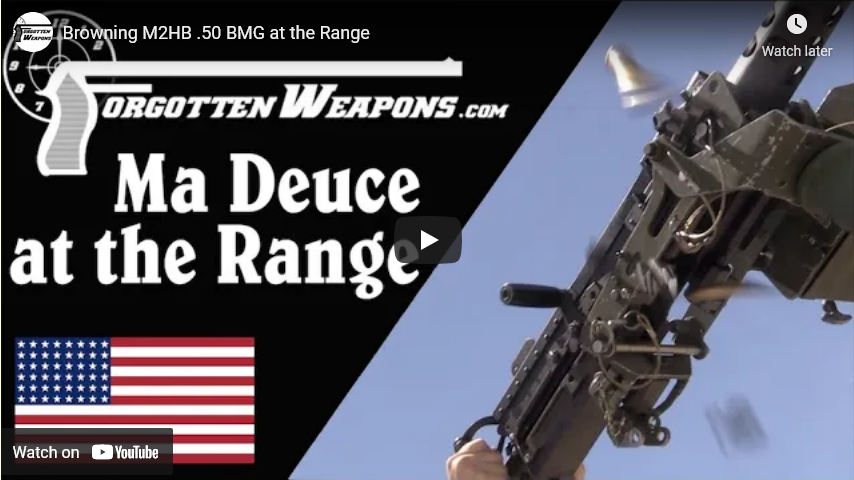
Browning M2HB .50 BMG at the Range
Forgotten Weapons
Published 26 Dec 2020http://www.patreon.com/ForgottenWeapons
https://www.floatplane.com/channel/Fo…
Cool Forgotten Weapons merch! http://shop.bbtv.com/collections/forg…
The Browning M2 heavy machine gun is one of the longest serving firearms in US military service, and still going strong. Let’s take this one out to the range and find out why!
Contact:
Forgotten Weapons
6281 N. Oracle #36270
Tucson, AZ 85740
July 4, 2021
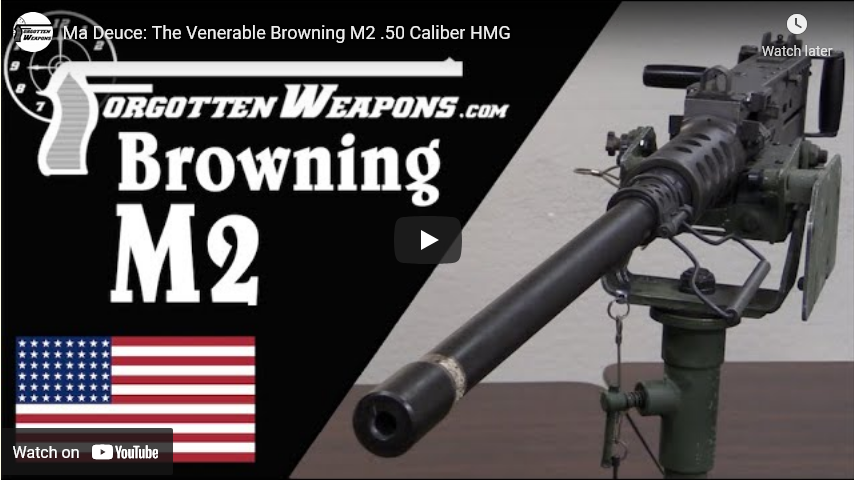
Ma Deuce: The Venerable Browning M2 .50 Caliber HMG
Forgotten Weapons
Published 25 Dec 2020http://www.patreon.com/ForgottenWeapons
https://www.floatplane.com/channel/Fo…
Cool Forgotten Weapons merch! http://shop.bbtv.com/collections/forg…
The M2 Browning machine gun was first conceived in 1918, as a request by General John Pershing of the AEF for a large-caliber anti-aircraft and antitank machine gun. John Browning scaled his M1917 water-cooled .30 caliber design up to .50 caliber, and the first prototypes were test fired in November of 1918. Impetus behind the project faltered after the Armistice, but Colt continued to develop the gun during the 1920s and 1930s. It was first adopted in 1922 by the US Coastal Artillery as an anti-aircraft gun, but significant manufacture would not come until World War Two. By this time, the gun’s main role had shifted, from antitank to being an aircraft armament, and some 2 million were made during World War Two, primarily as aircraft guns.
The M2 remains in service today, highlighting the brilliance and longevity of John Browning’s designs.
Contact:
Forgotten Weapons
6281 N. Oracle #36270
Tucson, AZ 85740
June 28, 2021
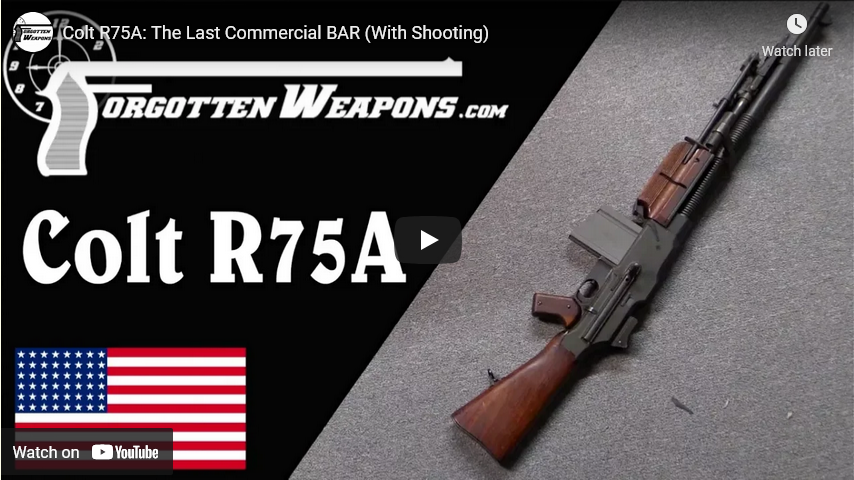
Colt R75A: The Last Commercial BAR (With Shooting)
Forgotten Weapons
Published 2 Mar 2018The R75A was the last version of Colt’s commercial BAR, with 832 made between August and December of 1942 for the Netherlands Purchasing Commission. It was a derivative of the commercial R75 BAR, with a pistol grip, magazine well cover, and ejection port cover. The R75A added on a folding bipod and a detachable barrel functionality, albeit not of the most elegant sort. To remove the barrel, one first used the lever under the muzzle to detach the gas block from the barrel by sliding it rearwards. Then a tool or cartridge tip was used to pry open the barrel locking lever at the front of the receiver, which then allowed the barrel to be rotated about 60 degrees to unlock its interrupted threads and remove it.
http://www.patreon.com/ForgottenWeapons
Cool Forgotten Weapons merch! http://shop.bbtv.com/collections/forg…
If you enjoy Forgotten Weapons, check out its sister channel, InRangeTV! http://www.youtube.com/InRangeTVShow
April 28, 2021
How Does it Work: Short Recoil Operation
Forgotten Weapons
Published 19 Jan 2021http://www.patreon.com/ForgottenWeapons
https://www.floatplane.com/channel/Fo…
Cool Forgotten Weapons merch! http://shop.bbtv.com/collections/forg…
Correction: Browning invented the pistol slide, but not the overall short recoil system. Maxim was the first to successfully create a short recoil firearm.
Short recoil is the most common system used today in self-loading handguns, and it also used to be fairly popular in machine gun designs. The basic principle is that the bolt and barrel (in a handgun, slide and barrel) are locked together for an initial travel substantially less than the overall length of the cartridge. After typically a few millimeters of travel, the barrel stops and the bolt or slide is able to continue rearward to extract and eject the empty case. Short recoil can be paired with virtually any locking system, but today the Browning tilting barrel system is most common.
Short recoil has never been popular in shoulder rifle, as the reduction in mechanical accuracy from the moving barrel can be undesirable. In handguns and machine guns, this accuracy reduction is generally below the threshold of relevance.
Contact:
Forgotten Weapons
6281 N. Oracle #36270
Tucson, AZ 85740

February 22, 2021
The Best BAR: Luxembourg .30-06 FN-D at the Range
Forgotten Weapons
Published 17 Nov 2020http://www.patreon.com/ForgottenWeapons
https://www.floatplane.com/channel/Fo…
Cool Forgotten Weapons merch! http://shop.bbtv.com/collections/forg…
I normally want to have something specific to demonstrate when I take a gun to the range, but today I don’t. What I have today is and FN-D, the very best iteration of the Browning Automatic Rifle (BAR) — and I just wanted an excuse to take it out to enjoy. Specifically, this is a Luxembourg contract FN-D chambered for .30-06. So, please pardon my flimsy excuse, and enjoy!
Contact:
Forgotten Weapons
6281 N. Oracle #36270
Tucson, AZ 85740

January 31, 2021
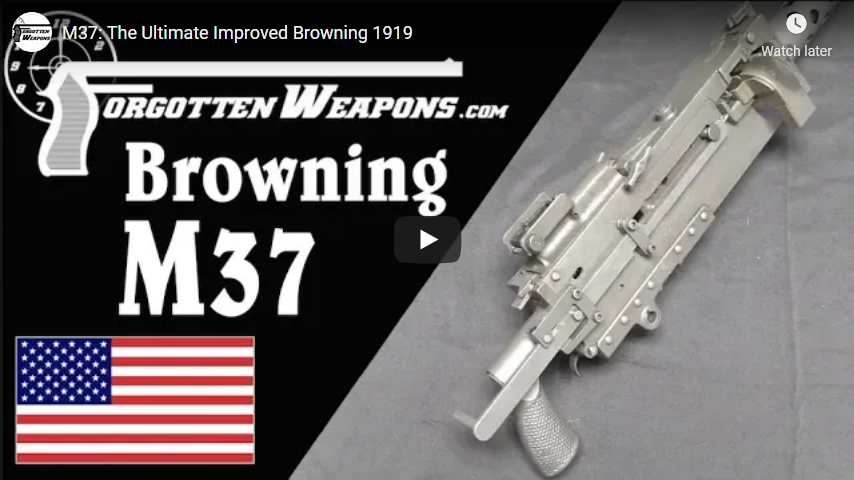
M37: The Ultimate Improved Browning 1919
Forgotten Weapons
Published 8 Mar 2019http://www.patreon.com/ForgottenWeapons
Cool Forgotten Weapons merch! http://shop.bbtv.com/collections/forg…
In November of 1950, the US Ordnance Department requested an improved version of the Browning 1919 air-cooled machine gun for use in tanks. The new version was to be able to feed from either the left or right, a feature which was unimportant for an infantry gun but much more relevant when mounting guns into the tight spaces of an armored vehicle. An interim conversion of existing guns to the M1919A4E1 pattern came first, followed by manufacture of all-new guns by the Rock Island Arsenal and Saco-Lowell company from 1955 until 1957.
The design of the gun fell to Bob Hillberg at High Standard. He came up with a clever set of reversible plugs to change the bolt between left and right hand feed, as well as a captive recoil spring, manual safety, improved top cover and rear cover latches, and several other strengthened parts. He also incorporated a charging handle extension with integral manual hold open and a link ejection chute that could be mounted to either side of the gun. His T153 design was formally adopted as the M37, in caliber .30-06. A 7.62mm NATO version (the M37E1) followed as well. The M37 would serve into the late 1960s on the M48 and M60 tanks as well as several helicopters.
Contact:
Forgotten Weapons
PO Box 87647
Tucson, AZ 85754
December 23, 2020
Gun Jesus Apocrypha: The Gospel of Browning
Forgotten Weapons
Published 25 Dec 2016A brief Christmas reading, as translated from the original ancient manuscripts by Fr. Frog (http://www.frfrogspad.com/jmb.htm).
http://www.patreon.com/ForgottenWeapons
Cool Forgotten Weapons merch! http://shop.bbtv.com/collections/forg…
If you enjoy Forgotten Weapons, check out its sister channel, InRangeTV! http://www.youtube.com/InRangeTVShow

November 28, 2020
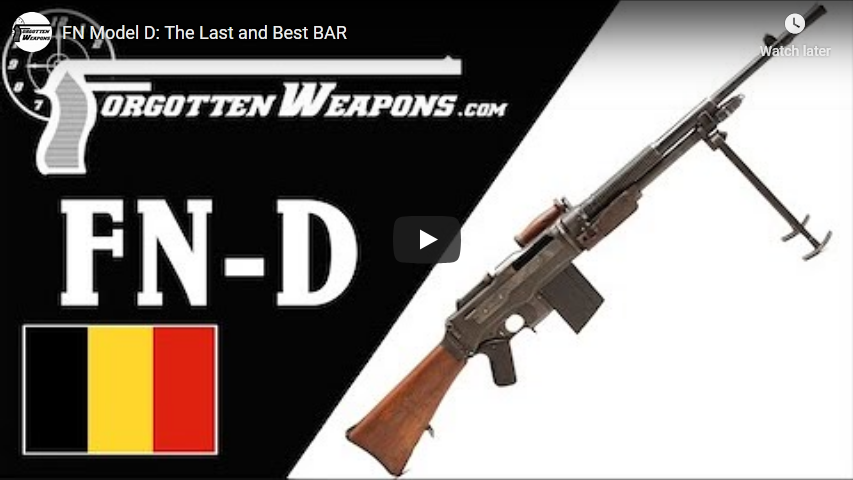
FN Model D: The Last and Best BAR
Forgotten Weapons
Published 21 Aug 2020http://www.patreon.com/ForgottenWeapons
https://www.floatplane.com/channel/Fo…
Cool Forgotten Weapons merch! http://shop.bbtv.com/collections/forg…
Contact:
Forgotten Weapons
6281 N. Oracle #36270
Tucson, AZ 85740