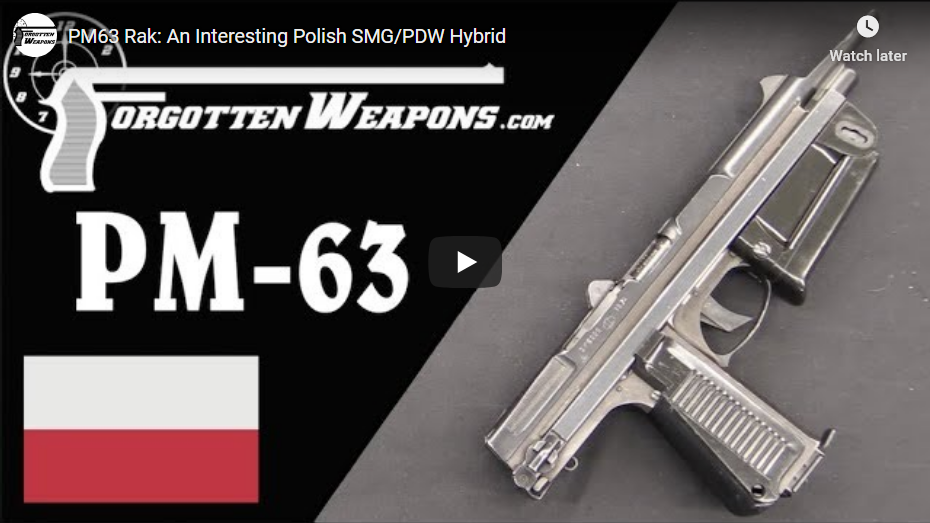
The PM-63 Rak is a pretty interesting Polish Cold War machine pistol or personal defense weapon. It fires from an open bolt, but uses a slide like a pistol rather than a bolt in an enclosed receiver like a typical SMG. There are several other interesting elements to the design, so let’s take a closer look…
Thanks to Movie Armament Group in Toronto for giving me the opportunity to bring you this video! Check out MAG on Instagram: https://instagram.com/moviearmamentsg…
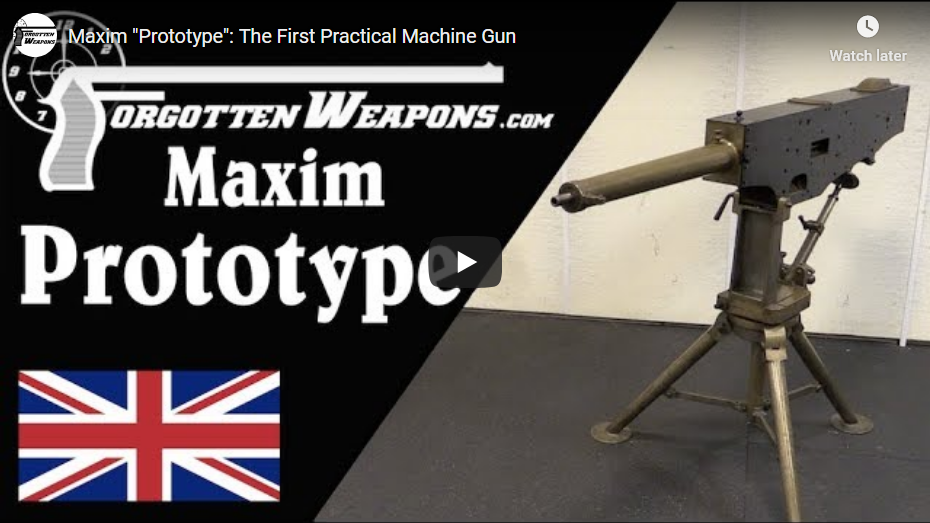
Hiram Maxim was the first person to create a truly practical and functional machine gun, based on a patent he filed in 1883. He pioneered the recoil operating system – the concept of harnessing the recoil generated by a firearm to perform the actions of reloading that firearm. His patent was based on a lever action rifle, but his intent was to create a machine gun, complete with belt feed and water cooling. After a testbed “forerunner” gun, he built this model which he called the “Prototype”. It was meant as a proof of concept, and used in many public exhibitions and demonstrations.
The Prototype used a hydraulic rate of fire control system which could be set as high as 500 rounds/minute and as low as just one round per minute. The gun did not have a trigger as we would recognize it today, but rather a single lever like a vehicle accelerator which acted as both trigger and fire rate control. Only three of these Prototypes exist today, with one belonging to the USMC, one on public display at the Royal Armouries museum in Leeds, and this one in the NFC reserve collection at Leeds.
For a fantastic exploded view of all this guns working parts, check out this work by YouTube channel vbbsmyt:
Many thanks to the Royal Armouries for allowing me to film this tremendously important artifact! The NFC collection there — perhaps the best military small arms collection in Western Europe — is available by appointment to researchers:
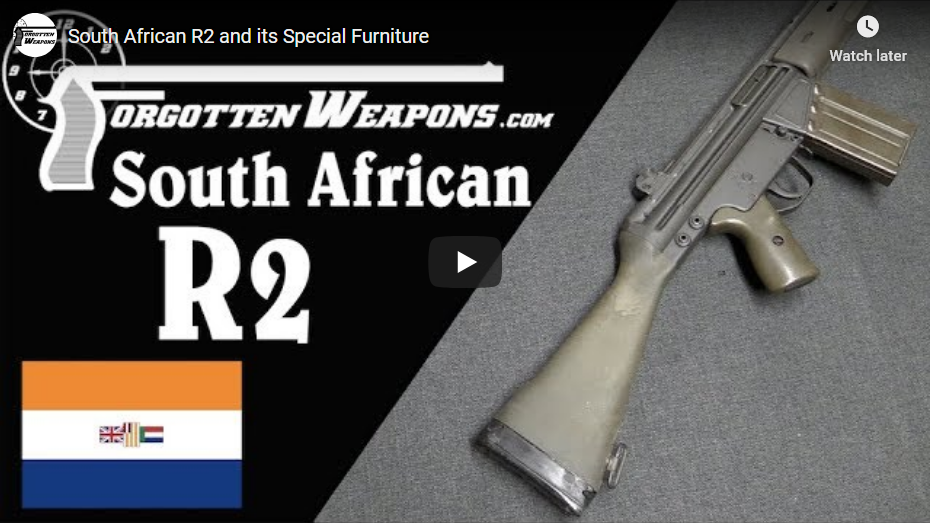
In South African military service, the R1 was the FN FAL and was the preferred infantry combat rifle until the adoption of the Galil as the R4 rifle. So what were the guns in between? Well, the R2 was a South African adaptation of the G3. A large number of rifles were needed as a reserve, and also to equip second echelon units like the Air Force, Cape Corps, and South West Africa Territorial Force. To reduce the expense of this, South Africa purchased something like 100,000 G3 rifles from Portugal and designated them R2.
The Portuguese hand guards and buttstocks were found to be unsatisfactory, however. In the heat and harsh ultraviolet radiation of South West Africa (now Namibia) in particular, the plastic would shrink and lose its fit, leading to the guns being called “rattlers” by the SADF troops. The fix this, the American firm of Choate Machine & Tool was contracted to make new hand guards based on the H&K export pattern — wider and longer and with fittings for a bipod. New stocks were also made, duplicating the shape of the R1/FAL stock.
Contact:
Forgotten Weapons
PO Box 87647
Tucson, AZ 85754
Comments Off on South African R2 and its Special Furniture
The blow forward system has only been used on three commercially-produced firearms: the Schwarzlose 1908, Hino-Komuro, and Mannlicher 1894 (The SIG AK-53 uses a forward barrel movement, but in conjunction with a locked breech). It offers a simple system with a theoretical extra margin of safety because the side cannot come backward off the gun, but at the cost of substantially increased felt recoil. Once the blowback system was out of patent protection, there was no convincing reason to use the blow forward mechanism.
Contact:
Forgotten Weapons
PO Box 87647
Tucson, AZ 85754
Direct gas impingement is an operating system that has been used only in a few production guns (all of them rifles). It is extremely simple, although perhaps not well suited to adjustability. It is also not the operating system of the AR series of rifles – we will cover those in a separate video.
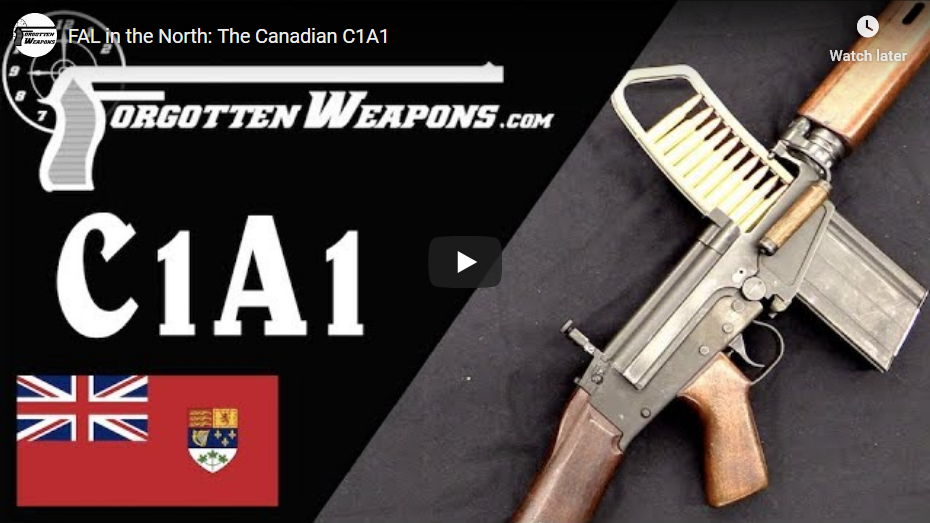
Canada was the first country to adopt the FAL rifle, purchasing trials rifles from FN within weeks of the formal standardization of the 7.62mm NATO cartridge. Canada acquired production rights to the rifle along with the technical package from FN, and spent 18 months converting the drawings into 1st-angle inch pattern (which would be used by the rest of the Commonwealth nations subsequently). Both a C1 rifle pattern and a C2 LMG pattern were made, although today we are looking at just the C1.
The first production was a run of 20 toolroom prototypes, one of which we have in today’s video. After a few changes were made – most distinctively to the rear sight – full-scale production commenced. Over the following years, a few minor changes were made, and a slightly improved C1A1 pattern adopted. These would service the Canadian military until eventually replaced with the C7 rifles.
Contact:
Forgotten Weapons
PO Box 87647
Tucson, AZ 85754
Comments Off on FAL in the North: The Canadian C1A1
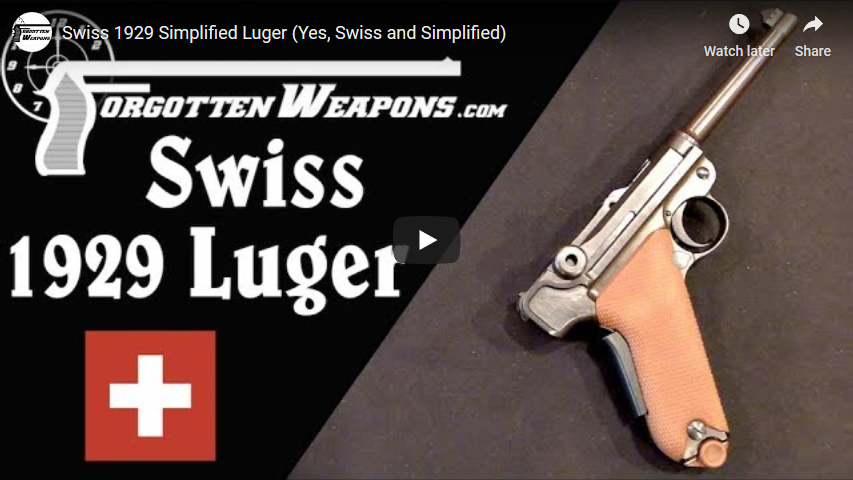
Switzerland was the first nation to adopt the Luger as a service pistol, and they purchased them DWM in Germany from 1900 until 1914. World War One stopped deliveries, of course, and after the war the Swiss opted to begin their own production at Waffenfabrik Bern. These Swiss Lugers have become known as the model 06/24 by collectors, and were made until 1933. During that time, Bern was looking for ways to simplify and economize their production, and these efforts came together with the development of the Model 1929. It actually entered production in 1934, and was made until 1947 with a total of about 28,000 made for the military and about 1,900 made for the civilian market.
The main mechanical change to the 1929 pattern was a lengthening of the grip safety. Other changes included simplifying the profile of the front strap of the grip, removing knurling and serrations on the controls, and only serializing four parts. A production date stamp was also added to the inside of the frame, however.
Contact:
Forgotten Weapons
PO Box 87647
Tucson, AZ 85754
Comments Off on Swiss 1929 Simplified Luger (Yes, Swiss and Simplified)
During World War One massive railway guns were used to reach deep behind enemy lines and attack enemy infrastructure with both sides using the massive artillery pieces. In this episode Matt takes a look at some archival footage of America’s massive railway guns ranging from 10 to 16 inches.
If you enjoy our work please consider supporting us via Patreon, TAB is a viewer supported, non-monetised channel and any help is very much appreciated!
The Answer:
According to the original footage notes the mystery item is a 60-feet tall captured German field periscope ‘claimed to have been used by the German Crown Prince during the war’.
Footage:
https://catalog.archives.gov/id/24749
Comments Off on TAB Short: US Military Railway Guns In Action
Knights Armament introduced their “Assault Machine Gun” a couple years ago, and I had a chance to take both versions (5.56mm and 7.62mm) out to the range recently. The gun is the spiritual descendant of the Stoner 63, but is more directly made on Eugene Stoner’s Model 86 light machine gun. It utilizes the constant recoil principle, with the bolt never actually contacting the rear of the receiver during the cycling process. This results in recoil being felt by the shooter as a continuous steady force instead of a rapid series of impacts and that makes it tremendously controllable. Not surprisingly, these guns are already being sold to military and security organizations worldwide…
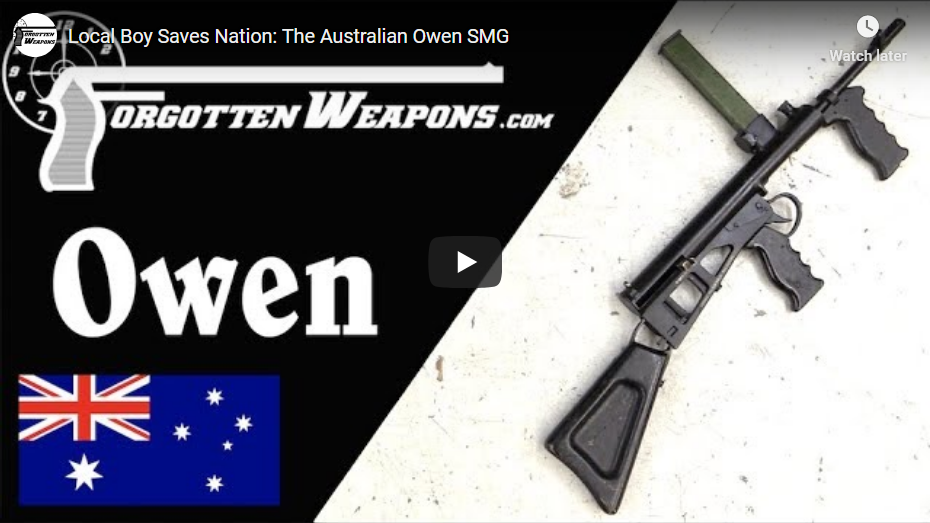
The Owen submachine gun is one of the ugliest SMGs ever designed, and yet also one of the most beloved by its users. The original basis for the gun was a .22 rimfire submachine gun designed by 23-year-old Australian Evelyn Owen. That prototype was found by his neighbor Vincent Wardell after Owen left for military service. Wardell was the manager of Lysaght Works, an engineering firm, and thought that the gun might be the basis for a useful military SMG. As it turned out, he was right – it became the standard SMG of The Australian military through World War Two and the Korean War, and was one of the best such guns of that period. For more details on the history of the Owen, see my full article:
Thanks to Movie Armament Group in Toronto for giving me the opportunity to bring you this video! Check out MAG on Instagram: https://instagram.com/moviearmamentsg…
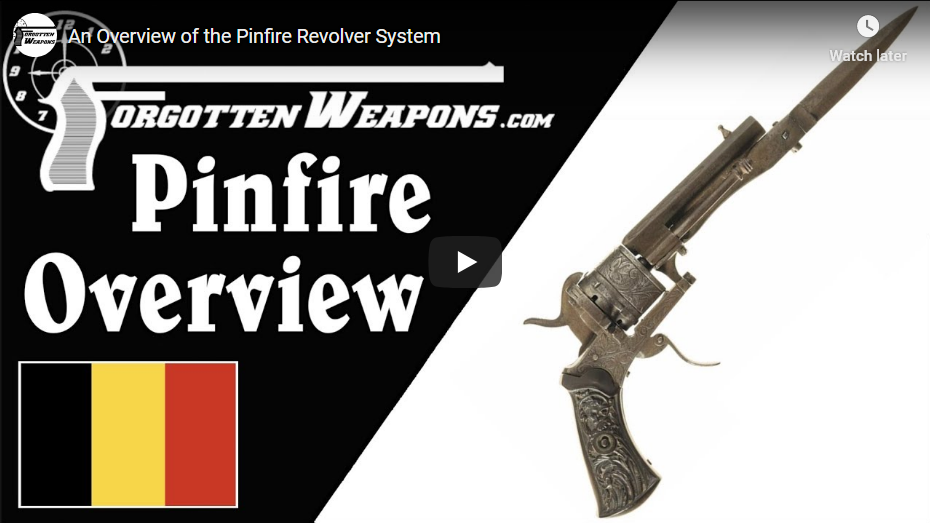
The pinfire system was an early cartridge type which saw widespread use in Europe, but was not widely adopted in the United States. First invented by a French designer named Pauly, it was made commercially feasible by Casimir Lefacheaux. It was Casimir’s son Eugene, however, who took the pinfire cartridge to its full potential, garnering a French military contract in the 1850s and building Lefacheaux into one of the largest French/Belgian non-government arms manufacturers in the mid 1800s.
Todays we are looking at an assortment of pinfire revolvers, to get some basic idea for the sort of variety that was made over the decades. Small to large, plain to fancy, and with all manner of quirky details (like folding bayonets and Lefacheaux’s triple-action fire control system).
Contact:
Forgotten Weapons
PO Box 87647
Tucson, AZ 85754
Comments Off on An Overview of the Pinfire Revolver System
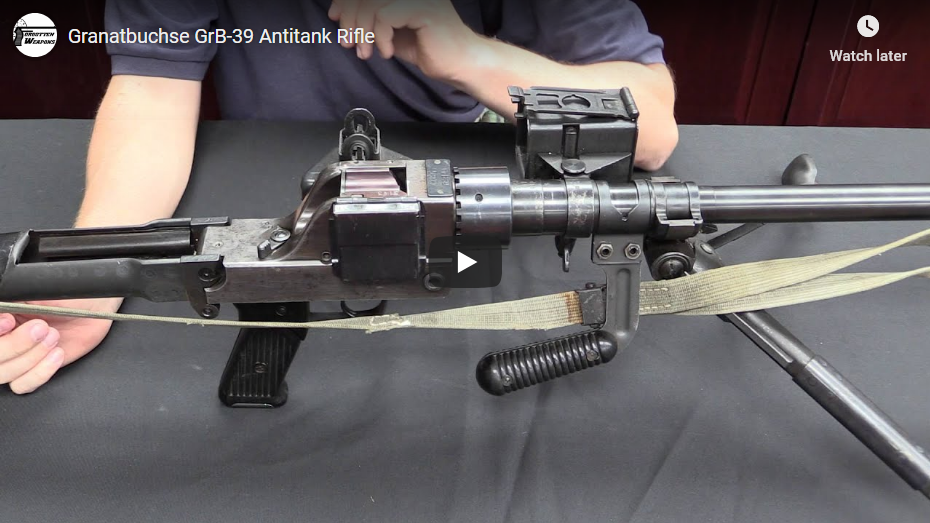
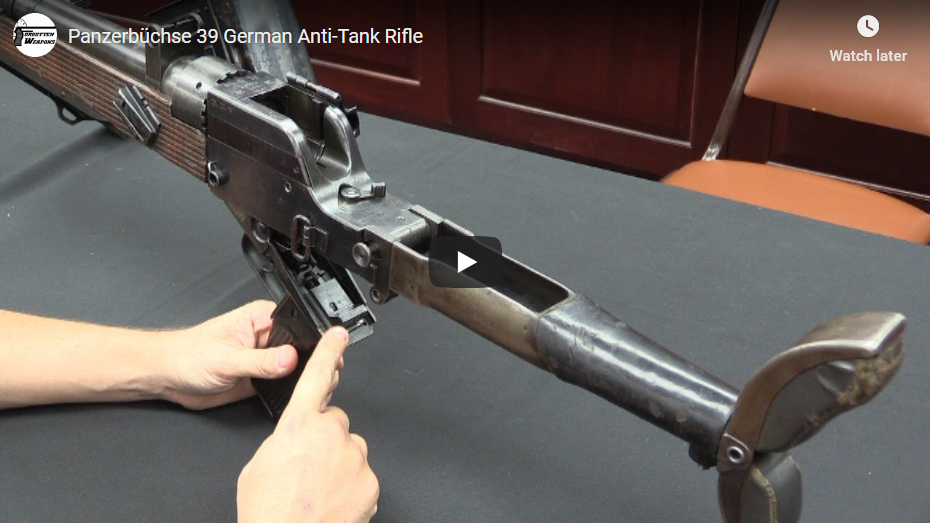
Like most countries, Germany had a standard-issue antitank rifle when World War II began — the Panzerbuchse 39. It fired an 8 x 94mm cartridge with a small very high velocity armor-piercing bullet. And like the other AT rifles from the 1930s, the PzB-39 became obsolete quickly as tank armor improved during the war. However, while most countries simply scrapped their antitank rifles, the Germans opted instead to convert the guns into dedicated grenade launchers.
Because the PzB-39 was already designed for a very high pressure cartridge, it was ideally suited to handle the stresses of firing large anti-tank grenades. Rather than relying on simple kinetic energy to penetrate, the grenades could use shaped charge technology to be vastly more effective than AP bullets.
In converting the PzB-39 into the GrB-39, the barrels were cut down, grenade launching cups attached to the muzzles, new sights designed for grenade use, bipods lengthened, and the folding stocks were fixed in place. Most of the PzB-39 rifles in service were subject to these modifications, and the resulting GrB-39 guns were able to be reasonably effective through the end of the war.
Comments Off on Granatbuchse GrB-39 Antitank Rifle
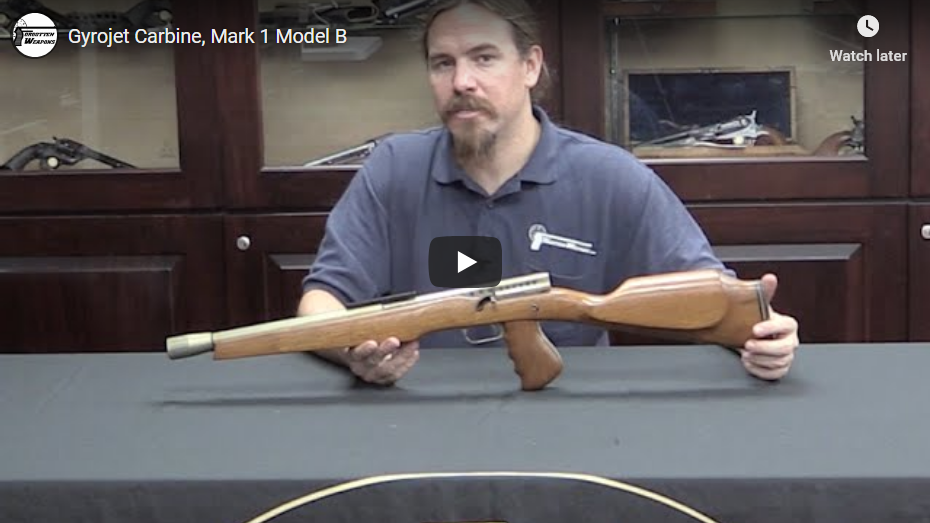
The Gyrojet was one of the more creative and one of the most futuristic firearms innovations of the last few decades – unfortunately it wasn’t able to prove sustainable on the market.
The idea was to use burning rocket fuel to launch projectiles, instead of pressurized gas. The advantage was that without the huge pressure of standard cartridges, a rocket-firing gun could be made far lighter and cheaper, as it had no need to contain pressure. The rockets would accelerate down the barrel as their fuel burned (and the 4 rocket jets would be angled to put a spin on the projectile for accuracy), and the weapon would actually have the most kinetic energy at something like 20 yards downrange, when the fuel was expended.
A decent number of Gyrojet handguns were made and sold (mostly as curiosities), but intrinsic accuracy problems prevented them from ever being taken seriously as weapons. The company behind the guns (MB Associates) went out of business shortly, unable to fully exploit their full range of ideas. One of those ideas was a carbine variant of the gun. A few hundred were made in two different models, and we have the chance today to take a look at one of the Mark 1 Model B sporter-style carbines.
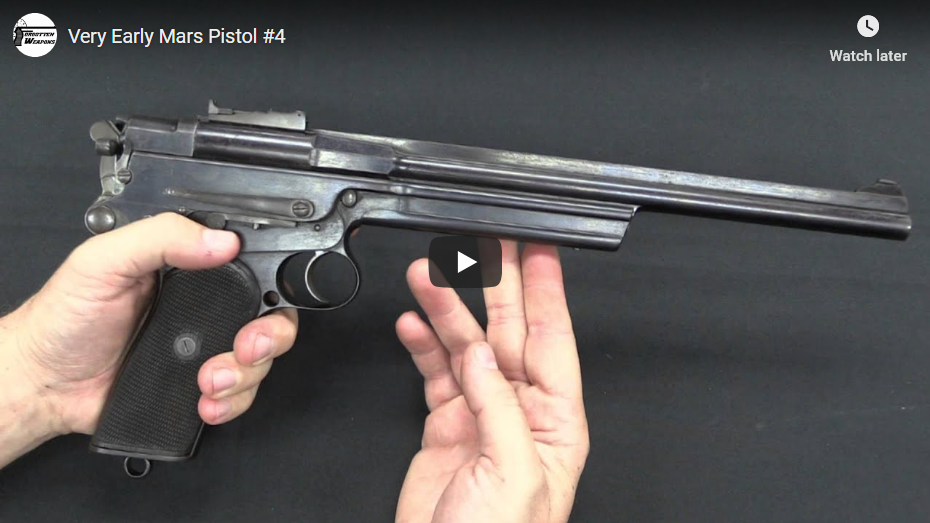
Until the midle of the 20th century, the most powerful automatic pistol made was Sir Hugh Gabbett-Fairfax’s Mars pistol. With the .45 caliber version approaching the energy of a .45 Winchester Magnum, it was quite the accomplishment for a gun designed initially in 1898! Well, RIA has a very early example of the Mars – serial number 4 – coming up for sale. This gun (chambered for the .360 Mars cartridge) has a number of features that differ from the more “typical” Mars pistols (all 80 or so that were ultimately made). These include a very long barrel, a tangent-style rear sight, and a 3-lug bolt instead of the standard 4-lug type. A very cool pistol to have a look at!
Most countries still had anti-tank rifles in their military inventory at the beginning of WWII – the Solothurn S18-100, the Lahti L39, the Boys AT Rifle, the PTRD and PTRS, and so on. For Germany, this role was fulfilled by the Panzerbüchse 39, a single-shot falling block rifle firing a high velocity 8mm AP cartridge. It was nominally effective in the opening campaigns of the war, but was quickly rendered obsolete as Allied armor improved. German planners has a huge number (25,000) of these on hand for the invasion of Russia, where they expected Russian armor to be vulnerable to them – which was not the case. Most were subsequently converted into Granatbüchse 39 AT grenade launchers, which were then used until the end of the war.