Sabaton History
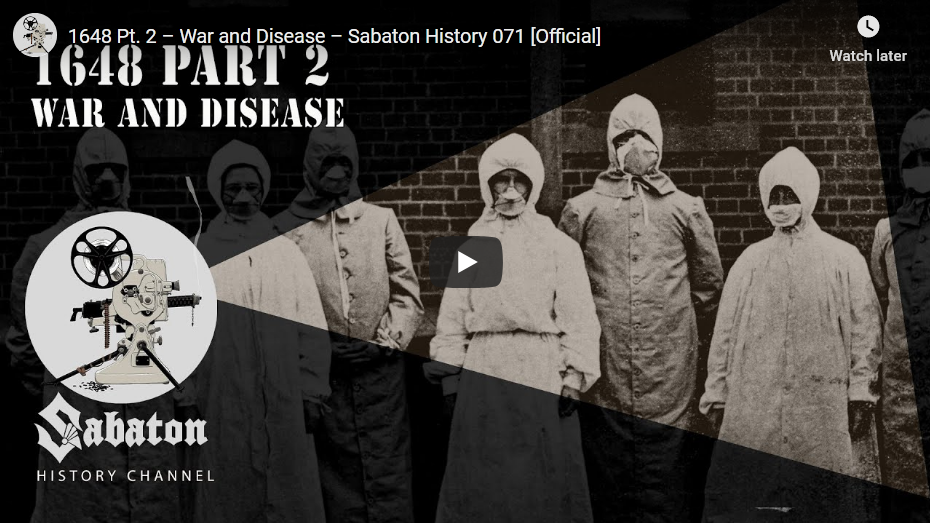
Published 12 Jun 2020War and Plague. Just two horsemen of the apocalypse but never really far away from each other. Where armies march, disease usually follows. From the earliest records of time to modern day, epidemics and contagious diseases are the cause of uncountable deaths. Pandemics like the Spanish Flu or the Bubonic Plague killed millions of people around the world. To survive, mankind had resort to quarantines and plague houses, and put its trust to physicians and the evolution of modern medicine.
Support Sabaton History on Patreon: https://www.patreon.com/sabatonhistory
Listen to “1648” on the album Carolus Rex:
CD: http://bit.ly/CarolusRexStore
Spotify: http://bit.ly/CarolusRexSpotify
Apple Music: http://bit.ly/CarolusRexAppleMusic
iTunes: http://bit.ly/CarolusRexiTunes
Amazon: http://bit.ly/CarolusRexAmz
Google Play: http://bit.ly/CarolusRexGooglePlayListen to Sabaton on Spotify: http://smarturl.it/SabatonSpotify
Official Sabaton Merchandise Shop: http://bit.ly/SabatonOfficialShopHosted by: Indy Neidell
Written by: Markus Linke and Indy Neidell
Directed by: Astrid Deinhard and Wieke Kapteijns
Produced by: Pär Sundström, Astrid Deinhard and Spartacus Olsson
Creative Producer: Joram Appel
Community Manager: Maria Kyhle
Executive Producers: Pär Sundström, Joakim Broden, Tomas Sunmo, Indy Neidell, Astrid Deinhard, and Spartacus Olsson
Post-Production Director: Wieke Kapteijns
Edited by: Karolina Dołęga
Sound Editing by: Marek Kaminski
Maps by: Ryan Weatherby, Karolina DołęgaEastory YouTube Channel: https://www.youtube.com/channel/UCEly…
Archive by: Reuters/Screenocean https://www.screenocean.com
Music by Sabaton.Sources:
– Welcome Images
– National Library of Scotland
– IMW: Q 10378,
– National Museum of Health and Medicine
– National Archives
– Icons from The Noun Project by: Muhamad Ulum & Adrien CoquetAn OnLion Entertainment GmbH and Raging Beaver Publishing AB co-Production.
© Raging Beaver Publishing AB, 2019 – all rights reserved.
June 13, 2020
“1648” Pt. 2 – War and Disease – Sabaton History 071 [Official]
June 12, 2020
History of Prussia | Animated History
The Armchair Historian
Published 14 Sep 2018Sign up for The Armchair Historian website today:
https://www.thearmchairhistorian.com/Our Twitter: https://twitter.com/ArmchairHist
Sources:
The Rise and Fall of Prussia, Sebastian Haffner
Germans and Slavs, Arno Lubos
Frederick the Great, Tim BlanningMusic:
“Hungarian Rhapsody” by Franz Liszt“Twenty six variations on La Folia de Spagna”, London Mozart Players
Matthias Bamert, conductor*Correction 1: In 1648, Brandenburg-Prussia also acquired parts of Pomerania, which isn’t shown in the video. Pomerania is a state directly above Brandenburg.
November 9, 2019
“1648” – The Thirty Years War – Sabaton History 040 [Official]
Sabaton History
Published 7 Nov 2019Europe had grown weary of war by the summer of 1648 and after much deliberation, peace talks in Westphalia had reached their final stages. Warlords across the entire continent were preparing for peace but not all of them agreed. The exceptionally ruthless German-Swedish General Königsmarck advanced into Bohemia to lay siege to Prague.
Support Sabaton History on Patreon: https://www.patreon.com/sabatonhistory
Listen to Carolus Rex (Where “1648” is featured):
CD: http://bit.ly/CarolusRexStore
Spotify: http://bit.ly/CarolusRexSpotify
Apple Music: http://bit.ly/CarolusRexAppleMusic
iTunes: http://bit.ly/CarolusRexiTunes
Amazon: http://bit.ly/CarolusRexAmz
Google Play: http://bit.ly/CarolusRexGooglePlayListen to Sabaton on Spotify: http://smarturl.it/SabatonSpotify
Official Sabaton Merchandise Shop: http://bit.ly/SabatonOfficialShopHosted by: Indy Neidell
Written by: Markus Linke and Indy Neidell
Directed by: Astrid Deinhard and Wieke Kapteijns
Produced by: Pär Sundström, Astrid Deinhard and Spartacus Olsson
Creative Producer: Joram Appel
Executive Producers: Pär Sundström, Joakim Broden, Tomas Sunmo, Indy Neidell, Astrid Deinhard, and Spartacus Olsson
Maps by: Eastory
Edited by: Iryna Dulka
Sound Editing by: Marek KaminskiEastory YouTube Channel: https://www.youtube.com/channel/UCEly…
Archive by: Reuters/Screenocean https://www.screenocean.com
Music by Sabaton.Sources:
– Thumbnail image: Petri Krohn, CC BY-SA 3.0.
– Les misères et les malheurs de la guerre – The British Museum
– “Germania: dos mil años de historia alemana” series from Fondo Antiguo de la Biblioteca de la Universidad de Sevilla
– The peace of Munster painting courtesy of Amsterdam Museum
– RijksMuseumAn OnLion Entertainment GmbH and Raging Beaver Publishing AB co-Production.
© Raging Beaver Publishing AB, 2019 – all rights reserved.
From the comments:
Sabaton History
2 days ago
This episode about “1648” is about peace and about a devastating and deadly siege to Prague. We enjoy doing these episodes as we usually only make episodes about more modern topics. Now, we have to do without film and photo material, and be creative with paintings and sketches. Kudos to the editor Iryna who makes that work brilliantly! If you agree and want to support our work, you can do so by going to our Patreon page: https://www.patreon.com/sabatonhistoryCheers, the Sabaton History team.
September 7, 2019
“A Lifetime of War” – Thirty Years War – Sabaton History 031 [Official]
Sabaton History
Published on 5 Sep 2019The Sabaton song “A Lifetime of War” is about the Thirty Years War, which influenced many lives of Northern European soldiers, mercenaries, farmers and city-dwellers.
Support Sabaton History on Patreon: https://www.patreon.com/sabatonhistory
Listen to Carolus Rex (“Lifetime of War” is featured):
CD: http://bit.ly/CarolusRexStore
Spotify: http://bit.ly/CarolusRexSpotify
Apple Music: http://bit.ly/CarolusRexAppleMusic
iTunes: http://bit.ly/CarolusRexiTunes
Amazon: http://bit.ly/CarolusRexAmz
Google Play: http://bit.ly/CarolusRexGooglePlayWatch the official music video for Lifetime of War right here: https://www.youtube.com/watch?v=zvdbD…
Hosted by: Indy Neidell
Written by: Markus Linke and Indy Neidell
Directed by: Astrid Deinhard and Wieke Kapteijns
Produced by: Pär Sundström, Astrid Deinhard and Spartacus Olsson
Creative Producer: Joram Appel
Executive Producers: Pär Sundström, Joakim Broden, Tomas Sunmo, Indy Neidell, Astrid Deinhard, and Spartacus Olsson
Maps by: Eastory
Edited by: Iryna Dulka
Sound Editing by: Iryna Dulka and Marek KaminskiEastory YouTube Channel: https://www.youtube.com/channel/UCEly…
Archive by: Reuters/Screenocean https://www.screenocean.com
Music by Sabaton.Sources:
– Folger Shakespeare Library
– Map of Hanseatic League: H.F. Helmolt, History of the World, Volume VII, Dodd Mead 1902
– Fondo Antiguo de la Biblioteca de la Universidad de SevillaAn OnLion Entertainment GmbH and Raging Beaver Publishing AB co-Production.
© Raging Beaver Publishing AB, 2019 – all rights reserved.
June 28, 2019
“Gott Mit Uns” – The Thirty Years War – Sabaton History 021 [Official]
Sabaton History
Published on 27 Jun 2019The Sabaton Song “Gott Mit Uns” is about the Battle of Breitenfeld, fought between the Swedish under command of King Gustavus Adolphus and the Holy Roman Empire under Count Tilly. This battle was hugely influential in the Thirty Years War and the religious wars that were plaguing Europe in the 17th century.
Support Sabaton History on Patreon: https://www.patreon.com/sabatonhistory
Listen to Carolus Rex (where “Gott Mit Uns” is featured):
CD: http://bit.ly/CarolusRexStore
Spotify: http://bit.ly/CarolusRexSpotify
Apple Music: http://bit.ly/CarolusRexAppleMusic
iTunes: http://bit.ly/CarolusRexiTunes
Amazon: http://bit.ly/CarolusRexAmz
Google Play: http://bit.ly/CarolusRexGooglePlayCheck out the trailer for Sabaton’s new album The Great War right here: https://www.youtube.com/watch?v=HCZP1…
Hosted by: Indy Neidell
Written by: Markus Linke and Indy Neidell
Directed by: Astrid Deinhard and Wieke Kapteijns
Produced by: Pär Sundström, Astrid Deinhard and Spartacus Olsson
Creative Producer: Joram Appel
Executive Producers: Pär Sundström, Joakim Broden, Tomas Sunmo, Indy Neidell, Astrid Deinhard, and Spartacus Olsson
Maps by: Eastory
Edited by: Iryna Dulka
Sound Editing by: Marek KaminskiEastory YouTube Channel: https://www.youtube.com/channel/UCEly…
Archive by: Reuters/Screenocean https://www.screenocean.com
Music by Sabaton.Sources:
– National museum
– National Portrait GalleryAn OnLion Entertainment GmbH and Raging Beaver Publishing AB co-Production.
© Raging Beaver Publishing AB, 2019 – all rights reserved.
April 28, 2019
The Battle of Lützen – 1632 – The 30 Years War (in Swedish, with English sub-titles)
Gripen
Published on 3 Dec 2015One of the bloodiest battles of the Thirty Years War. Sweden vs. the Holy Roman Empire. A mass grave has been found, with the victims from the battle. Are they Swedish/Finnish soldiers or German mercenaries?
(This Swedish documentary has English subtitles).
From the comments:
Blah b
2 years ago
This documentary is often painful to watch, the way inexperienced modern people with no sense of empathy project their values onto those times. They weren’t “defenseless men standing still”. Armies had learned the hard way that massed musket fire won battles. If everybody is looking for cover and looking out for themselves, you can never operate such rigid units.So the individual soldier was harshly drilled to indeed stand still even with cannonballs tearing through his unit, or another unit standing 30-80 meters away. Because if individuals acted as individuals, the battle would be lost and the army would be destroyed.
But when that machine operated, it would win battles. The system invented by Maurice of the Netherlands ensured that if you were attacking a group of musketeers, every 20-25 seconds, they could deliver a crushing volley that can kill or injure 10-25% of a another unit, that means they only needed 2-3 salvos to achieve a local victory. Untrained units would literally never touch a musketeer, as his unit would’ve routed the attackers before they got within touching range.
Also there were no standing armies, there was no national identity as such. Mercenaries were totally acceptable. Mercenaries could become very loyal and reliable if paid on time [and] consistently, and would easily crush national armies that usually lacked the routine of professional soldiers. Loyalty and your identity was constructed differently. It would’ve been perfectly normal for me to utterly hate and maybe kill my neighbours if they were of a different religion. Otherwise, a Swedish protestant from far away was an ally with the right ideas. I wouldn’t have been able to understand him and everything would be alien about him, but I’d consider him a friend, and Catholics from the next village where I’d lived all my life would be enemies.
Unless the king comes around and says the Catholics are friends. Because the king is appointed by God who runs the world on a day to day [basis], and you obey without question. If the king says it’s so, that means God himself agrees and says it’s so, and you don’t question God. Loyalty until death is about the least you owed your king in those days.
People who can’t understand how such things worked historically, really should not be making documentaries…
September 23, 2018
30 Years War | 3 Minute History
Jabzy
Published on 28 Oct 2015Thanks to Xios, Alan Haskayne, Lachlan Lindenmayer, William Crabb, Derpvic, Seth Reeves and all my other Patrons. If you want to help out – https://www.patreon.com/Jabzy?ty=h
June 11, 2018
Feature History – Thirty Years’ War
Feature History
Published on 12 Nov 2016Hello and welcome to Feature History, featuring religious conflict, tragic war, and a really nifty collaboration with Jabzy.
3 Minute History – German Peasant’s War
https://www.youtube.com/watch?v=zeQVAUmyLks
September 13, 2017
The Thirty Years War
Published on 10 Nov 2014
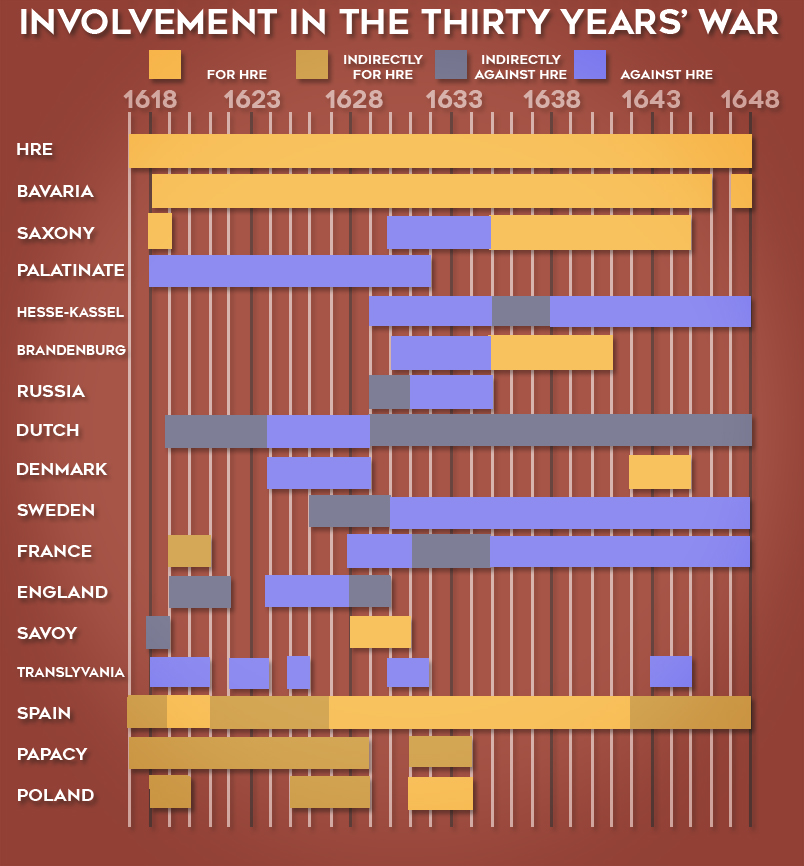
The Thirty Years’ War was fought from 1618-1648 (Thirty Years!) in the Holy Roman Empire. It began as a conflict between Catholics and Protestants in Bohemia, but grew to involve Denmark, Sweden, and France. After the French began helping Gustavus Adolphus, the Protestant king of Sweden, the lines became blurry and the war became more about the balance of power in Europe than about religion. The Peace of Westphalia paved the way for France to become the dominant power in Western Europe and for the permanent decline of the Holy Roman Empire as a political institution.
If you like this lecture, check out my other lectures for AP European History and Western Civilization!