
Castles differ from that other standby of medieval fortifications — city walls — in one crucial way, and that difference sheds a lot of light on their military application.
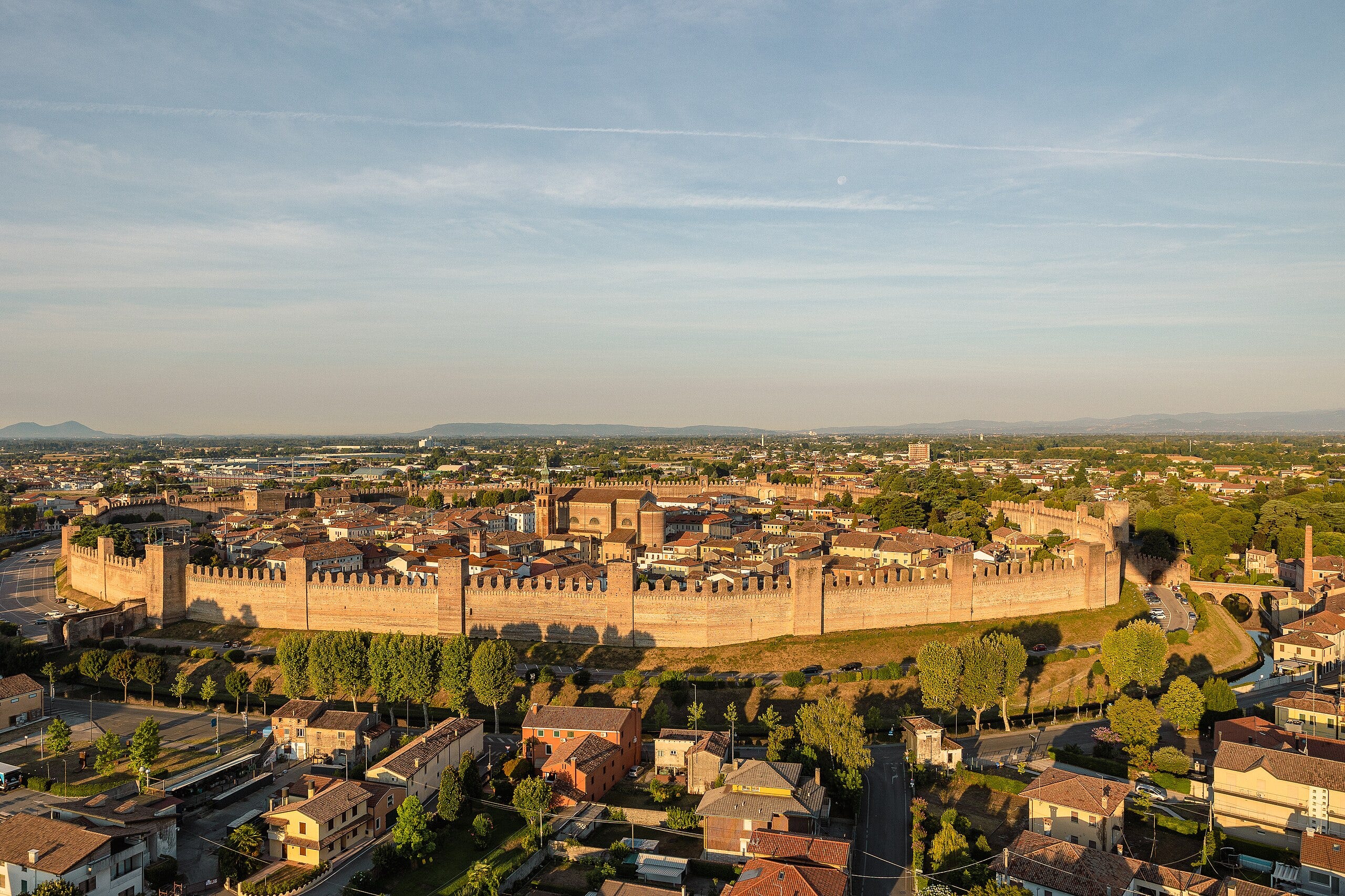
The walls of Cittadella, Italy (photo by Edoardo Bortoli, CC BY-SA 4.0).
A massive city wall, like the one shown above, has the very clear purpose of limiting access to a city or town. Close the gates, and no one can get in. Try to get in, and we’ll shoot you! The walls are meant to protect the settlement, both its inhabitants as well as its structures and physical wealth.
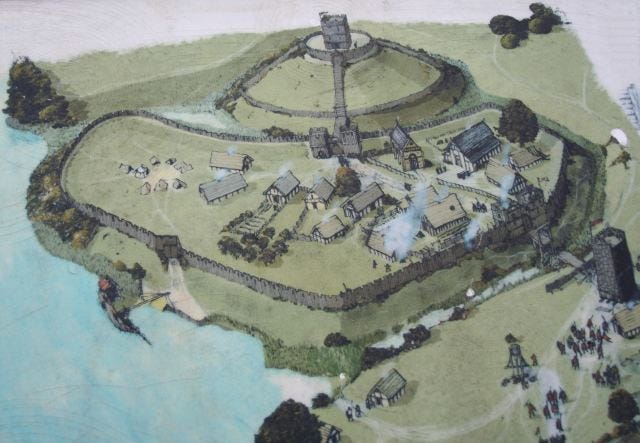
A castle, on the other hand, has a much smaller footprint than a city. It might only be a few buildings and a courtyard. Indeed, as we’ll see later in the series, the earliest castles (the classic “motte and bailey” design) were relatively small fortifications of earth and timber, capable of being built in a matter of days.
Image of a motte and bailey style castle. This particular one would take much longer than a few days to make, but it’s worth noting that even this “primitive” castle of timber and earth would have been a serious problem for any attacker. (Duncan Grey – Display Board of Huntingdon Hill Motte and Bailey Castle – CC BY-SA 2.0).
Especially if a lord was not in residence, a castle might only have a garrison of a few dozen, a far cry from the walls around urban centers that protected thousands or tens of thousands of lives!
So why bother?
Because, unlike a city wall which is meant to defend everything within it, a castle isn’t built in order to protect a tiny bit of land on top of a hill. Instead (say it with me, class): a castle is built to deny an enemy freedom of movement.
It’s not about what’s inside the walls. It’s about what’s outside the walls.
A castle allows you to control a disproportionately large area of land.
That control matters a great deal, because land was the source of wealth in pre-modern contexts. In societies where 80-95% of the populace were farmers, wealth and power came from controlling arable land. Capital did not derive principally from urban centers — wealthy and valuable as those were.1
Before we go further into how that impacts war and politics, I want to take a moment and dig deeper into why a castle allows its owner to control the land, because it’s something that’s usually glossed over, and understanding this dynamic will have a significant bearing on everything else we talk about here.
The Ugly Nature of Rule
As I’ve explained before, in order to actually rule an area, the ruler needs to have a monopoly on legitimate violence within that area. The emphasis here is on legitimate violence, which is significantly different than just “brute force”; force alone will always be a temporary and unstable method of rule. [You can read this explainer for more on that.] A ruler’s legitimacy allows that monopoly to continue unopposed.
One of the main reasons why a ruler needs that monopoly is that it allows for the collection of resources for use by the state. I’m going to lump all this together under the word “taxes”, but to be clear: in pre-modern societies, “taxes” could include manual labor commitments, payments in kind (in crops, in material, etc.), or in cash.
For all that, the ruler needs his agents to have unfettered access to the country he aims to rule; his tax collectors, law enforcers, merchants, judges, and certainly his lords and military all need to be able to move freely throughout the realm in order to do all the necessary business of maintaining law, order, and the collection of taxes.
Those are the most basic elements of statehood, the most basic mechanism of ordinary, everyday governing.
Castles fit into that system the same as any other governmental or administrative center: it’s a place to collect and store resources, a place for state agents to shelter, a locale for arbitration of justice, a residence for a lord … A castle can be a courthouse, police station, secret service listening post, governor’s mansion, and revenue service office all in one.
And a castle is fortified for much the same reasons that governmental buildings across history have always been fortified.
Even if the majority of a subject populace believes your rule is legitimate — a big if! — then there will still be people who chafe at the collection of taxes and who feel wronged by the administration of justice. Those outliers — if indeed they even are outliers — might try something stupid, like taking back their resources or stabbing your
thugspeace-loving tax collectors. Better to have everything locked up, right?And if the castle is large, and visibly imposing? Well that doesn’t hurt, does it?
That’s the every-day purpose of castles, at least in the sense that on any average Tuesday morning, that’s what the castle is for. That’s what people in the castle are doing. Ruling.
Eric Falden, “What Were Castles Actually For?”, Falden’s Forge, 2025-07-29.
1. There are exceptions, of course, such as thassalocratic polities. But sea-faring societies don’t built castles and are therefore WAY outside the bounds of this discussion.
December 14, 2025
QotD: Why are Castles?
Comments Off on QotD: Why are Castles?
No Comments
No comments yet.
RSS feed for comments on this post.
Sorry, the comment form is closed at this time.


