
The US government’s extended “shutdown” may trigger the loss of Supplemental Nutrition Assistance Program (SNAP) benefits to around 10% of America as of Saturday. A few years ago, Nathan Mayo pointed out that despite the good intentions of the SNAP program, it isn’t actually doing the job it is meant to be performing:
A recent administrative action has permanently increased benefits for the Supplemental Nutrition Assistance Program (SNAP) by 25 percent. Unfortunately, this historic boost fails to address the structural problems that plague this nearly 60-year-old program.
The official Supplemental Nutrition Assistance Program (SNAP) webpage proudly proclaims that, “SNAP provides nutrition benefits to supplement the food budget of needy families so they can purchase healthy food …”
To that admirable end, the program formerly known as food stamps distributed $79 billion to 40 million people last year. Yet this desire to provide wholesome food to needy families conflicts with clear evidence that wholesome food is not what they think they need. Whether they play by the rules or not, people receiving SNAP benefits currently spend between 70-100 percent of that benefit on things other than healthy food.
Government researchers determined that average SNAP recipients increase their food expenditure by only 30 percent of the value of their benefits. In other words, a person previously spending $300 on food a month who qualifies for $100 of food stamp benefits will start spending $330 on food and shift the $70 from his existing budget to other purposes. This surprisingly low percentage suggests that food is not recipients’ top priority, as people who were in dire need of food would be expected to boost their food budget by the full value of the benefits.
What of the hope that needy families will buy nutritious food? According to a study of a major retailer, recipients spend about 20 percent of their total grocery budget on junk food, with soft drinks as the top purchase—enough to supply a family of four with 20 two-liters of soda per month. Given the marginal amount of SNAP spent on food and the typical benefits for a family, SNAP literally expands the grocery budget by the exact amount needed to cover the junk food. SNAP recipients also spend about 27 percent less on fruits and vegetables than non-SNAP households. This difference cannot be attributed to a lack of access because around 85 percent of SNAP purchases are made at large chain grocery stores with vast produce selections. However, one factor in these choices is likely smaller grocery budgets and the fact that fresh produce is more expensive.
A less savory contributor to this poor nutrition may be that SNAP encourages unhealthy purchases through the “house money” effect. When gamblers win money, they are less careful with their winnings since they view the “house money” as more disposable than their own cash. Similarly, when people receive SNAP dollars, they are sometimes less careful about their purchases than they would be with their hard-earned dollars.
On the one hand, the lack of SNAP benefits might be lower impact than expected, or it might mean most major American cities go “full Mad Max“:
There are 41.7 million Americans slurping up Supplemental Nachos And Porkrinds (SNAP) benefits. That’s an amazing number, and it shows just how far down the bread and circuses route that we’ve gone. I was surprised at the number, but I can now surmise that the only people voting for Democrats are single white women and freeloaders. But I repeat myself.
The federal government shutdown is, as I write this, dragging into its fourth week. I’m generally pretty happy about that since the impact to almost everyone I know is … zero. However, that may soon change. EBT cards, (EBT stands for Entitled Bums Treats) are about to have a zero balance.
The Democrats in the Senate have voted a dozen times as I write this to not fund the SNAP (Socialist Nourishment And Pampering) program. The reason? This is one of their key weapons against Trump. They want to blame Trump for not having a budget because it won’t fund the SNAP (Scam Network for Appetite Pandering) program. Since people who use EBT (Endless Bailout for Takers) aren’t generally the ones who pay attention to anything that takes longer than 17 seconds, they’ll buy it.
Some states (Virginia, for one) realize that the place will look like Mad Max in by Monday if the pizza rolls stop flowing, and have found some cash in the couch cushions to kick the can down the road. New Jersey doesn’t even own a couch, so they have no money, and Connecticut has mobilized their National Guard for emergency ramen drops.
No more swiping for that purple drank or Hot Pockets®. When the EBT (Everyone But Taxpayers) card goes dry, life may get … interesting.
What will happen? “Mostly peaceful” flash mobs looting grocery stores. These flash mobs will make the 2020 riots look like a church picnic gone wrong because someone demanded gluten-free tofu.
Because SNAP (Subsidized Nuggets for Apathetic Parasites) isn’t just a program: it’s the duct tape holding urban America’s powder keg together. As mentioned, there are 41.7 million people, about 12.3% of the U.S. population, who rely on those cards for daily food.
H/T to Clayton Barnett for that link.
Oh, but wait … yet another judge has issued a ruling directing the federal government to ignore the lack of congressional approval or funding:
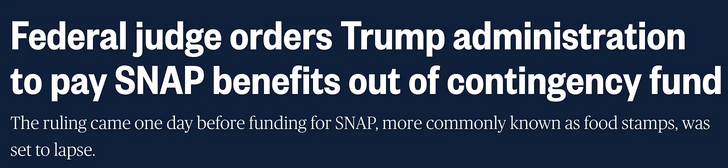
An order today from a federal judge in Massachusetts requires the Trump administration to pay SNAP benefits even though Congress hasn’t funded the current operation of the program.
Judge Indira Talwani, an Obama appointee, concludes that people will be harmed if SNAP benefits are not provided, and Congress previously appropriated contingency funds for emergencies in the SNAP program, so there’s no need for current appropriations — the executive branch must use emergency and contingency funds to pay for current operations despite the absence of current appropriations.
[…]
Defendants — the Trump administration — are required to use contingency funds to pay for current operations, whether or not Congress has funded current operations. A court has just concluded that a federal program must operate in the absence of current appropriations. That’s … an interesting choice.
Update, 3 November: Welcome, Instapundit readers! Please do have a look around at some of my other posts you may find of interest. I send out a daily summary of posts here through my Substack – https://substack.com/@nicholasrusson that you can subscribe to if you’d like to be informed of new posts in the future.



[…] NO GOVERNMENT PROGRAM DOES THE JOB ITS SUPPOSED TO DO! EBTpocalypse imminent? […]
Pingback by Instapundit » Blog Archive » NO GOVERNMENT PROGRAM DOES THE JOB ITS SUPPOSED TO DO! EBTpocalypse imminent? — November 3, 2025 @ 03:33
if a judge thinks he/she can order the President to act, why doesnt the judge just order the Legislature to act?
Comment by susan harms — November 3, 2025 @ 04:32
It is odd that having gone that far beyond normal practice, you’d think it would be an obvious next step for them. Yet none of them have crossed that particular Rubicon … yet. Puzzling.
Comment by Nicholas — November 3, 2025 @ 10:02