
Freddie deBoer discusses the way NFL media coverage has changed from the retired jocks of old to today’s emphasis on data nerd analysis and clickbait contrarianism:
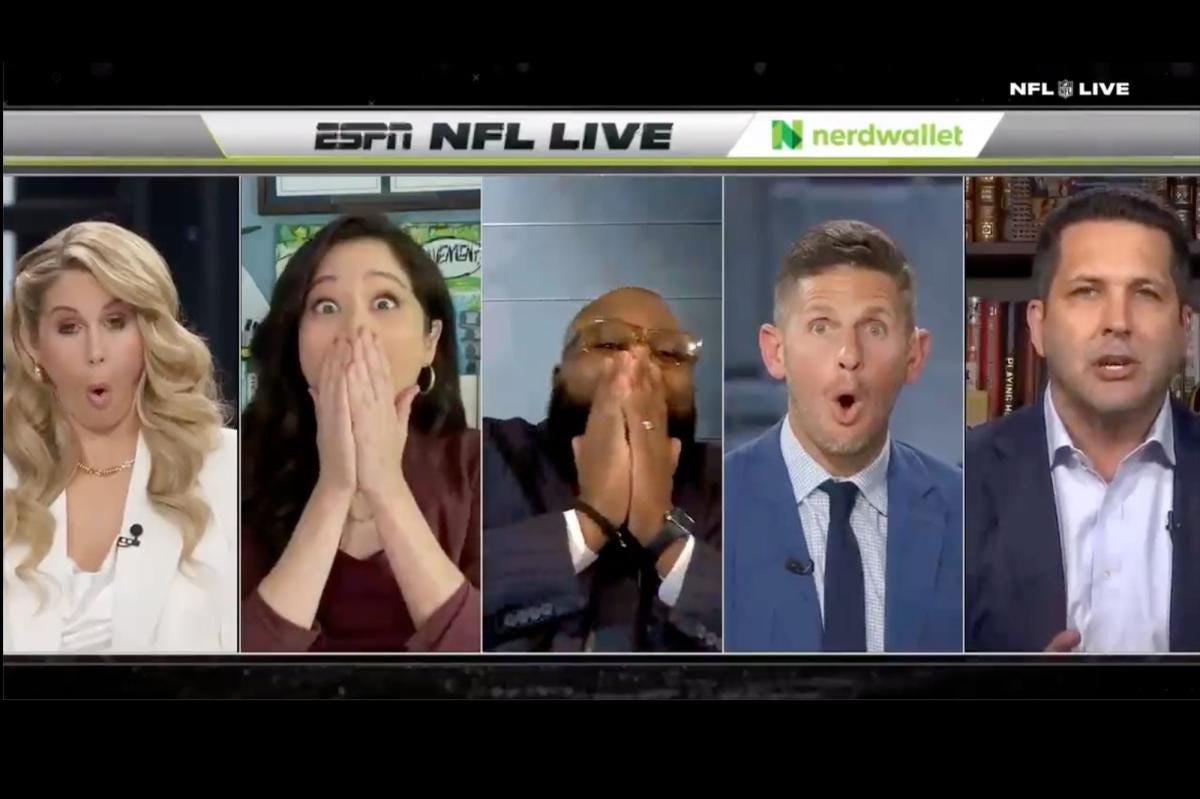
Being a sports media professional means forcing yourself to have this kind of a reaction every time you’re on camera.
Screencap from Freddie deBoer
Consider how smart football journalism was supposed to be by now. Long the domain of ex-jocks ladling out evidence-free bromides about how you have to pound the ball and causation-flipping claims that time of possession is the ultimate metric, today NFL media is dominated by the nerds, analysts who proudly announce that they’ve never played the game and let their teenage resentments power their never-ending performance of Well, Actually football contrarianism. Experience is out! Numbers are in! Empiricism reigns! The bible was right: someday, the meek will inherit the earth, and it’s happening every Sunday on NFL Twitter, where it’s always time to re-prosecute high school.
And yet … The analytics revolution promised to graft rationality and context onto our game-day commentary, but when it comes to the most common and pernicious trend in NFL analysis — overreacting to small samples and short runs of good or bad performance — nothing has really changed. That’s because NFL new media conditions dictate that even the most temperamentally sober and judicious talking heads operate as 24/7 hype machines. This is not, to put it mildly, a new problem. In 2007, ESPN’s Kevin Jackson wrote that NFL media was “Overreaction Nation – a land where no sample size is too small for drawing conclusions, where the most common movement is the knee-jerk”. That description still fits the NFL media perfectly. Week after week, cable TV and podcasters spin wild narratives, proclaiming teams hopeless or superhuman after one game, seemingly embracing the idea that “no sample size is too small”. That this all comes from people who will tell you that they’re the keepers of the flame of Rational Football Analysis only makes it all more annoying.
Modern front offices have jumped on modern statistical analysis, with every team employing analytics departments and with more and more coaches regularly expressing disdain for yesterday’s conventional wisdom. This isn’t a secret; the Ringer, which has always employed its fair share of football nerds who heap contempt on the old ways, proclaimed back in 2018 that “football’s analytics moment has arrived”, pointing out the rise of modern tracking data and explaining how it gives teams an edge. But if we’re honest, even the Ringer was clear that football will never be baseball in statistical clarity: “Football will likely never be baseball, where statistics can basically explain anything,” Kevin Clark (now of ESPN) wrote – “there are too few games and too many variables”. In other words, the sport I love the most is inherently a beast of variance, full of noise. You’d think that message would temper the beat writers.
Instead, it seems the analytics evangelists and talking heads don’t trust their own analytic philosophy. They invoke “small sample size” as a scolding cliché if you dare overreact, but shamelessly turn right around and do it themselves. With every Monday morning comes a fresh rush of oversimplified hot takes. And time has proven that the ostensibly-objective analytics peddlers are no better when it comes to hype than their old school former player competition.
The Minnesota Vikings drafted J.J. McCarthy last year as their “quarterback of the future” only to lose him for his rookie season with a knee injury in the preseason. He started two games so far this season and got injured in his first loss and will only return to play this coming weekend. Bust? A lot of online fans certainly seem to think so, on the basis of a two-game sample, one of which included one quarter of amazing work earning him NFC Offensive Player of the Week. Fans are fickle at the best of times, but the NFL media hype juices that into a kind of sports schizophrenia.
Could Drake Maye be the next big thing? Sure. He certainly has the physical ability. Or he could be Daunte Culpepper. Could CJ Stroud and Jayden Daniels justify all of the hype from their rookie years? Of course! The point is that I don’t know, you don’t know, and neither do the NFL pundits. Neither does Ben Solak. And what bothers me in particular about this species of condescending NFL pundit is that they will endorse concepts like “small sample size theater” when it conforms to their narratives and then gleefully discard those concepts when they don’t. It’s quite frustrating.
Here are tropes to watch out for when it comes to the NFL hype train:
- One Game = Season’s Fate A single loss becomes proof a coach’s job is on the line, a single win means the team is a contender.
- Player of the Year (or Bust) in 48 Hours A QB throws two picks and the media declares him washed up; the next week he goes 25-of-30 and he’s an MVP candidate. NFL pundits alternate between funeral dirges and coronation ceremonies every Monday.
- Outsized Weighting of One Stat Analysts cherry-pick a percentage or grade and assign it cosmic meaning, AKA “going the full PFF.” (This is, not coincidentally, a big part of why so many ex-players despise PFF.)
- Vox Populi Misguided NFL analysis has a habit of looking an awful lot like chatter on Reddit; go look for a team’s subreddit and note the way that supposedly adult-in-the-room analysts ape the exact same hype and intensity of the Reddit squad. A lot of new media-style entities even straight-up quote random tweets as if they’re serious analysis. When you’re looking to backstop deeply irresponsible predictions, any evidence will do.


