
J.D. Tuccille on the results of Argentina’s recent elections which returned significantly more of Javier Milei’s allies than pre-election polls predicted:
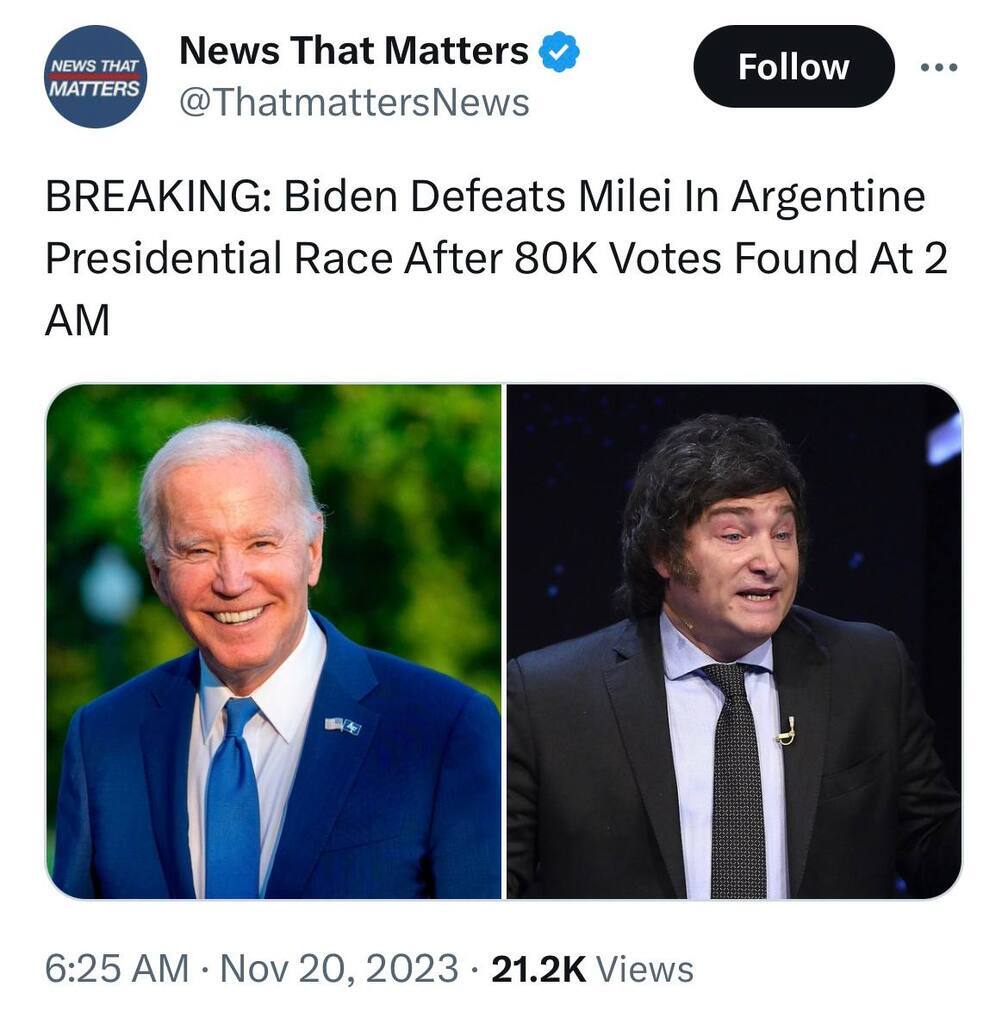
And things were going so well before 2am …
Argentina’s libertarian President Javier Milei won an important election victory on Sunday when his coalition, La Libertad Avanza (LLA), received a plurality of votes in the country’s legislative elections. With about half of the seats in the lower house up for grabs and a third of the Senate, LLA didn’t gain a majority, but it dramatically increased its share enough to block repeals of presidential decrees by lawmakers from other parties and to support presidential vetoes.
As Reason‘s César Báez commented, the results give Milei and his allies crucial time to continue needed free-market reforms and, hopefully, restore the fortunes of a country once held up as a model of prosperity, but which has been driven into poverty by decades of statist misrule.
In what it calls “a shocking electoral victory”, La Nacion reports that LLA pulled 40.66 percent of the vote. That’s well ahead of the opposition Peronists, who have long dominated the country and drew 31.7 percent of votes. Importantly, LLA won the populous province of Buenos Aires (home to 40 percent of voters), a Peronist stronghold where Milei’s allies were recently trounced in local elections.
From Wealth to Poverty Under Government Economic Meddling
This is good news for anybody who hopes for the advance of freedom, of course. But it’s especially encouraging for Argentines who, over the course of generations, have seen their country reduced from one of the wealthiest in the world to an impoverished basket case.
“At the end of the 19th century, economists agreed: Argentina, the ‘land of silver’, had a golden future ahead of it,” Deutsche Welle noted in 2020. “‘Rich like an Argentine’ was a common phrase at the time.”
The German broadcaster added, “in an unprecedented fall, Argentina went from ranking among the world’s top economies to one at the very bottom of the list. Today, economists simply roll their eyes at the fate of Argentina, which is now a developing country.”
The reason is simple enough: Argentines handed their political fates to a man named Juan Peron. In the 1930s, Peron served as a military observer in Europe, traveling to countries including Germany, Italy, and the Soviet Union. He was deeply impressed by some of the worst ideas to ever motivate a government and blended them into his own “justicialist” ideology. Through decades of political dominance, first Peron and then successor justicialists demonstrated that, in practice, there’s no real difference between fascism and socialism and that statist economics by any name are destructive.
To illustrate just how destructive Peron’s legacy has been, it’s worth pointing out that after Sunday’s election, The Wall Street Journal reported that Milei’s free-market, smaller-government policies “have restored some credibility to Latin America’s third-largest economy, but about one in three people still live in poverty”. One-third of the population living in poverty is horrifying, but what’s remarkable is that this is an improvement over what went before. At the end of the preceding Kirchner presidency, poverty stood at 41.7 percent and then briefly rose to 52.9 percent before falling to its current level.
In Spiked, Hugo Timms points out that the success of La Libertad Avanza is almost diametrically opposed to what most mainstream media reports were saying in the days leading up to the elections:

Argentine president Javier Milei has won a significant victory in Argentina’s midterm elections, held on Sunday. His libertarian party, La Libertad Avanza (Liberty Advances), claimed more than 40 per cent of the vote, effectively doubling its share of seats in the senate and lower house to 37 (out of 72) and 64 (out of 257) respectively.
The result came as a bitter shock to much of the mainstream Western press. Milei’s assault on established economic orthodoxies since his election in December 2023 led many “experts” to take it for granted that Milei’s party was in for a hiding.
In a primer for the election published last weekend, the Observer had already begun salivating over the prospect of Milei’s defeat. “Argentina is counting the cost of its turn to Javier Milei”, wrote economics editor Heather Stewart. Glum portraits of Nigel Farage and Donald Trump behind Milei loomed above the article. “Politicians around the world are closely watching what happens when populist economic prescriptions collide with reality”.
This was a comparatively soft take compared with what the Guardian published earlier in October. “Farage, Trump, Musk: your boy Javier Milei just took one hell of a beating. Why so quiet?”, blared the headline when Milei’s party was defeated in a provincial election in the capital Buenos Aires. The Guardian said Milei’s “hard right” administration was “melting away”, along with his “once-packed international throng of cheerleaders and wolf-whistlers”.
Unsurprisingly, the BBC struggled to get to grips with Milei’s victory on Sunday, even though its only job was to convey the results impartially. Apparently, the president made gains despite Argentina “hurtling towards an economic collapse”, it editorialised. It said the voter turnout of 68 per cent reflected “widespread apathy”. This might be lower than past midterm elections in Argentina, but it was still higher than turnouts at last year’s US presidential election (65 per cent) and the most recent UK General Election (60 per cent).
None of this should come as a shock. Since Milei’s rise to power in 2023, most of the commentariat has been eager to see him fail. His promises to radically cut public spending and deregulate key industries were seen in the eyes of many economic experts to only mean one thing: the dreaded return of Thatcherite “neoliberalism”, from which, they claim, Britain and America have never truly recovered.
The antipathy is mutual. In a speech to the World Economic Forum in January 2024, Milei famously referred to the world’s political classes as “parasites who live off the state”. That his speech was shared approvingly by Elon Musk on X confirmed, in the eyes of the Western establishment, Milei’s status as a dangerous insurrectionist.


