In UnHerd, Christopher Harding profiles the new Prime Minister of Japan, Sanae Takaichi, the first female PM who was elected to office on the 21st:
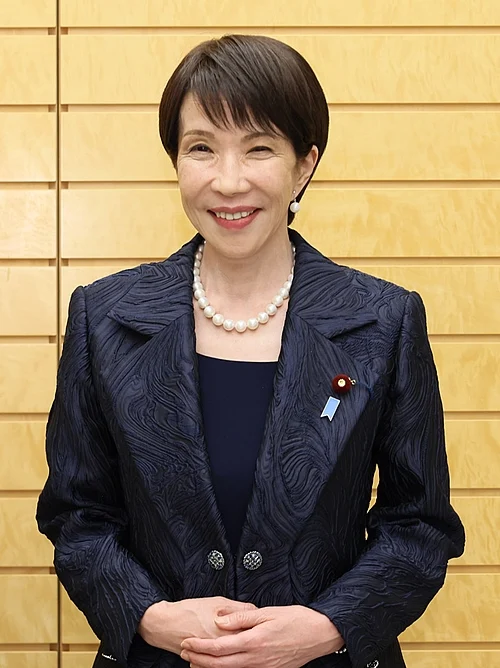
Sanae Takaichi, new Prime Minister of Japan, 21 October, 2025
Photo by the Cabinet Public Affairs Office via Wikimedia Commons.
As a teenager, Sanae Takaichi no doubt riled her parents now and again with her love of motorbikes and heavy metal. Today, poised to become Japan’s first female prime minister at the age of 64, she is polarising a nation. Some credit “Japan’s Iron Lady” with the steely resolve required to tackle the country’s domestic problems and stand up to China. Others lament the apparent fact that to succeed as a woman in Japanese politics you have to adopt the worst instincts of the men, from policies that prop up the patriarchy — men only on the imperial throne, compulsory shared surnames for married couples — to a nativist ultranationalism.
While Takaichi’s premiership will represent a milestone for modern Japan, it’s important in Japanese politics not to place too much weight on the frontman — or woman. The reality is more like one of those bands where the bassist writes the songs but, disliking the limelight, hires a series of relatively disposable vocalists to present them to the public. Alongside machinations in her own party, the LDP, where senior background figures largely decide who gets the premiership and how long they keep it, Takaichi’s fortunes may come to depend on how she deals with two intertwined issues: the economy and immigration.
First, the economy. People in Japan, and the young in particular, are furious about a combination of high taxes, low wage-growth, rising inflation and insecure job prospects. Japanese governments of the past 30 years have struggled with some or all of these problems, trying and largely failing to find solutions against the backdrop of a national debt that has now ballooned to an extraordinary 235% of GDP.
One of the reasons why Japan’s economic problems have been so intractable in recent years is the country’s rapidly declining population — now shrinking by almost a million people every year. Nearly a third of Japanese people are over the age of 65 and after years of hard graft, they expect to be looked after in old age. But that takes money and it takes carers. Japan is short on both. Nursing has long been in crisis, with just one applicant now for every four jobs advertised.
Back in the 2010s, the hope was that “care bots” might see to the needs of the elderly and infirm, freeing up younger people to increase productivity in the wider economy. But the widespread deployment of humanoid caregivers is not expected until well into the 2030s, if ever, in part because of the level of mechanical precision combined with advanced AI required of a robot designed to look after humans. Even robots that simply provide companionship have turned out to be prohibitively expensive and to require a self-defeating level of human oversight: charging them, fixing them, getting them from A to B.
Update, 26 October: