
The last couple of elections Pierre Poilievre has fought attracted the attention of a group of activists who claim their shenanigans are directed at effecting changes in our electoral system, by flooding the field with frivolous candidates to somehow change how we elect our members of parliament. It’s odd that these serial efforts were directed at the leader of His Majesty’s Official Opposition, who has no power to change the electoral system rather than, say, the Prime Minister or his cabinet ministers who, theoretically, do:
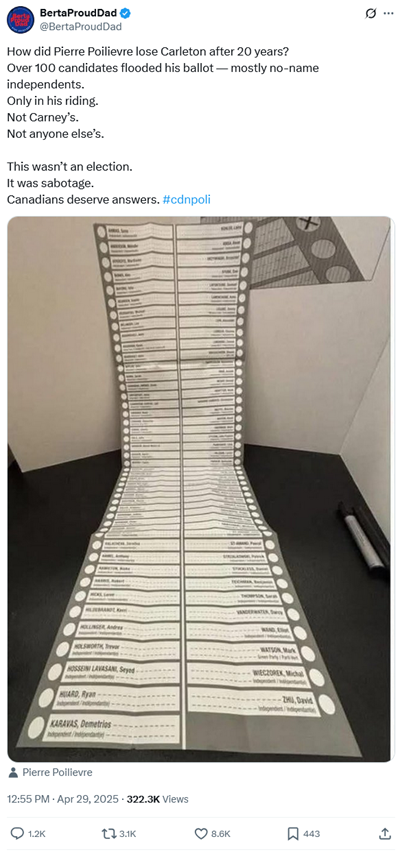
Pierre Poilievre’s riding had an insane number of protest candidates registered for the last general election. Oddly, the same wasn’t true in any other riding in the country. This was an organized protest for electoral reform, supposedly.
On Monday, Alberta Conservative House Leader Joseph Schow mentioned to reporters that the province’s government has legislation in the works to protect the Alberta electoral system from the shenanigans of the Longest Ballot Committee (LBC). That’s the protest group that has been flooding some federal election ballots with spurious candidates — most recently in the federal riding of Battle River-Crowfoot, where Elections Canada had to desperately improvise an all-new write-in system after the LBC persuaded more than 200 people to contest an August by-election.
Kieran Szuchewycz, one of the whimsical conspirators behind the committee, was the person who successfully (and without hired legal counsel) persuaded an Alberta Queen’s Bench judge in 2017 to eliminate statutory election-deposit requirements as unconstitutional. Justice Avril Inglis accepted that the purpose of deposits — which had already been made unconditionally refundable — was to deter frivolous candidates, and that this was desirable and rational.
But she concluded that “it makes little sense to suggest that the deposit requirement achieves any filter other than for those that cannot part with $1,000 for the duration of the election.” Deposits, which had been part of Canadian elections since before Confederation, had suddenly failed the Oakes test. Inglis’s ruling immediately led to an intentional explosion in openly frivolous federal candidacies, engineered by the very same gifted amateur who had talked her into it.
With deposits proclaimed unconstitutional, the only remaining defences against the Longest Ballot Committee’s DDoS attacks on democracy were the requirements for candidates to gather a hundred signatures of constituency residents on their nomination forms and to hire an official agent. The LBC skates around those by recruiting nominators who are willing to endorse anybody, using the same hundred signatures for many candidates, and by providing the same official agent, often somebody named Szuchewycz, to multiple candidates.
These days Mr. Szuchewycz’s brother Tomas is the public face of the LBC: earlier this month he appeared before the House of Commons procedure committee, which has dedicated a few meetings to the subject of LBC tomfoolery. (Kieran, the original smooth talker who got rid of election deposits, is currently listed as “on leave” from the board of electoral-reform group Fair Vote Canada.) There was a heated but unenlightening contretemps between Szuchewycz and Conservative MP Michael Cooper over whether the LBC had used unlawful techniques in their signature-harvesting efforts.
Szuchewycz explained the goals of the LBC ballot-fouling. The group’s supporters and leaders are obviously garden-variety election-reform nerds, but they now focus on the need for taking election design away from the House of Commons and delegating it to an “independent, non-partisan” body. Election reformers have an absolutely terrible track record of advancing their ideas when they’re put to direct referendum tests, and they were hilariously betrayed by Justin Trudeau in the Commons itself, so it is natural that they would seek a side door to the reforms they want. Even if that side door itself has an anti-democratic rule-by-expert character, which it absolutely does.
Update: Added missing URL to the main story.


