
Freddie deBoer on the stereotyped way that the “Gray Lady” — the New York Times — once again lets the independent media do all the serious work to investigate an issue before “the Grey Lady squats down on that issue and says ‘this is mine now'”:
You may groan! You may say, “Again?” You may roll your eyes. But I’m going to talk about this one more time, and then I think I’m done. But I’ve always been right about all of this, and it needs to be said.
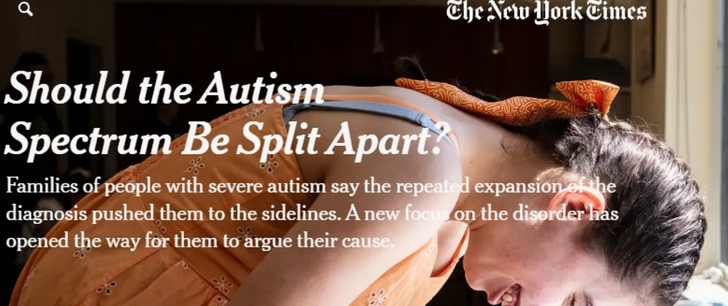
The Times has once again parachuted into a conversation that has been going on for decades, planted its flag, and declared itself the discoverer of new territory. Yesterday they published a piece on autism, neurodiversity, RFK Jr., and whether the autism spectrum should be split up — split back up, that is, to reflect on the massive differences between those with profound autism and those for whom “neurodiversity” is mostly a social badge, a tidbit to be displayed on a Bumble profile. (The answer is yes, of course the spectrum should be split up again, for reasons I’ve written about at great length.) That issue, unusually raw, will bubble on, as it sits at a genuinely uncomfortable intersection of liberal identity norms, online culture, and the genuinely debilitating reality of severe autism. In terms of progressive discourse rules, the plight of the severely autistic and their loved ones is truly a problem from hell: those rules insist that you can’t ever question someone’s diagnosis, no matter how dubious; they demand that you acquiesce to claims made from a position of disability, no matter if they cut directly against the claims made by others from their own position of disability; they have long ago lost sight of any distinction between identity and disorder; and they’re governed by a selective and incoherent vision of standpoint theory that insists that only the autistic can speak out about autism – which perversely empowers the least-afflicted and silences the interests of the most-afflicted, as the most-afflicted literally cannot speak for themselves. You know my rap on all this.
In meta terms, though? This tendency of the NYT to helicopter in to long-simmering debates and bless them with the paper’s attention, and in so doing anoint those debates as worthy of attention by grownups, is only the latest example in an old, ugly dynamic. The little people in independent media ask difficult questions and engage in rancorous debates and stick their necks out in the service of ideas, which is what the media is supposed to do. Then, once the heavy lifting is done, the Grey Lady squats down on that issue and says “this is mine now”. The paper’s consolidation of both prestige and financial security — its status as both far and away the most prestigious publication in world media and maybe literally the only financially healthy newspaper left in the United States — has all manner of pernicious, perverse consequences in an industry that can only function when people within it are engaged in debates with real stakes and real hurt feelings. Again, nothing you haven’t already heard from me. But when there is only one endpoint for the ambitious to aspire to, there’s an inherent and unavoidable silence about that endpoint’s myriad failings. The Times, for its part, has walled off criticism within its own pages with its “we don’t do media criticism” rule, a profoundly self-interested and cynical policy that helps them evade ever having to justify their own widely-criticized practices. And for all manner of complex reasons, the broader world of stodgy old media, dying though it may be, still holds all the cards when it comes to defining debates that involve institutional stakeholders, as the debate about autism’s future certainly does.
I don’t begrudge any writer for wanting to weigh in on these issues — God knows they matter and need more attention — but what’s striking about the Times‘s coverage is how effortlessly it erases the long history of people already fighting these battles, and the richness of the debate that preceded them. Whole archives of independent writing, analysis, and advocacy disappear when the Paper of Record decides that a question now exists. Until then, the issue is marginal, unserious, relegated to the sidelines; afterward, it’s real, it’s official, it’s legitimate … and therefore too important to be left up to those of us in the cheap seats. This is the paradox, you see; no issue that independent media concerns itself with can be considered truly serious, and no issue that they (eventually) deign to be truly serious is something that they trust the independent media to engage with responsibly. Quite a little trap, there. And when the grownups in the room walk in, we’re meant to feel blessed by their presence, happy to have our pet issues taken seriously. Everyone else who’s been in the trenches for years is supposed to be grateful for their newfound recognition.



That’s like saying you should split cancer between “cancer-spectrum” and “real cancer”. People on the autistic spectrum are autistic, just as people with migraine disorder suffer migraines–individual expressions vary, but the fundamental issue is the same.
Further, anyone who knows folks with autism knows that WE ALREADY subdivide it. No one’s lumping highly autistic people with those that are high-functioning. For that matter, high-functioning autistic people aren’t lumped together. This mental condition has some common traits (inability to pick up social cues, hyperfixation, issues with muscle movement and sensory overload, etc), but fundamentally each autistic person is unique and has to be dealt with by those around them as an individual. For that matter in the individual it’s not a constant; some days the issues flare up more than others, some days are better than others. So yeah, the notion that we need to split up autism is complete and utter nonsense; I don’t know that it can actually be split any finer than it already is (thus the use of “spectrum”).
And the worst part? That’s not even the point of this article. The author blithely ignores the reality of dealing with the disorder he’s presenting himself as an expert in, not to say anything about autism or how it should be dealt with, but to attack a newspaper he has a beef with. This sort of rhetorical trickery is frankly vile, and displays the author to be someone who is very unconcerned with who he harms, so long as he can make someone he doesn’t like look bad.
Comment by Dinwar — October 7, 2025 @ 09:13