Note that this piece was published before the assassination of Charlie Kirk the next day, and it does not directly address issues stemming from that crime.
On Substack, Lorenzo Warby explains why conspiracy theories spring up so readily:
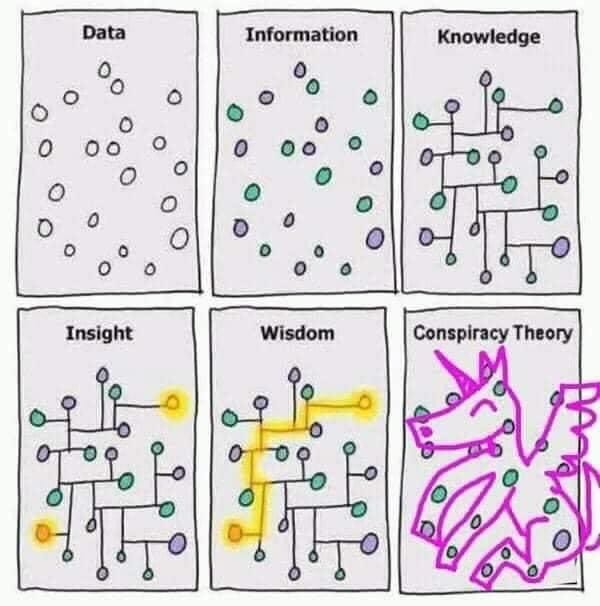
Analysis of events abhors an analytical vacuum. That is, if your mental architecture lacks certain key analytical tools or framing, then you will be driven to mischaracterise — potentially seriously mischaracterise — events.
Given the human propensity for identifying patterns, and awareness of human intentionality, what can very easily fill in an analytical gap is some form of conspiracy theory. A conspiracy theory alleges that there are centrally organised people operating in secrecy — usually in a malign way — controlling events.
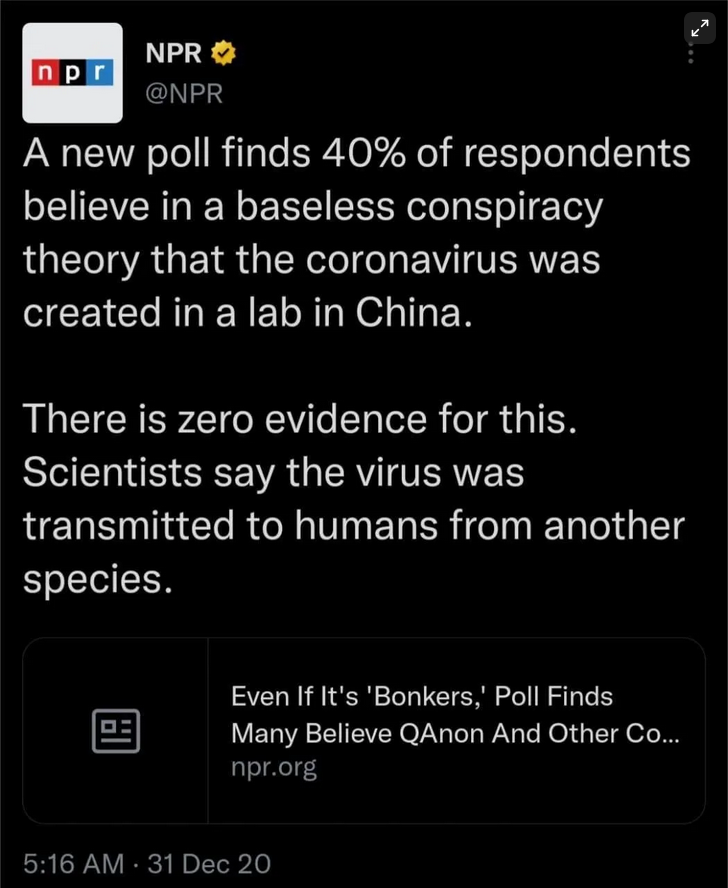
A conspiracy theorist is someone who advances such an idea. The term can also be used as a term of abuse for anyone who inconveniently notices patterns — such as folk advancing claims and beliefs that suit people like themselves — or simply advances claims that people find inconvenient or awkward.
There are actual conspiracies. We know there are actual conspiracies, because they have been exposed.
The question is whether the claimed level of coordination and control over events, and the required level of continuing secrecy, is what is happening. The more restricted one’s analytical tools, the more conspiracy is likely to seem the default explanation for any coordinated pattern of behaviour.
Something that people do openly is not a conspiracy. Nor is conspiracy the only way for people to coordinate. It is perfectly possible to coordinate via mutual signalling, for instance. This is particularly true if people are engaged in shared status games. It is even more true if networks share common interests, common information sources and are playing shared status games.
Among us Homo sapiens, much of the point of status is to generate currencies of cooperation. We are a very status-driven species because we are very social beings, so prestige (conspicuous competence) and propriety (conspicuous conformity to norms) have been currencies of cooperation for our highly cooperative subsistence and reproduction strategies that developed across hundreds of thousands of years.
In thinking about the dramatic changes brought about by the Sexual Revolution of the 1960s, it became clear to me that there were always sexual outliers, there are always folk trying different life strategies. Due to the Pill and legally available abortion, which life strategies worked suddenly changed, so folk shifted to them and the norms that enabled them.
Thinking seriously about the mechanisms by which sexual mores changed leads to considering networks, signalling, life strategies. Once you grasp the power of these social mechanisms, you are in a much better situation to see how much conspiracy theories are a product of a lack of analytical breadth and depth. Conspiracy theories are a mechanism to “explain” events, one that occurs naturally to our pattern-seeking minds aware of human intentionality. They do so, however, in the absence of analytical alternatives, if we do not have better operational mechanisms to explain events — and especially observed social coordination — by.