
Dr. Robert Lyman rebuts the common-since-the-1950s adulation of the Wehrmacht‘s attacks of May-June, 1940 through the Low Countries that drove the British Expeditionary Force off the continent and destroyed the flower of the French army prior to the surrender of France in June:
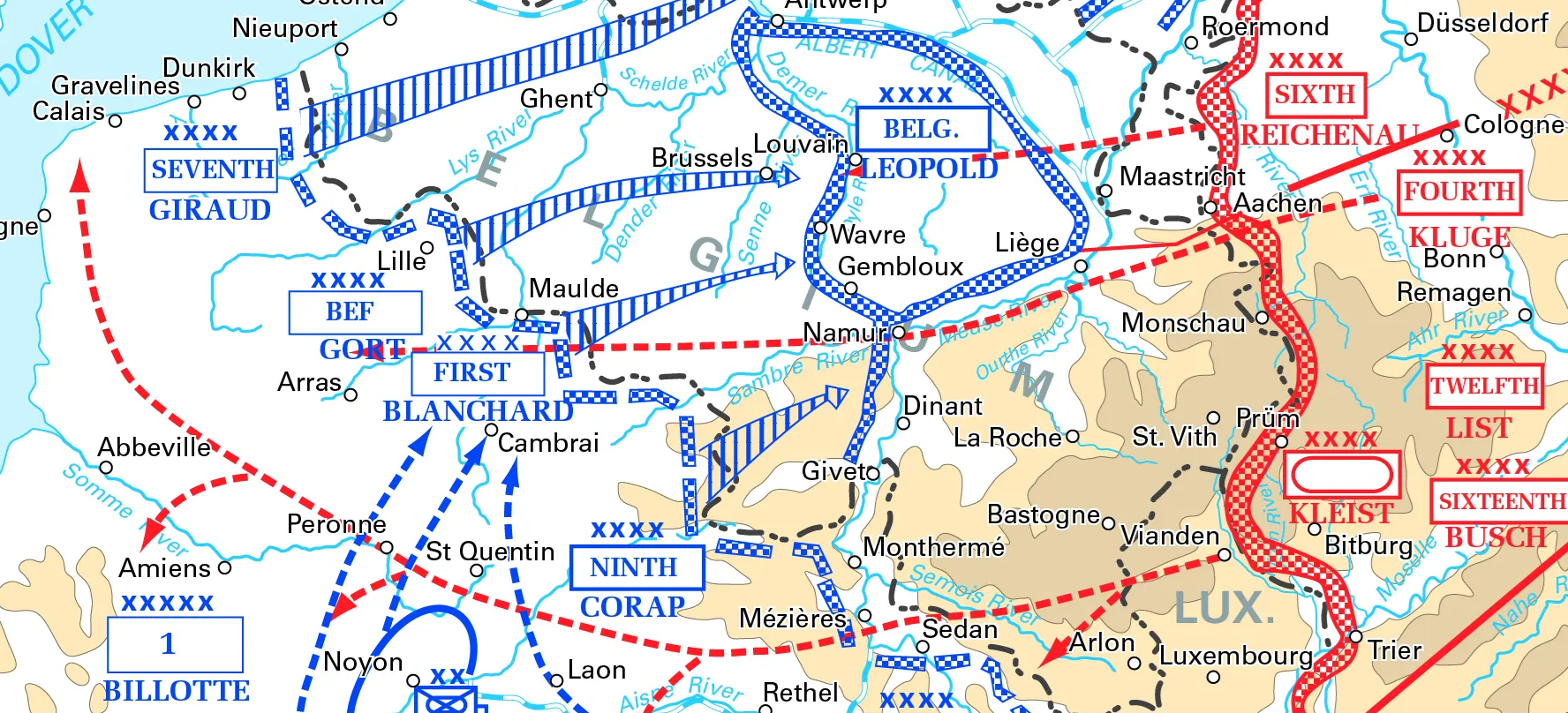
Detail from the West Point Military Atlas map of the “Campaign in the West, Disposition and Opposing Forces, 1940”
Full map.
The world has largely remembered Sichelschnitt as a brilliant German operation of war, but it was one that was fundamentally enabled by Allied ineptitude. Indeed, Blitzkrieg wasn’t particularly new, innovative or even a warfighting doctrine. It is best described, in the context of France 1940, as an event. It was simply the way that the Wehrmacht exerted its tactical and operational superiority over its more pedestrian enemies in 1940. In fact, it was the 1940 extension of what the German Army had first demonstrated in Flanders in March 1918, this time with tanks and Stukas. It was the Panzerwaffe (“tank force”) – combined with a tactical air force – which in 1940 would create the breakthrough that Ludendorff had been unable to achieve in 1918. Where it was applied, by Army Group A, it concentrated fast-moving armoured vanguards co-ordinated with tactical air power, such as 400 Ju 87 Stuka dive-bombers, to so overwhelm the enemy in both time and space that they were unable to respond quickly enough to the changing and challenging battlefield. In 1940 the panzer came into its own, the sound of clattering tracks on French cobblestones a new feature in the sound of battle and a key element in how France remembers its defeat in 1940.
It wasn’t the type of tank in the German inventory which mattered, but the way in which these tanks were employed. Only about 10 per cent of the army comprised tanks, the remainder relying on horse and wagons and the raw, painful feet of the marching infantry. Of the 2,539 tanks the Wehrmacht deployed in 1940, only 916, or 36 per cent were battleworthy, the remainder being clattering tin cans with machine guns (the obsolete Panzer Mark Is and Mark IIs). The only modern tanks were 683 Panzer Mark IIIs and Czech T38 tanks armed with a 37mm gun, and 278 of the larger Mark IVs with a short 75mm gun. But it was enough. The German operational strategy was to use this mass of armour not to fight a large confrontational tank battle, but to achieve breakthrough and breakout, bursting through the enemy’s linear defences. It was surprise and shock action that so discomforted the Allies, who had lazily and, given what we know of British failure to understand 1918, ignorantly assumed that the war would progress against a 1914 rather than a 1918 pattern. The armoured vanguard would surge through the outer skin of the enemy defences, concentrating heavy effort in one place, before driving hard into the heart of enemy territory. With an enemy intent on fighting a linear battle, the rear areas, behind this outer crust, would be weakly defended and full of rear-echelon, administrative and supply troops managing the lines of communication up to the front, not expecting to have to fight. It was by driving hard and fast behind the enemy front line, breaking the cycle of Allied battlefield decision-making, that Blitzkrieg was to achieve its psychological effect.
In contrast the Allies remained concerned about retaining the integrity of their defensive lines. The diaries of Major General Henry Pownall, for instance, are replete with concerns as the days spun past about the widening frontages on one defensive line or another. British concern was misplaced. It was to spread the ever-decreasing butter of the British infantry across ever-widening stretches of French and Belgian bread, without realising that the Germans were concerned not with rolling up a front line, but with driving hard to the rear. By so doing they would take risks with their flanks, but the discombobulatory effect on the enemy was considered to far outweigh any worry about the risk of counter- attack from an increasingly battered and disorganised enemy. Of course this operational concept was risky, but the risks taken were carefully calculated given what the German General Staff knew about British and French tactical doctrine, or the lack of it.
These German tactics were psychologically disconcerting for those not trained to expect them. As was demonstrated on the Meuse, artillery would batter a position in co-ordination with armoured columns bypassing fixed defences and attacking those it needed to clear from the flanks and the rear. The infantry accompanying the advancing armour – Panzergrenadiers (mechanised infantry) – arrived in tandem with the Stukas, which could drop their bombs from a screaming dive. Each Stuka seemed to those at the receiving end to be diving directly at them, personally. For untrained troops it was a terrifying experience. The panzers would sweep on while the truck-borne infantry would turn up to deal with survivors of this storm of fire and movement. By this time, of course, the disorientated French and British would now consider themselves cut off, behind their front line, with no prospect of being relieved. Surrender or a disorganised escape to the rear would seem to be a more sensible option than the forlorn hope of continued resistance when the surrounding fields were dotted with the grey-green uniforms and coal-scuttle helmets of their enemy. The psychological effect of Blitzkrieg was considerable. This wasn’t how their fathers had told them war was fought. How did the Germans manage to discomfort them on the battlefield so comprehensively? Were they inadequate soldiers, unable to meet the standards of campaigning set by the previous generation? Or was it that their tactics were simply not able to cope with the shock of a comprehensive assault by German infantry, armour and air power all descending on them at once? This was the battlefield that the British had entirely dominated, by virtue of their tactical innovations, in 1918. It was now Germany’s turn, a direct result of the failure of the British Army to develop its doctrine and approaches to warfighting at the end of the Great War. Brave men in 1940 did their duty, but against a battle-winning concept of their enemy, they were out-thought rather than out-fought. And critically, when an army thinks it is beaten, it is indeed beaten.


