
In the Coolidge Review, Amity Shlaes points out some strong similarities between Donald Trump’s career and that of the Bull Moose himself, Theodore Roosevelt:
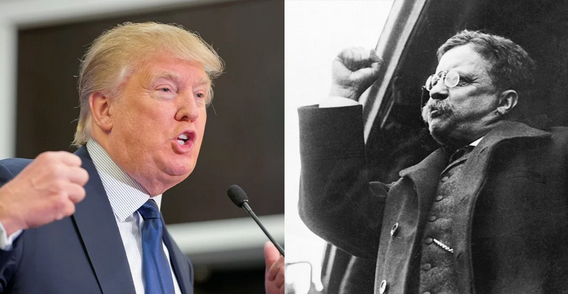
Though a century apart—TR served from 1901 to 1909 — these two chief executives have favored the same modus operandi: using unpredictability to amass power. And the record of Theodore Rex, as Edmund Morris titled his TR biography, bodes ill for both the economy and the Republican Party.
The Trump-TR Parallels
But to the similarities. They start, for both men, pre–White House. As Trump did, TR staged his pre-presidential efforts as much with an eye to public recognition as to sustained reform or strengthening institutions.
Whenever TR stumbled, he pivoted to a new venture and publicized it like mad, though the medium in those days was the printed word, not season after season on The Apprentice. Before the cognoscenti had even absorbed the meaning of the young Roosevelt’s humiliating fourth-place score in a key 1886 New York City mayoral contest, for example, TR was off to the Badlands, memorializing his ranching experiences in dispatches and books such as Ranch Life and the Hunting Trail.
As Trump does, TR routinely alienated GOP grandees, circumventing them to get ahead. As Trump has, TR skillfully cultivated the media — so skillfully that members of Congress were left trying catch up with whatever shifts in public opinion resulted from the politician’s press alliances. TR’s Rupert Murdoch was the widely syndicated William Allen White of Kansas’s influential Emporia Gazette. TR’s equivalent of Fox News was the New York Journal, whose owner, William Randolph Hearst, drummed a steady beat of support when Roosevelt called for war against Spain.
Today, Murdoch must be scratching his head over what his showcasing Trump has wrought, especially now that Trump decided to sue both Murdoch and his Wall Street Journal. White, too, found that he had second thoughts about his decision to back TR: “Roosevelt bit me and I went mad,” White reportedly told a colleague.
[…]
BULLY
The occupant of what he labeled the Bully Pulpit — “bully” as in “excellent” — proved a literal bully as well.
As president, TR perpetually unnerved fellow Republicans, pivoting back to domestic politics. As Trump has, TR cast his campaigns in moral terms rather than economic ones. Where Trump launched his tariff war, TR made war against trusts, large combinations of companies. Relying more on whim than statute, Roosevelt segregated trusts into “good trusts” and “bad trusts”.
TR targeted an invincible-looking industry that, in those days, mattered as much as the interstate highways, or the internet, do today: railroads. James Hill’s Great Northern Railway took over a struggling competitor, Northern Pacific. Roosevelt asked Hanna what he made of the combined entity, Great Northern Securities. Hanna replied that it was “the very best thing possible for the future of the whole Northwest territory”. Roosevelt nonetheless sicced the Justice Department on the Great Northern.
J. Pierpont Morgan, a participant in the beleaguered deal, called on the president to inquire, as desperate steel importers these days do from time to time, whether their attorneys might work out the matter behind the scenes.
No.
Next, the disconcerted Morgan asked whether other investments of the House of Morgan might be assailed. Roosevelt’s reply captures the chill of arbitrary leadership. The administration would not go after the other Morgan companies, he said — unless “they have done something we regard as wrong”.
As Edmund Morris reports in Theodore Rex, to observers such as French ambassador Jules Jusserand, Roosevelt seemed “more powerful than a king”. That power suited many voters fine, which is why Roosevelt won so headily when he ran for office on his own in 1904.
Of course TR, like Trump, occasionally supported laws that aligned with his impulses. One example is the Elkins Act of 1903, which made it illegal for railroads to charge different freight rates for different customers. This shallow effort to achieve market “fairness” deprived the railroads of a standard business tool: the ability to provides discounts to those who buy the product in larger quantities. Shares in railroads promptly dropped more than 20 percent, a shift that undermined TR’s premise of railroad invincibility.


