
Sylvain Charlebois on the new phenomenon of grocery stores going to great lengths to pretend that items for sale are Canadian when they’re not — “maple-washing”:
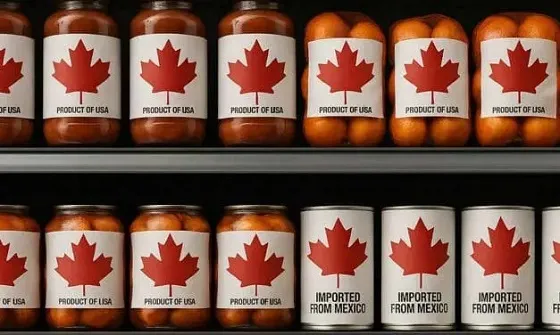
Image by Troy Media via Todayville
Canadian grocery retailers are misleading shoppers about where their food really comes from. Behind the patriotic packaging lies a growing problem: “maple-washing” — using Canadian symbols to suggest products are homegrown when they’re not. It’s eroding consumer trust and must end.
That’s why more Canadians are paying closer attention to what labels actually mean. Awareness around origin labelling has grown as people learn the difference between “Product of Canada”, “Made in Canada”, and “Prepared in Canada”. The Food and Drugs Act requires labels to be truthful and not misleading. A “Product of Canada” must contain at least 98 per cent Canadian ingredients and processing. “Made in Canada” applies when the last substantial transformation happened here, while “Prepared in Canada” covers processing, packaging or handling in Canada regardless of ingredient source.
The differences may seem technical, but they matter. A frozen lasagna labelled “Prepared in Canada”, for example, could be made with imported pasta, sauce and meat — packaged here but not truly Canadian. These rules give consumers the clarity they need to make informed choices.
Armed with this clarity, many Canadians have become more selective about what they buy. That vigilance has emerged alongside a surge in consumer nationalism, spurred partly by geopolitical tensions and anti-American sentiment. Even with U.S. giants like Walmart, Costco and Amazon dominating Canadian retail, many shoppers are deliberately avoiding American food products. The impact has been significant: NielsenIQ reports an 8.5 per cent drop in sales of American food products in Canada over just a few months. In an industry where sales usually shift by fractions of a per cent, such a drop is extraordinary. It shows how quickly Canadians are voting with their wallets.
That kind of shift, rare outside of crises, caught many grocers off guard. The sudden change left supply chains long dependent on U.S. products under pressure, and store-level labelling grew inconsistent. Early missteps — like maple leaves displayed beside imported goods — were excused as logistical oversights. But six months later, those excuses no longer hold. Persisting with misleading displays and false origin claims has crossed the line into misrepresentation. Instances of oranges or almonds labelled as Canadian, with prices quietly adjusted after complaints, show the problem is systemic, not accidental.


