
In The Freeman, Nicole James discusses how Australia’s attempt to protect young, innocent eyes from the terrors of the internet seems to be having all kinds of unforeseen impacts on adults:
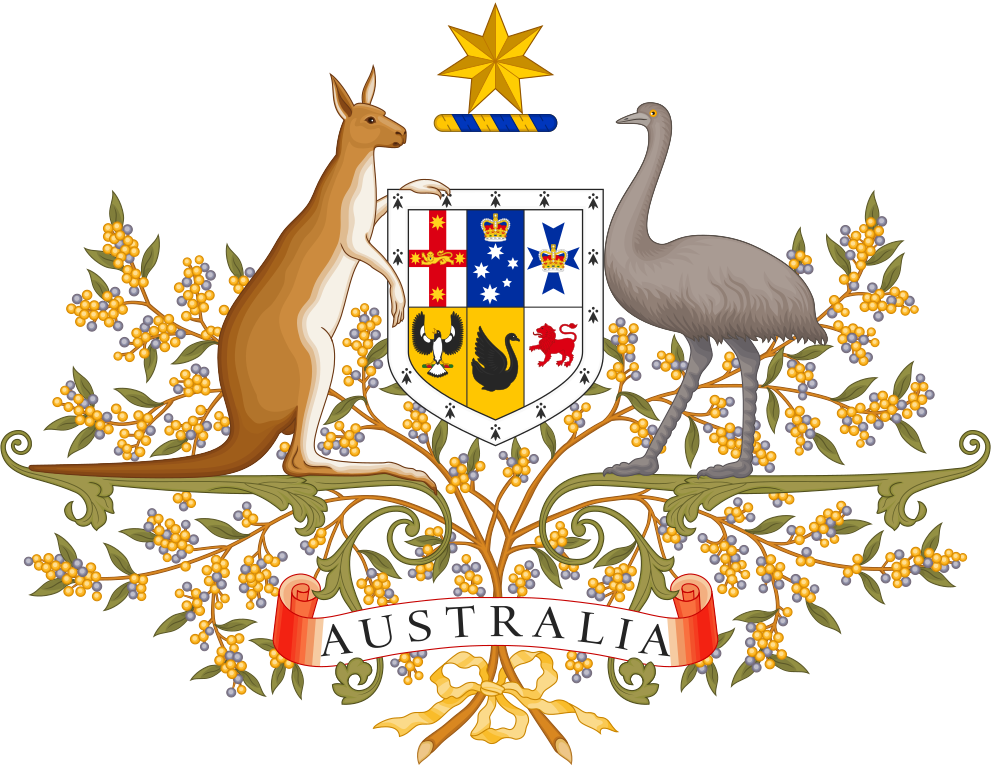
Commonwealth Coat of Arms of Australia (1912).
Quarterly of six, the first quarter Argent a Cross Gules charged with a Lion passant guardant between on each limb a Mullet of eight points Or; the second Azure five Mullets, one of eight, two of seven, one of six and one of five points of the first (representing the Constellation of the Southern Cross) ensigned with an Imperial Crown proper; the third of the first a Maltese Cross of the fourth, surmounted by a like Imperial Crown; the fourth of the third, on a Perch wreathed Vert and Gules an Australian Piping Shrike displayed also proper; the fifth also Or a Swan naiant to the sinister Sable; the last of the first, a Lion passant of the second, the whole within a Bordure Ermine; for the Crest on a Wreath Or and Azure A Seven-pointed Star Or, and for Supporters dexter a Kangaroo, sinister an Emu, both proper.
Once upon a time, not so long ago, children roamed freely through the pixelated wilderness of the Internet, posting dog memes, finding kindred spirits in weird little corners of Tumblr, and learning how to contour like Kylie Jenner. It was all chaotic, noisy, and entirely normal.
Now? Well, welcome to Australia in 2025, where the new Online Safety Amendment (Social Media Minimum Age) Bill has galloped through Parliament like a runaway Shetland pony, banning under-16s from social media. This is a full-blown digital eviction. And the ban isn’t limited just to TikTok and Snapchat. It also extends to YouTube (yes, YouTube), where apparently autoplay is now considered a gateway drug.
And how will they enforce this sweeping national grounding? Age verification, of course. Potentially through facial recognition. Not for the kids, mind you; they’ll simply be locked out. It’s everyone else who’ll need to prove they’re not children. Because nothing says “welcome to adulthood” like having to scan your actual face just to post a birthday shoutout or watch a slow-cooker recipe reel. All to reassure a tech platform that you’re not a rogue 14-year-old with strong opinions and a ring light.
The bill’s spiritual mother, eSafety Commissioner Julie Inman Grant, who, fun fact, once interviewed for a job at the CIA to analyze serial killers, gave a passionate speech at the National Press Club called “Swimming Between the Digital Flags”. It sounded very beachy and breezy until you realized she meant regulatory flags, and not the ones you’d use at Bondi. Her point was clear: the online world is full of rips and sharks and emotional jellyfish, and children must be protected from being dragged under.
Which is noble. Obviously. But somewhere between “protect the kids” and “build a biometric panopticon”, the line got a little smeared.
And where, you might ask, were parents in all this? Sitting quietly in the back, apparently, while Canberra (Australia’s Washington, DC) appointed itself Mum, Dad, the school principal, and possibly even the family dog. Because this isn’t just about safety; it’s about who decides what kids can see, say, share, and, in the case of a few bold young TikTokers, lip-sync while delivering motivational speeches to two mildly traumatized budgies.
The idea behind the project is that children are being harmed online, and honestly, yes, some are. The Internet is not all kittens and cake recipes. But rather than investing in education or digital literacy, the government has opted for a full blackout. It’s like banning scissors because one kid snipped their fringe into a reverse mullet.
And here’s the kicker. The bill had a consultation period of just 24 hours. That’s less time than it takes to read the terms and conditions you just agreed to without reading. (Don’t lie, we’ve all done it.)
In that tight little window, more than 15,000 submissions were made, and while some were supportive, the vast majority sounded the alarm. LGBTQIA+ organizations warned of disconnected teens losing safe spaces. Indigenous advocates pointed out the risks of further digital exclusion. Psychologists, educators, digital rights groups, and even a Community Soccer Club raised concerns.


