
Taylor Downing reviews the latest co-operative work between former British Chief of the General Staff Lord Dannatt and Dr. Robert Lyman:
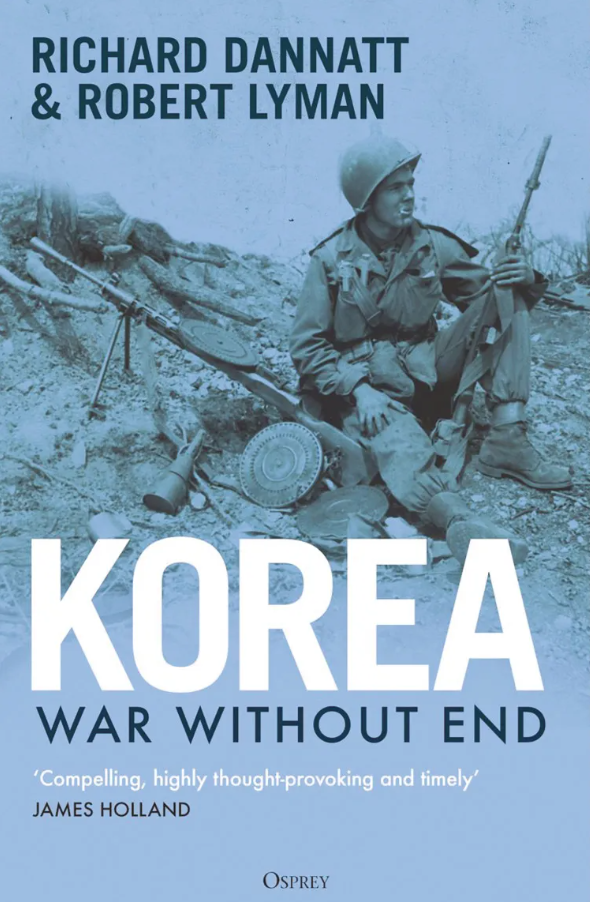
Their book has three premises. First, that the conflict in Korea is a forgotten one that very much deserves retelling. Second, that the war is very topical today partly because it shows how to fight (or not to fight) a conventional war in a nuclear age, and partly because it shows how politics must always take precedence over military ambition. And, third, the authors argue that the war was not a single conflict but was in fact two wars, quite separate but consecutive.
The “first” war is the story of the surprise invasion of South Korea by the North Korean People’s Army (NKPA), or the In Mun Gun, in June 1950 as their leader Kim Il Sung sought to reunite the Korean peninsula under Communist control without having any sense of the political response he would unleash. What followed was a rapid advance towards the southern city of Pusan in a form of Blitzkrieg that had not been seen since World War II.
This early phase covers the establishment of a US-led United Nations force for the first time in its history – only formed because the Soviet Union was boycotting the Security Council at the time. US troops finally slowed the NKPA advance and then, in a brilliant counterstroke masterminded by General Douglas MacArthur, an amphibious troop landing took place behind enemy lines at Inchon. This resulted in a complete reversal in the fortunes of the North Koreans and their retreat to pretty well their starting lines on the 38th Parallel that had divided the peninsula since 1945.
This, the authors argue, is where the war should have ended. The UN had achieved its aim of liberating the south from a Communist takeover. But instead a “second” war unfolded in which General MacArthur, convinced that he was fighting a crusade against world Communism, advanced rapidly through North Korea towards the Yalu River and the border with Communist or (as he called it) “Red” China. For him, victory had to include total defeat of the enemy. In scenes of remarkable hubris, MacArthur was convinced he had the war wrapped up and his troops would be home by Christmas. Instead, he provoked an attack by the Chinese People’s Volunteers on a massive scale, leading to the humiliating rout of US troops and a midwinter retreat back into southern Korea.
This “second” war had as its next phase the final standstill along lines roughly similar to the 38th Parallel and two years of stalemate, before an armistice was signed. The breakdown of the war into two separate conflicts is a fine way of interpreting the remarkable see-saw events of the first year of fighting. Seoul was captured and recaptured four times in nine months. Pyongyang was captured and lost, becoming the only Communist capital to have been taken in battle during the entire Cold War.
In the first stages of the conflict, UN troops, largely Americans who had been sent in from keeping the peace in Japan and who were entirely untrained and unprepared for combat, were thrown back so rapidly that many simply threw down their weapons and retreated. The NKPA, using the tactics the Japanese had used in their invasions of Malaya and Burma, completely outclassed the unprepared US forces.
Then, a few months later, the US-led advance made the Americans feel completely unstoppable as they headed north, only to be turned once more by the Chinese. Again, tactically outclassed and totally unprepared for mountain warfare in midwinter, where conditions were brutal, the UN forces collapsed. It is a remarkable story that very much merits the retelling.


