Ted Gioia on the apparent death wish of the academic publishing industry:
The most disturbing concept Freud ever invented — and he had a few, that bloke — is Thanatos, or the “death instinct”. This is an alleged drive among living organisms to destroy themselves.
Many have disputed that such a thing exists. Instincts preserve life — that’s their evolutionary purpose. The idea of a death instinct is impossible, so the critics claim. It’s like that Peacekeeper Missile or soft rock or marijuana initiative or any of those other two-word combinations of things that don’t belong together.
I’ve often criticized Freud, but I’ve come to accept this Thanatos notion, at least as a sociocultural concept. It explains so many otherwise inexplicable happenings in our society.
Take, for example, academic publishers. They are clearly imbued with a death instinct, no? How else can you explain their self-destructive behavior?
Universities have been publishing books for almost 500 years — dating back to 1534 A.D. when King Henry VIII allowed Cambridge University to set up a printing press. Running one of these publishing outfits is almost a requirement if a college wants to rise in the rankings, but I wonder how much longer this can last. After all, how can you succeed as a publisher if you put so little energy into selling books?
I know one academic publisher that previously sent out two hundred or more review copies of each new book — because they obviously wanted publicity for these titles. Those days are gone. Nowadays their preferred strategy is to send out zero physical copies to reviewers. I’m not exaggerating — I’ve heard it straight from their mouths: their goal is to distribute absolutely no hard copies to media outlets and book critics.
College students are spending 26% less on textbooks this year. That’s a bloodbath for the publishers. But this is the inevitable result whenever you assume the customer has no choice — because, sooner or later, they actually do.
Okay, I don’t blame the publishers entirely — just consider how rarely the New York Times reviews books from academic presses. You might think the cultural elites in New York would give some support to their fellow travelers in idea-mongering, but no dice. They treat those academic books like they’re toxic.
(By the way, I’m grateful to the Times Literary Supplement over in London, which still takes time to tell me about important scholarly works, most of them ignored in US media. But even that last holdout in Britain feels precarious — I fear they’ve been too contaminated by Yankee values.)
Yankee values? That’s up there with the Peacekeeper Missile.
But the lack of review copies is just one symptom among many. Let’s look at a few others.
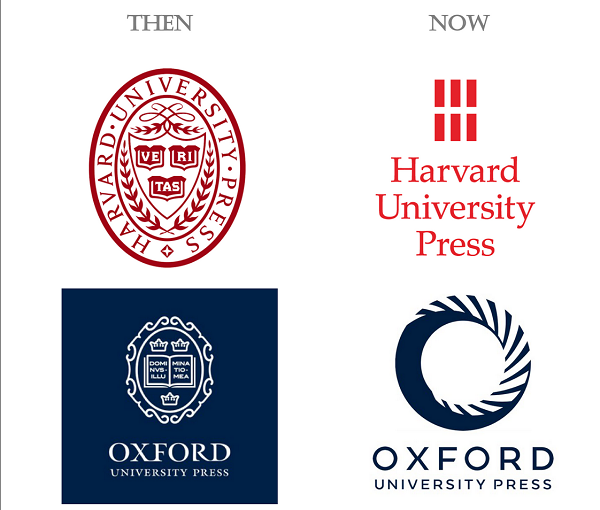
Just consider the flurry of rebranding efforts in academic publishing. As I’ve explained elsewhere, successful organizations rarely redesign their logos or “refresh” their brands. They don’t have time for such nonsense. But even more to the point, when you’re thriving, your logo is part of that success — it’s a sign of your strength, and you just don’t mess with it.
But that’s clearly not the case in academia nowadays.
I could give you countless examples from college campuses — where “rebranding” is more popular than a hot high school football prospect on a recruiting visit. But I’ll settle for two instances:
My only disappointment is that these brand redesigns didn’t come packaged with a new slogan. May I suggest something along the lines of: Information Solutions for a Changing World.
Or maybe, if we can be a bit more boastful: The Ultimate in Handheld Data Storage.
Does anybody still believe in this rebranding malarkey? Surely any reasonable person can see it’s all smoke and mirrors? But that hardly matters, because the brand redesign has tremendous symbolic value.
That’s why they do it.
The road to hell was once paved with good intentions — but nowadays we settle for symbolic gestures. They’re much cheaper than good intentions. And there’s no shortage of symbolic gestures nowadays — more than enough to pave that whole damned highway to hell.
It’s a shame that symbolism doesn’t pay the bills. Or fix problems. And it certainly won’t sell books.