
Forgotten Weapons
Published 29 Oct 2012Charles Manville developed this weapon in the 1930s as a riot control tool, and they were built in 12ga, 25mm, and 37mm. We should point out that the 12ga version was for tear gas rounds only (like today’s 12ga flare launchers) and not safe to use with high-pressure ammunition. Anyway, it was intended for use by prison guards and riot police, offering a much greater ammunition capacity than any other contemporary launcher.
During World War II, Manville tried to sell the military on a high-pressure version to fire 37mm explosive rounds, but was unsuccessful. Instead, the Manville company spent the was making parts for the Oerlikon 20mm AA guns, and the tooling for the gas launcher was all destroyed.
(more…)
July 18, 2023
Manville Gas Gun
November 15, 2022
New Zealand’s “splintered reality”
Earlier in 2022, when most of us were distracted by the Freedom Convoy in Ottawa, New Zealand was having its own populist protest moment, as Chris Bray recounts:
Back in February, protesters gathered outside New Zealand’s parliament began warning that police were using LRAD sound cannons to disrupt their protest. To the news media, it was evidence of how stupid and crazy the protesters had become, and still more proof of the obvious silliness of the anti-vaccine mandate protests in general.
Here are the first three paragraphs of that news story, laying it on thick with baseless claims and tinfoil hats:
Wellington anti-mandate protesters have been seen wearing tin foil hats, as some baselessly claim they are being targeted by “tech weapons” directed at them.
A video posted on Facebook on Thursday under the name Carlene Louise has attracted attention on social media.
In the video, the protester said people at the occupation site in Wellington are getting ill and claims without any evidence that the cause is “EMF machines”, “radiation machines” and “technological weapons” being directed at the occupation.
Four months later, police confirmed that they had used LRAD cannons against the protesters, though they claimed they didn’t use them until March. See, so it totally was a baseless conspiracy theory. Tinfoil hatted morons! Falsely claiming that the police did … what they … did. Hold on a second.
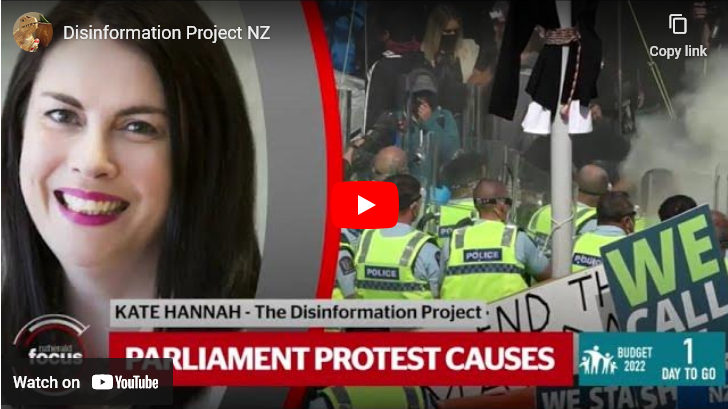
This nice bookending of claims and facts, and many other extraordinarily insightful juxtapositions, comes from a short documentary that, unfortunately, appears to only be available on YouTube:
In just half an hour, this is the whole thing, a perfect depiction of the “disinformation” project as it works everywhere. Note the moment when a news anchor and New Zealand’s bizarre prime minister are having an exchange about the viciousness and terrifying blood thirst of the far-right anti-government protesters, and the camera cuts away to show the protest, undercutting the description in real time. Note the moment when the disinformation expert tells an interviewer that she has determined that the protests are violent and dangerous, and then explains that people inside the protest believe that they’re engaged in a project of peace and love — a frightening example, she explains, of the splintered reality these people occupy inside their echo chamber. Note the moment when a member of parliament warns that anti-mandate protests are “fascist”.
And note, above all, how confused the news media figures are as they discuss the way their accurate and factual reporting from the perimeter of the protest, responsibly informed by experts and authorities, is being irresponsibly contradicted by livestreaming from inside the protest.

December 10, 2020
Making a Morning Star (Flail) for my Nephew
Rex Krueger
Published 9 Dec 2020Forged in Wood comes back hot with this Morning Star build!
More video and exclusive content: http://www.patreon.com/rexkrueger
Get the FREE measured drawing of the London Pattern Handle: https://www.rexkrueger.com/store
More woodshop weaponry builds below!
* Gun-Stock War Club: https://youtu.be/mFvBIJLciuc
* Viking Shield: https://youtu.be/AShF_5JOM2c
* Spiked Mace: https://youtu.be/Ig4H-ozMHNISign up for Fabrication First, my FREE newsletter: http://eepurl.com/gRhEVT
Wood Work for Humans Tool List (affiliate):
*Cutting*
Gyokucho Ryoba Saw: https://amzn.to/2Z5Wmda
Dewalt Panel Saw: https://amzn.to/2HJqGmO
Suizan Dozuki Handsaw: https://amzn.to/3abRyXB
(Winner of the affordable dovetail-saw shootout.)
Spear and Jackson Tenon Saw: https://amzn.to/2zykhs6
(Needs tune-up to work well.)
Crown Tenon Saw: https://amzn.to/3l89Dut
(Works out of the box)
Carving Knife: https://amzn.to/2DkbsnM
Narex True Imperial Chisels: https://amzn.to/2EX4xls
(My favorite affordable new chisels.)
Blue-Handled Marples Chisels: https://amzn.to/2tVJARY
(I use these to make the DIY specialty planes, but I also like them for general work.)*Sharpening*
Honing Guide: https://amzn.to/2TaJEZM
Norton Coarse/Fine Oil Stone: https://amzn.to/36seh2m
Natural Arkansas Fine Oil Stone: https://amzn.to/3irDQmq
Green buffing compound: https://amzn.to/2XuUBE2*Marking and Measuring*
Stockman Knife: https://amzn.to/2Pp4bWP
(For marking and the built-in awl).
Speed Square: https://amzn.to/3gSi6jK
Stanley Marking Knife: https://amzn.to/2Ewrxo3
(Excellent, inexpensive marking knife.)
Blue Kreg measuring jig: https://amzn.to/2QTnKYd
Round-head Protractor: https://amzn.to/37fJ6oz*Drilling*
Forstner Bits: https://amzn.to/3jpBgPl
Spade Bits: https://amzn.to/2U5kvML*Work-Holding*
Orange F Clamps: https://amzn.to/2u3tp4X
Screw Clamp: https://amzn.to/3gCa5i8Get my woodturning book: http://www.rexkrueger.com/book
Follow me on Instagram: @rexkrueger

July 30, 2019
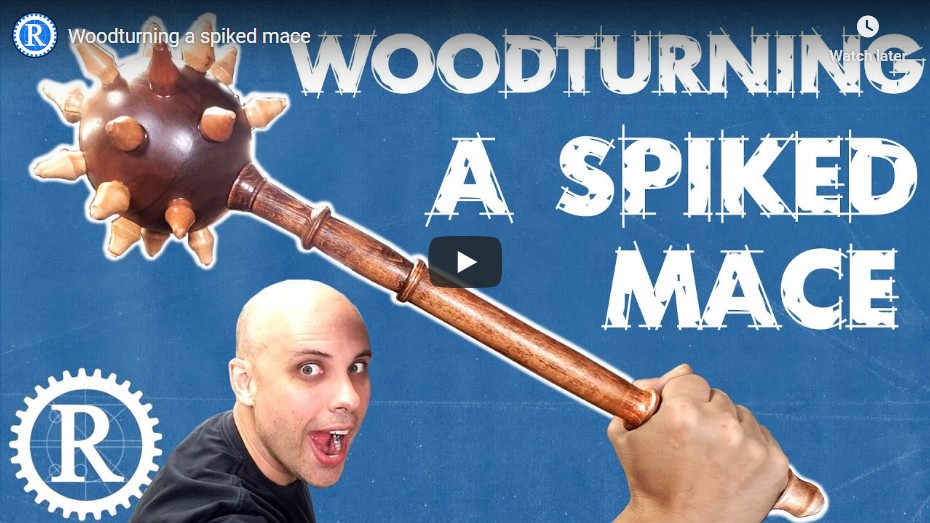
Woodturning a spiked mace
Rex Krueger
Premiered on 5 Jun 2019More video and exclusive content: http://www.patreon.com/rexkrueger
Get my woodturning book. Now in PAPERBACK! http://www.rexkrueger.com/book
Get the FREE Tip Sheet: https://www.rexkrueger.com/articles/2…Get plans, T-shirts and Hoodies: http://www.rexkrueger.com/store
Tools In This Video (Affiliate):
Lathe: https://www.harborfreight.com/12-inch…
Chuck: https://amzn.to/31aMq1x
Bowl Gouge: https://amzn.to/2JVIgW9
Calipers: https://amzn.to/2JZuPEC
Dividers: https://amzn.to/2JZ6lvb
Spade Bits: https://amzn.to/2Wpm9xY
Epoxy: https://amzn.to/2Wq4SVh
Minwax English Chestnut Stain: https://amzn.to/2XsbUoX
Guitar I Played the Metal Riffs on: https://amzn.to/2JWMCMx
January 19, 2019
Stopper 37mm: A Simple South African Riot Control Gun
Forgotten Weapons
Published on 29 Dec 2018http://www.patreon.com/ForgottenWeapons
Cool Forgotten Weapons merch! http://shop.bbtv.com/collections/forg…
The Stopper is a simple 37mm single shot riot control gun designed by Andries Piek in 1980. The South African police services were at that time using 37mm guns made by Federal Labs in the US, dating back to the 1930s, and the international embargo on South Africa made it impossible to get parts and do basic maintenance on those arms. So Piek (whose other work included the BXP carbine/SMG and design improvements to the LDP/Kommando) whipped out the Stopper in all of two weeks to provide a new domestic-production 37mm weapon for the police.
The Stopper is a simple break-action gun, with a manually cocked, single action, hammer-fired trigger mechanism. Two versions were made, one with the front grip and one without, and all were fitted with collapsing stocks. Production began in 1982 and ran until 1999, by Mitco Special Products under the Milkor name.
As an interesting postscript, Piek was inspired by seeing Christopher Walken using a Mannville 25mm revolving gas gun in the movie Dogs of War to make something similar in 37mm or 40mm. The gun he designed to this end became the Milkor MGL, adopted by South Africa in 1983 and by the US Marine Corps in 2005.
Contact:
Forgotten Weapons
PO Box 87647
Tucson, AZ 85754
December 1, 2018
California Arms Co 20ga “Defiance” Pistol-Shotgun
Forgotten Weapons
Published on 9 Nov 2018https://www.forgottenweapons.com/cali…
http://www.patreon.com/ForgottenWeapons
Made to compete with guns like the Ithaca Auto & Burglar, the “Defiance” form the California Arms Company is a side-by-side double barreled 20 gauge pistol. Only about 300 were made in the late 1920s – note that this was before the NFA introduced regulation of short barreled shotguns. Unlike the Ithaca and most other guns of this type, the Defiance is not simply a standard side-by-side shotgun cut down in length. Instead, it uses a cast aluminum grip assembly with two manually cocked strikers (and storage for two spare shells in the grip) and a barrel assembly with an integrated aluminum fore-end. The Defiance is nothing if not robust, despite perhaps being a bit slower to use than an Ithaca. Interestingly, the marketing for the Defiance also included a strong focus on the use of tear gas ammunition in addition to standard buckshot – the Lake Erie Chemical Company developed a 20ga tear gas cartridge in partnership with the California Arms Company. It was almost certainly too small to really be effective, though, and was not able to induce enough sales to keep the Defiance on the market long.
Contact:
Forgotten Weapons
PO Box 87647
Tucson, AZ 85754
November 12, 2018
German U-Boat Line-Thrower Rifle Conversions
Forgotten Weapons
Published on 21 Oct 2018https://www.forgottenweapons.com/germ…
http://www.patreon.com/ForgottenWeapons
These two Gewehr 98 rifles were converted by the Mauser factory to be used as naval line-throwing rifles. The exact nature of the line and lead projectiles is not clear, but they are clearly original military conversions and came form the Geoffrey Sturgess collection. Entirely new stocks were made for these guns, with a substantially increased length of pull to mitigate the harsh recoil of line throwing. The magazines were blocked with wooden plugs, allowing only one short (blank) round to be held, but allowing that round to be depressed enough to close the rifle’s bolt over it and keep the chamber empty. The barrels were replaced with launch tubes, on 10 inches long with a 2 inch bore and the other 10.5 inches long with a 1.75 inch bore.
Contact:
Forgotten Weapons
PO Box 87647
Tucson, AZ 85754If you enjoy Forgotten Weapons, check out its sister channel, InRangeTV! http://www.youtube.com/InRangeTVShow
December 7, 2016
Self-protection for women – “making the carrying of mace and pepper spray a sex-linked legal privilege”
Colby Cosh discusses the proposal of federal Conservative leadership hopeful Kellie Leitch to legalize the use of non-lethal chemical weapons:
… Leitch’s Thursday announcement struck me as a potentially elegant move in a hopeless chess game. Noting that a large number of women suffer physical violence over the course of their lives, she proposes that Canadians should be allowed to carry chemical mace and pepper spray for self-defence. “Women should not,” she wrote in a Facebook posting, “be forced by the law to be victims of violence when there exist non-lethal means by which they can protect themselves.”
That’s a true statement, no? Leitch does not suggest that the carrying of chemical spray weapons should be a benefit reserved only to women — she just wants to legalize those weapons generally. Perhaps I am a little more feminist than she is: I would be comfortable making the carrying of mace and pepper spray a sex-linked legal privilege. Hell, I would consider extending it to very small firearms.
Activists for feminism are continually characterizing the world of women as one of terror, abuse, and uncertainty. For Leitch to take them at their word, applying a tough-on-criminals spin, is an authentic Trump touch. I do not wholly approve of the tactic, but, as much as I think some feminists are attention-hungry zanies, I recognize the kernel of truth in their image of the universe. I’ve never had a close female friend who could not tell of bizarre, creepy, threatening things happening to them — sights and encounters that, to a male with an ordinary upbringing, seem to have wriggled from the corner of a Hieronymus Bosch painting.
Leitch got exactly the response she must have wanted from the Liberal Status of Women Minister Patty Hajdu, who blurted that giving women extra self-defence options was “putting the onus on” them, and thereby “offensive.” I find this is an odd way to raise the status of women — suggesting that if some of them might like to carry a can of mace in their purses, and could even be trusted by the authorities to use it responsibly, they are thereby dupes of the patriarchy.
I also enjoyed Colby’s description of Leitch’s “Trump-flavoured” campaign: “it’s like a bag of boring snack chips with a chemical dash of Southern spice exhaled over it. And I can’t help suspecting that there is something slightly phony about the media panic surrounding her candidacy.”
June 23, 2015
“Being skunked” takes on a new meaning
At Defence One, Patrick Tucker looks at an “improved” stink bomb now available to American police departments:
As protestors and police officers clash on the streets of Baltimore and other divided cities, some police departments are stockpiling a highly controversial weapon to control civil unrest.
It’s called Skunk, a type of “malodorant,” or in plainer language, a foul-smelling liquid. Technically nontoxic but incredibly disgusting, it has been described as a cross between “dead animal and human excrement.” Untreated, the smell lingers for weeks.
The Israeli Defense Forces developed Skunk in 2008 as a crowd-control weapon for use against Palestinians. Now Mistral, a company out of Bethesda, Md., says they are providing it to police departments in the United States.
Skunk is composed of a combination of baking soda and amino acids, Mistral general manager Stephen Rust said at the National Defense Industrial Association’s Armament Systems Forum on April 20. “You can drink it, but you wouldn’t want to,” said Rust, a retired U.S. Army project manager.
The Israelis first used it in 2008 to disperse Palestinians protesting in the West Bank. A BBC video shows its first use in action, sprayed by a hose, a system that has come to be known as the “crap cannon.”
July 20, 2013
The Angry Nerd comes down on Comic Con weapon checks
March 31, 2013
The question is not whether armed drones will be deployed domestically, but when
Glenn Greenwald presents a strong case that it is inevitable that armed drones will be deployed over the US:
The use of drones by domestic US law enforcement agencies is growing rapidly, both in terms of numbers and types of usage. As a result, civil liberties and privacy groups led by the ACLU — while accepting that domestic drones are inevitable — have been devoting increasing efforts to publicizing their unique dangers and agitating for statutory limits. These efforts are being impeded by those who mock the idea that domestic drones pose unique dangers (often the same people who mock concern over their usage on foreign soil). This dismissive posture is grounded not only in soft authoritarianism (a religious-type faith in the Goodness of US political leaders and state power generally) but also ignorance over current drone capabilities, the ways drones are now being developed and marketed for domestic use, and the activities of the increasingly powerful domestic drone lobby. So it’s quite worthwhile to lay out the key under-discussed facts shaping this issue.
I’m going to focus here most on domestic surveillance drones, but I want to say a few words about weaponized drones. The belief that weaponized drones won’t be used on US soil is patently irrational. Of course they will be. It’s not just likely but inevitable. Police departments are already speaking openly about how their drones “could be equipped to carry nonlethal weapons such as Tasers or a bean-bag gun.” The drone industry has already developed and is now aggressively marketing precisely such weaponized drones for domestic law enforcement use. It likely won’t be in the form that has received the most media attention: the type of large Predator or Reaper drones that shoot Hellfire missiles which destroy homes and cars in Pakistan, Yemen, Somalia, Afghanistan and multiple other countries aimed at Muslims (although US law enforcement agencies already possess Predator drones and have used them over US soil for surveillance).
October 21, 2011
New study shows Tasers often misused by police
Robert Farago lists some of the findings from a recent New York Civil Liberties Union study on the use and mis-use of TASERs:
- Nearly 60 percent of reported Taser incidents did not meet expert-recommended criteria that limit the weapon’s use to situations where officers can document active aggression or a risk of physical injury.
- Fifteen percent of incident reports indicated clearly inappropriate Taser use, such as officers shocking people who were already handcuffed or restrained.
- Only 15 percent of documented Taser incidents involved people who were armed or who were thought to be armed, belying the myth that Tasers are most frequently used as an alternative to deadly force.
- More than one-third of Taser incidents involved multiple or prolonged shocks, which experts link to an increased risk of injury and death.
- More than a quarter of Taser incidents involved shocks directly to subjects’ chest area, despite explicit warnings by the weapon’s manufacturer that targeting the chest can cause cardiac arrest.
- In 75 percent of incidents, no verbal warnings were reported, despite expert recommendations that verbal warnings precede Taser firings.
- 40 percent of the Taser incidents analyzed involved at-risk subjects, such as children, the elderly, the visibly infirm and individuals who are seriously intoxicated or mentally ill.
May 19, 2011
Making light: are LED flashlights now “tacticool”?
Chris Dumm has a bit of fun reviewing an LED flashlight:
Remember back when Mag-lite was the last word in aircraft-grade aluminum illumination? Those old incandescent Mag-Lites weren’t any brighter than ordinary flashlights, but their indestructible machined-aluminum bodies made them the choice of police, private security, Elvis and burglars. They were “tacticool” before people had a chance to learn to hate that word. The longer D-cell Mag-lites resembled aluminum billy clubs; they delivered a more devastating blow than any Monadnock PR-24 police baton ever could. Despite their size and weight, however, they still weren’t all that bright.
Then new technology arrived in the form of noble gas (Xenon bulbs) and heavy metal (Lithium batteries). SureFire and Streamlight built flashlights bright enough to temporarily blind and disorient a target without having to bash his brains in with five D-cell batteries wrapped in an aluminum Little League bat. And they were tough enough to drown, drop and attach to the hardest-kicking riot shotguns in the SWAT unit’s arsenal without fizzling out at the worst possible moment.
The new flashlights were rugged, dazzlingly bright and incredibly compact. Their only drawbacks: astronomical prices (for lights, bulbs, and batteries) and battery run-times of one hour or less. They quickly became the law enforcement standard, until LED technology took the lead and never looked back.
December 8, 2010
Has anyone seen this Taser?
John Oates has a bit of fun at the expense of the Metropolitan Police:
Police appeal for missing Taser
Shocking loss, but stunning Christmas presentThe Metropolitan Police ia appealing for the return of a Taser and four cartridges that were left on the roof of a police car, which was then driven away…
A Met firearms officer attended an early morning briefing at Norfolk Row, Lambeth. After the briefing, possibly focussed on coffee and a bacon sandwich, the copper put the Taser on the roof of the marked police car and drove off.
An hour and a half later it dawned on the unfortunate officer what had happened, by which time the Taser was no longer on the roof.
September 29, 2010
Taser shotgun shell
In a word, YIKES!
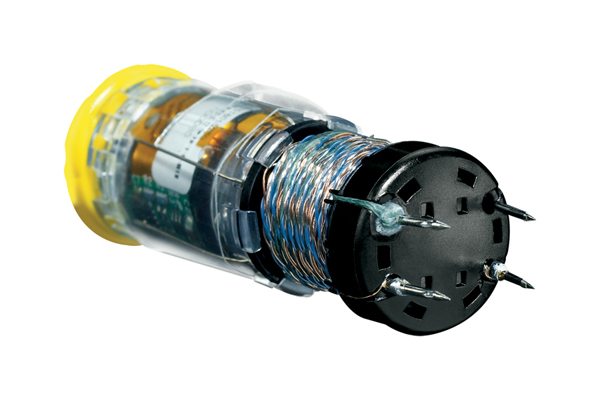
That is something nobody wants to be hit with, especially fired out of a shotgun.
The “X12” Taser shotgun is made by Taser International of Scottsdale, Arizona and fires a battery-packed 12-bore shell with forward-facing barbs that deliver a debilitating electric shock.
In August last year, New Scientist revealed research that showed an early version of the weapon was both difficult to aim accurately, putting victims’ eyes at risk, and sometimes delivered a shock for more than five minutes, rather than 20 seconds.
A five minute jolt rather blurs the line between non-lethal and kinda-sorta-lethal, doesn’t it?


