
… the Wilson government wasn’t an aberration, for political history is littered with examples of people being found out, often in the most embarrassing possible circumstances. Now that he’s remembered as a byword for complacent failure, it’s easy to forget that David Cameron was a straight-A student who won an exhibition to Brasenose College, Oxford and was described by his tutor, Professor Vernon Bogdanor, as “one of the ablest” students he’d ever taught. (By now you should have spotted a theme.) An even more glaring example, however, comes from across the Atlantic.
Google “Michael Ignatieff” and you wonder if it was really legal for one man to have enjoyed so many blessings. Everything the Canadian intellectual touched turned to gold. At boarding school in Toronto in the Sixties he was captain of the soccer team and editor of the yearbook. He taught at Oxford and the London School of Economics. He presented The Late Show for the BBC and wrote columns for the Observer. His documentaries won awards; his biography of Isaiah Berlin was shortlisted for some of the world’s most prestigious non-fiction prizes; his novel was even shortlisted for the Booker Prize. He was awarded a professorial chair at Harvard, then another at Toronto. And when his friends in the Canadian Liberal Party invited him to make a bid for the leadership, further glory seemed inevitable.
What happened next, however, makes Kwarteng’s stewardship of the Treasury look like a triumph. In 2011 Ignatieff led the Liberals to the worst defeat in their history, finishing third with just 34 seats. What was worse, he even lost his own seat in Etobicoke–Lakeshore, the first Canadian opposition leader to do so since 1900. His staff were in tears, the world was watching, and all those book prizes must have seemed an awfully long way away. In the cruellest twist imaginable, the man who always came top in exams had failed the most public exam of all.
Dominic Sandbrook, “Kwasi Kwarteng was the wrong sort of clever”, UnHerd, 2022-10-17.
January 20, 2023
QotD: Michael Ignatieff
February 8, 2021
QotD: The deeply rooted anti-Americanism in Canadian politics
Ben Woodfinden, “True North Patriotism and a Distinctly Canadian Conservatism”, The Dominion, 2020-10-20.
February 22, 2014
Federal Liberals to switch emphasis to the economy
David Akin recounts the last few federal campaigns the Liberal Party ran and the dismal results they achieved:
When the Conservative war room in the 2011 general election first saw video of then-Liberal leader Michael Ignatieff hoarsely exhorting Canadians to “rise up!”, they could hardly believe their good fortune.
As Maclean’s political editor Paul Wells reports in his latest book, The Longer I’m Prime Minister, Conservative operatives at first thought it was a hoax. But, no, there was Ignatieff running around the country, literally calling for a revolutionary overthrow in the midst of the worst recession since the Depression.
“You’ve got Stephen Harper on the one hand saying times are dangerous and we need a stable government and then you got a guy yelling at people to rise up?” a Conservative told Wells.
Canadians, of course, did not rise to Ignatieff’s call to arms, and instead dumped Liberals in record proportions. New Democrats and Conservatives had stuck doggedly to themes that revolved around pocketbook issues and reaped the electoral rewards.
The Liberals ignored pocketbook issues, too, in 2008 focusing instead on Stephane Dion’s “Green Shift”. Dion’s plan could quite easily have been sold as a job creation plan with a huge tax cut but instead was sold as the solution for a problem — climate change — Canadians were not nearly worried about as much their own household economic security.
And in 2006, Paul Martin had a rock-solid economic record that should have helped him glide right by the sponsorship scandal and back to power. Incredibly, he tried to seal the deal in the last weeks of the campaign with a surprise pledge to eliminate the “notwithstanding clause.” Riiiight! Canadians love to vote for parties promising constitutional amendments!
This time, the party appears to have decided to fight the 2015 election campaign on economic grounds, and Justin Trudeau’s video appearance is intended to be the beginning of that new tack. As Akin points out, the Tories and NDP have been occupying that part of the agenda for the last few years, so the Liberals have to find a way to draw the public attention to them and away from the other parties. That may be a key advantage for them in media terms, as Trudeau is far more mediagenic than Harper or Mulcair, so they have a fighting chance to catch attention but still need to work on what to do when they get it. The next election is starting to look more interesting all the time.
Update: Stephen Gordon is attending the Liberal convention and while he applauds them for allowing non-party members to sit in on their economic discussions, he’s not blown away by the quality of the economic arguments and suggestions:
I don’t want to be overly harsh (really!), because the proposals were the result of a lot of work and thought on the part of the people bringing them forward. Engagement on that level is something we need more of. The problem is that they came from people whose views on economics have been largely conditioned by the dirigiste approach that Liberal governments have adopted in the past. I counted no fewer than nine calls for a ‘National Strategy’, a few ‘National Policies’ and countless other ways of spending enormous amounts of money, often for no better reason than ‘it’d be really neat if we had this.’ For example, the “Building a More Competitive Economy” session was chock-a-block with proposals for infrastructure spending, and bereft of anything that would have actually created more competition in the Canadian economy.
The fault lies within the policy process itself. None of the proposals were accompanied with estimates of their costs, and I’m informed that party members are warned against discussing costs when they put their proposals together. (I can only infer that the party would rather avoid controversial stories on proposals that had not been endorsed by the leadership.) This is unfortunate, because cost-benefit analysis is at the heart of economic policy analysis. Virtually all of the policy initiatives proposed here bring some benefits, but the really hard and interesting question is whether or not these benefits outweigh their costs. The problem is that answering this question is the prerogative of the leadership, and not the delegates.
September 21, 2013
Michael Ignatieff on the aftermath of electoral defeat
The Toronto Star has an excerpt from Michael Ignatieff’s new book, Fire and Ashes:Success and Failure in Politics:
Zsuzsanna and I returned to Stornoway and disconsolately packed up our things. I remembered a photograph I’d seen of men in overalls carting belongings into a moving van at the back of 10 Downing Street after Margaret Thatcher defeated James Callaghan in 1979.
The arrival of the moving van is as momentous a symbol of the sovereignty of the people as the moment when a leader takes the oath of office. Now the moving vans were at our back door. The people had told us to pack our bags.
In an emptying house that had once felt like home, I pulled my books off the library shelves as the portrait of Laurier, our greatest prime minister, seemed to follow me with its eyes. Every leader of the party but two had become prime minister. Now I had become the third leader to fail.
The day before I’d had an airplane, a security detail, a staff of 100, a car and driver, a chef and housekeeper to welcome us home, and, most valuable of all, a political future. The day after, that future had vanished. I was unemployed and five and half months short of eligibility for the pension that usually goes with six years of service as an MP.
I was filling boxes while making phone calls to find myself a job. Rob Prichard, a friend of 30 years, came to the rescue, and after he’d made a few calls to John Fraser, master of Massey College, David Naylor, the president of the University of Toronto, and Janice Gross Stein, director of the Munk School of Global Affairs, I was back in my old life, teaching human rights and politics once again. Finding a new start was much harder for many of my defeated colleagues.
‘Defeated, disconsolate, forlorn’
I hadn’t driven for five years, and so I went to renew my licence the day after the defeat. The photograph they took that day shows a person I now barely recognize: defeated, disconsolate and forlorn. The eyes — my eyes — don’t focus.
October 2, 2012
Eric Hobsbawm is about to be beatified as “the most celebrated British historian of the 20th century”
Michael Burleigh on the recently deceased — and totally unrepentant Communist — Eric Hobsbawm:
I can almost hear the wave of mourning that is about to fix Hobsbawm in the public consciousness as “the most celebrated British historian of the 20th century”. You have to understand the British Left, which is still near hegemonic in the humanities and social science departments in our universities, to grasp why those of a more liberal conservative persuasion will disagree.
First there is the tendency to worship at the feet of foreign gurus, a failing George Orwell (or as Hobsbawm had it, the “upper-class Englishman Eric Blair”) attributed to Britain’s alienated intellectuals taking “their cookery from Paris and their opinions from Moscow”. This led them to give credibility to such evanescent charlatans as Michel Foucault, the chief exponent of “knowledge as power”, and the Palestinian activist and literary critic Edward Said.
[. . .]
Throughout, there was a dogmatic refusal to accept that the Bolshevik Revolution had been a murderous failure. Asked by the Canadian academic and politician Michael Ignatieff on television whether the deaths of 20 million people in the USSR — not to mention the 55 to 65 million victims of Mao’s Great Leap Forward — might have been justified if this Red utopia had been realised, Hobsbawm muttered in the affirmative.
Everything Hobsbawm wrote deceitfully downplayed the grim role of the Communists in Spain in the Thirties or the forcible nature of the coups the Soviets carried out in Eastern Europe after 1945. Such a cosmopolitan thinker had ironically become imprisoned within a deeply provincial ideological ghetto, knowing or caring nothing for the brave Czechs or Poles who resisted Stalin’s stooges, while being manifestly nonplussed by the democratic transformations of Central Europe since 1989-90. That the secret police — the Sword and Shield of the Revolution — would end up running Vladimir Putin’s FSB-mafia state was literally inexplicable to him.
April 27, 2012
Michael Ignatieff’s incautious remarks prove he was the wrong leader for the Liberal party
Matt Gurney on the media kerfuffle over Michael Ignatieff’s perhaps-quoted-out-of-context remarks on Quebec and separation:
Michael Ignatieff is not entirely right when he claims his now infamous remarks on the inevitability of Quebec’s independence, made during a BBC interview discussing Scotland’s possible exit from the United Kingdom, were taken out of context. He is correct that the sound bites that aroused so much media interest in Canada did not do justice to the full interview. But, in the final analysis, he did indeed say, in clear terms, that Canada and Quebec are essentially two counties, that they have little to say to each other and that Quebec is at a “way station” on its inevitable road to full sovereignty. Ignatieff, a brilliant man whose political instincts remain as faulty as ever, may regret saying what he did, but he did say it.
Separatist politicians welcomed his comments, as it “confirms” that Quebec’s independence is inevitable. Federalist politicians, particularly those unkindly disposed toward the Liberals, slammed Ignatieff, and the party he led for good measure. It was all premised upon the idea, whether sincerely believed by Ignatieff’s critics or not, that his comments may in some way encourage Quebec to leave.
That’s unlikely. But it might — just might — hasten along the day when the Rest of Canada (the ROC, as it’s called) decides to rid itself of Quebec.
Ignatieff described the situation we face as Quebec and Canada having nothing to say to each other. That’s not exactly it. It’s not that we don’t have anything to say, it’s just that we don’t have anything in common. And the more we talk to each other, the clearer that becomes. But that growing distance between Quebec and the ROC is not, as Ignatieff described it, a “contract of mutual indifference.” If it was, that would be fine. But that isn’t the system we built. Quebec’s indifference to the ROC comes at a cost — almost $7.4-billion in transfers from other Canadian provinces a year. That’s effectively half of the total sum dispersed through the equalization process. That’s not indifference, that’s bribery. And the price Quebec is willing to settle for is not necessarily the price the ROC will be willing to pay indefinitely.
March 12, 2012
The role of narcissism in calls for military intervention in Syria
Brendan O’Neill says that one of the driving factors for those demanding military action in Syria is narcissism:
Failed Canadian politician Michael Ignatieff recently made waves with an op-ed in the Financial Times calling for Western intervention in Syria. Revisiting some of the themes of his 1990s writings (Ignatieff made a living championing ‘humanitarian interventionism’ before he led Canada’s Liberal Party to its worst electoral defeat ever), Igantieff said the West should impose a ‘comprehensive quarantine of Syria’ in order to ‘force [Assad] from power’.
Yet the most startling thing about his piece was not its extreme short-term historical amnesia, its ignorance of the disasters unleashed in Iraq and Afghanistan following Western meddling, but rather its exhibition of self-regard and self-concern, even of that most malignant form of self-love: narcissism. Ignatieff mentioned his own feelings about what is happening in Homs six times and the possible feelings of the people of Homs themselves only three times. His short op-ed mainly focused on the ‘guilt’ and ‘shame’ felt by people like Igantieff — that is, Western observers possessed of a good, caring, Sarajevo-informed ‘international conscience’ — while the ‘fear’ and ‘desperation’ of the people of Homs were given far briefer treatment.
This ratio of 2:1 between Ignatieff’s feelings of guilt and Syrians’ feelings of desperation not only suggests that modern Western interventionists are two times more obsessed with themselves than they are with the victims of foreign conflicts they claim to care so much about — it also reveals that what is really motoring the demands for Western intervention in Syria are the emotional needs of Western observers rather than the practical needs of Syrians. This kind of narcissism is now widespread among those who desperately want the ‘international community’ to intervene in Syria. These people are so amazingly vain that they see the bombing of Syria as a kind of balm for their guilt-ridden consciences, a physical act that might help to make their own emotional turmoil that bit more bearable. Their rallying cry should be: ‘Bomb Syria so that I can sleep at night.’
May 4, 2011
He comes not to praise Ignatieff
Colby Cosh, that is. He has a column up at Maclean’s which he admits “was prepared in a factory that manufactures gloating. Some traces may appear.”
When I argued that Ignatieff’s long absence from the country was a problem — very, very carefully distinguishing my own argument from the content of Conservative attack ads — I was greeted with a chorus of “How dare you?” I was told I had no standing to criticize a man of Ignatieff’s intellectual attainments; by that standard, none of those who have been living Canadian politics for the last quarter-century had any right to speak — so how’d that argument work out? I was told that I was engaging in a “personal attack”; how’d the argument that personalities have nothing to do with election success work out? I was told that love for Canada is all that matters, and you can love it just as much from a distance as you do from the inside; how’d the lovefest turn out? This is not just idle gloating — and even if it is, maybe it is about time for Liberals to stop obsessing over the psychological motives of commentators and start listening. This is about whether the Liberal Party is capable of making use of criticism, even unfriendly or biased criticism, as advice. This is the question, fundamentally the only question, that will determine whether it has a future, if it wants one.
But the point he’s trying to make, other than a quite understandable bit of back-patting for his prescience back at the beginning of Ignatieff’s short run as Liberal leader, is that the back-room handlers set this up:
… this election could have been avoided if Ignatieff hadn’t been allowed to commit to a “Not another second of Conservative government” position on the 2011 budget. I don’t know what story Paul Wells will tell in his sprawling Making Of The Prime Minister 2011 feature, and if he disagrees with me I would strongly encourage you to take his word over mine. My information is that the Liberal high command was playing a calculated gambit by leaving the go/no-go choice on Jack Layton’s desk. They thought that a spring 2011 election was better for them than an autumn one or a 2012 one. And they thought that Layton, in any event, would probably be too ravaged by illness not to support the budget — in which case they were prepared to go out and blame him for every jot and tittle in that document. This makes sympathy for the Liberal braintrust very, very difficult.
Some of the troubles facing the federal Liberals
Sarah-Taïssir Bencharif lists the financial issues alone:
Whoever replaces Michael Ignatieff next week will be the Liberals’ fifth leader in five years. And he, or she, won’t be getting much of a prize. Fewer seats, less status and no keys to Stornoway.
The Liberals will also have to rebuild with less funding: fewer votes mean less public subsidy, and the NDP now receives the money allocated to the Official Opposition.
If Stephen Harper indeed eliminates public subsidies for the parties, they will be further pushed to do more with less. The Liberals will have to relearn how to talk to voters to get their money and their support.
The current system has worked well for the Liberals, allowing them to reduce their dependence on individual donations to the party. Changing that system now will be a double burden for them, as they will have to ramp up their fundraising efforts from a much-reduced base (and still facing the costs of the most recent election campaign).
May 3, 2011
Conservatives win majority, NDP break through to official opposition
A political earthquake in Canada, as the Liberal party vote collapses across the country and the separatist Bloc Quebecois vote collapses even further in Quebec. The result of division on the left is a majority for Stephen Harper’s Conservative party.
As I’m writing this post, the current numbers are:
- Conservatives — 167 seats
- New Democratic Party — 103 seats (historic high)
- Liberals — 34 seats (with leader Michael Ignatieff losing his own seat)
- Bloc Quebecois — 3 seats (below “official party status”, with leader Gilles Duceppe losing his own seat)
- Greens — 1 seat (historic high, as party leader Elizabeth May wins the first Green seat in parliament)
As I posted in a Twitter update a few hours back, this is the same situation that allowed Liberal leader Jean Chretien to win three straight majorities: a divided opposition. This time, instead of the Progressive Conservatives fighting the Reform Party on the right, it’s the Liberal Party fighting the NDP on the left.
The test facing Jack Layton is how to manage his hugely inflated caucus in the new parliament (with new Quebec MP’s in the majority) and perhaps finding ways to keep the rump of the Liberal party willing to work with his new official opposition.
It must be a great day to be an NDP supporter, with historic gains for the party and new respect for leader Jack Layton.
April 29, 2011
April 24, 2011
Duceppe throws down the gauntlet: “This election is a battle between… Canada and Quebec”
The rise of the NDP in Quebec is forcing Bloc Québécois leader Gilles Duceppe to take a much stronger line against Jack Layton:
The NDP’s newfound status proved jarring enough for Duceppe to make a strident, emotional appeal to his base Saturday:
“This election is a battle between… Canada and Quebec,” said a message Saturday from the Bloc leader’s Twitter account.
He later erased that note and replaced it with a toned-down appeal for all sovereigntists to back his party. The message is a clear departure from previous campaigns that saw Duceppe work to broaden his appeal beyond sovereigntist voters.
“This election is not a left-right battle, but a battle between federalists and sovereigntists,” said the later message from Duceppe’s account. “Between the parties of the Canadian majority and Quebec.”
There are even anti-NDP attack ads, including a new one from the Liberals featuring a yellow traffic light and the message, “Not so fast, Jack.”
The Liberals have been forced to pay more attention to the NDP than they had planned, especially with the parties in a statistical tie in the latest polls. Liberal Leader Michael Ignatieff was even booed loudly at at hockey game last night, which has only been lightly mentioned in the media. His low personal popularity is starting to be seen as a big reason for the Liberals’ plight in the polls — although it can’t be the only reason.
The NDP’s financial promises are one area the Liberals can safely attack:
The Liberals are pointing out a series of alleged exaggerations in the NDP platform, saying the promises are based on invented revenues like a supposed $3.6 billion that would come in the first year of a climate cap-and-trade system. The Liberals call it, “fantasy money.”
The Liberals also heaped ridicule on the NDP promise to hire 1,200 new doctors and 6,000 nurses for the bargain-basement rate of $25 million.
They said the NDP promise to save $2 billion by slashing subsidies to the oil sands overstates the possible savings by four times, and that the math is similarly wonky on the NDP’s pledge to crack down on foreign tax havens.
“It’s time to take a close look at what Jack Layton’s saying to the Canadian people. The numbers add up and up and up,” Ignatieff said.
“Mr. Layton has got a platform that when you look at it closely has . . . $30 billion of spending, which we think is not going to be good for the economy and he derives it from sources we just don’t think are credible.
“He’s got a cap-and-trade system that’s going to deliver $3.5 billion in the first year. We don’t even have a cap and trade system. It’s science fiction.”
April 21, 2011
News topic for today: the rise in NDP support in Quebec
It may be just another blip in the polling, or it could really be the NDP benefitting from weaker BQ numbers. Lots of trees will be consumed in this debate, and many electrons will be inconvenienced. The national numbers don’t show the pattern all that well, but the NDP may finally be close to that popularity breakthrough they’ve been hoping for since the brief taste of power they got in the Trudeau years. Instead of asking the Liberal leader how many NDP cabinet seats he’d need to give to Jack Layton, we might be asking Jack how many Liberal cabinet ministers he’d have in his coalition.
Jack Layton’s New Democratic Party has surged past Gilles Duceppe’s faltering Bloc Quebecois and is now in first place in Quebec, according to an Ekos public opinion poll released exclusively to iPolitics.
The poll, conducted earlier this week, found the New Democrats have jumped 10 percentage points since the eve of the leaders debate to 31.1% while the Bloc has dropped like a rock by 7.4 percentage points to 23.7%.
The Liberals are steady at 20.6% while the Conservatives have dropped slightly to 16.9%.
While the margin of error is higher at the city level, in Montreal the NDP is at 32.9% while the Bloc is at 29.7%.
Nationally, the NDP is now in a statistical tie with the Liberals at 24.9% to 25.8%. Both lag well behind the Conservatives who were preferred by 34.5% of respondents.
Update: Jane Taber has more on the regional breakdown:
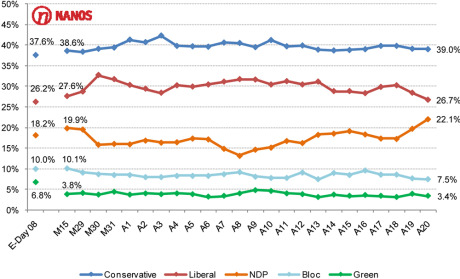
Atlantic Canada now is shaping up to be a three-way race, with the NDP gaining every day for the past seven days. The Tories are at 36.3 per cent followed by the Liberals with 33.1 per cent and the NDP at 28.3 per cent. (There is a margin of error of plus or minus 9.7 percentage points, 19 times out of 20 in the regional sample.)
In British Columbia, the Liberals have dropped significantly — Mr. Ignatieff has seen his support decrease from 33.5 per cent Monday to 22.7 per cent Wednesday night. The Conservatives have 43.5 per cent support and the NDP are at 29.6 per cent, up from 24.7 per cent the night before. (The margin of error in that province is plus or minus 7.9 percentage points, 19 times out of 20.)
In Quebec, Mr. Layton remains strong although the Bloc is still in first place with 32 per cent support compared to 23.4 per cent for the NDP, 20.8 per cent for the Liberals and 17.5 per cent for the Conservatives. “At 32 per cent it would be the worst ever showing for the BQ in a federal election,” Mr. Nanos said, noting that their previous worst showing was in 1997 where they won 37.9 per cent of the vote.
If all of this isn’t just a blip, it’s terrible news for Michael Ignatieff. That grinding noise you hear is the knife-sharpening back at Liberal HQ.
Update, the second: If the initial news was promising for Jack Layton, the poll done for La Presse must have been like a big shot of adrenalin:
A new poll by CROP for La Presse suggests that the enthusiasm for Mr. Layton is such that the NDP has now overtaken the Bloc Québécois in voting intentions for the first time in Canadian history. The online poll suggested that the NDP is now first choice for 36% of Quebecers, compared to 31% for the Bloc, 17% for the Conservatives and a mere 13% for the once mighty Liberal Party.
Having heard the NDP boast about “historic breakthroughs” over the years, I’m loath to get too carried away until these numbers are confimed by other pollsters. In 2008, Mr. Layton was in a statistical tie with Stéphane Dion two weeks before election day but ended up trailing by eight points and 40 MPs.
Yet there are signs this time might be different. In Quebec in particular, the Liberal brand is damaged goods and the Bloc is looking like a tired, one-trick pony. There is nowhere else to go for left-of-centre voters.
Update, the third: Forum Research says that the NDP is already in second place nationally:
“The Tories are ahead everywhere except Quebec, it’s all going to come down to what happens in Quebec,” says Mr. Bozinoff, noting the tradition of Quebec voters to move en masse when they have sharply changed preferences in past elections.
The survey of 2,727 voting-age Canadians was conducted Wednesday evening. It was an interactive voice response survey with a margin of error of plus or minus 2.2 per cent 19 times out of 20. The margin of error for regional and provincial breakdowns is slightly higher, but in such a large survey, with 348 citizens reached in the GTA alone, it is a reliable indicator of election trend lines.
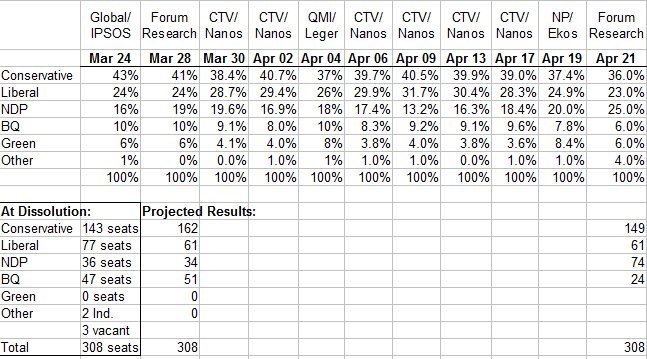
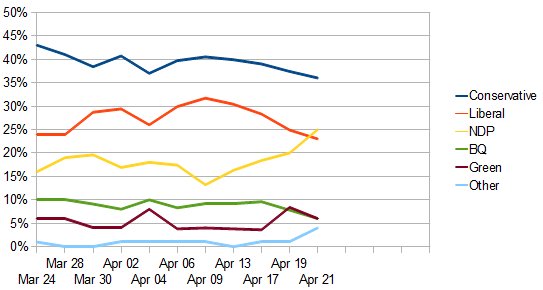
Nationally, the survey gave the Conservative Party support from 36 per cent of decided and leaning voters, 25 per cent for the NDP, 23 per cent for the Liberal party, and six per cent each for the Green Party and the Bloc Québécois. A separate Forum Research analysis, based partly on ridings won and lost in the 2008 election, suggest the survey results would give the Conservatives 149 of the 308 Commons seats if an election were held today, with 71 seats for the NDP, 64 for the Liberals and the Bloc Québécois would have 24 seats.
My occasionally updated percentage tracker, now (thanks to commenter request) with a graph to match:
April 20, 2011
Michael Ignatieff as a modern Kaiser Wilhelm II?
This is a fascinating article. I’m not sure I agree, although we’ll find out in less than two weeks if this is the “Black Day of the German Army Liberal Party”:
The Liberal party, like the Kaiser’s Germany, is stuck in the middle. (An analogy I do not expect any Liberal to use in public, ever.) To the right is the Conservative party. To the left, the NDP. Every election campaign is a two-front war.
To deal with this mortal peril, the Liberals have traditionally followed their own Schlieffen Plan.
In the event of electoral war, the Liberals move swiftly to the left. Taking ground from the NDP ensures vote splits go their way but also creates the perception that the NDP is out of the fight. Voters whose primary concern is stopping the barbarians in the East — the Conservatives, naturally — are thus forced to support the Liberals.
Now, here comes the part of the column Michael Ignatieff won’t like.


