
One of the nicest things about the game of golf is that it’s a gentle one — no bodies crashing against each other, no feats of strength, no slam-dunks or soaring home runs: just quiet, delicate and deliberate movements.
Which also applies to the subtle art of gamesmanship. No in-your-face screaming “Bring It On!” chest-thumping or trying to put your opponent off his shot; just quiet, subtle digs designed to get inside his head to make him change his game, to his disadvantage or your advantage.
I remember once mis-hitting a drive which just managed to stay on the fairway, but only went for about 150 yards — whereupon my opponent asked disingenuously: “Does your husband also play golf?” implying, of course, that I hit like a girl.
And before anyone thinks that this kind of remark is in any way demeaning to women — it isn’t, because the fact of the matter is that women can’t hit the ball as far as a man can, which is why all golf courses have a “Ladies Tee” in each hole, usually many yards closer to the fairway and green than those used by men.
So when Tiger Woods (47) surreptitiously handed his opponent Justin Thomas (29) a tampon after his drive had traveled further than the younger man’s, everyone knew exactly what he was doing: teasing Thomas, and playing a little gamesmanship.
Kim du Toit, “Growing Skin”, Splendid Isolation, 2023-02-21.
May 22, 2023
QotD: Gamesmanship in golf
May 1, 2023
Balm for a golfer’s soul
Alan Ashworth wants to persuade you to read the works of P.G. Wodehouse. In this installment, he appeals to the golfers in the audience:
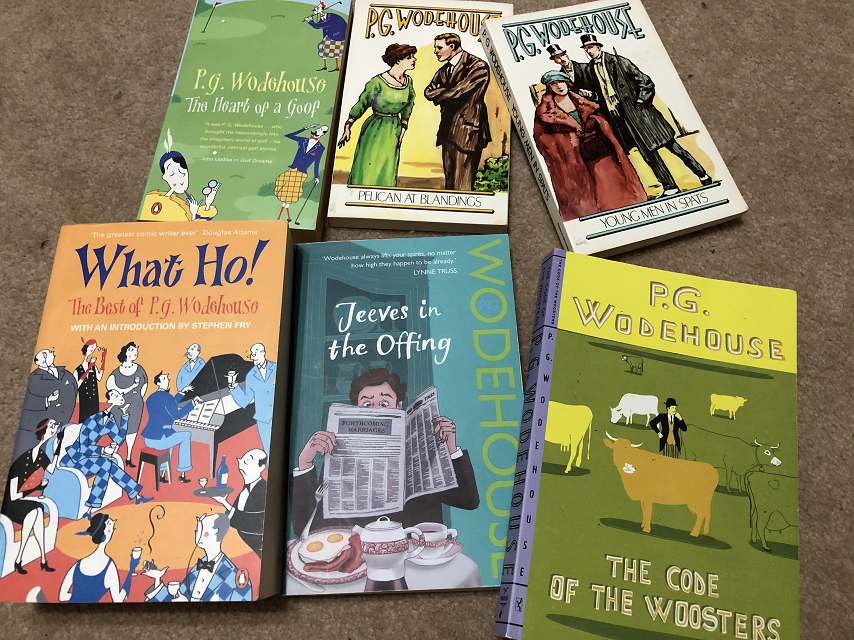
When Pelham Grenville Wodehouse was at Dulwich College between 1894 and 1900, he was blissfully happy with school life and developed an enduring love of cricket and rugger – he went off boxing because the other blighters kept hitting him. The two sports were central to his early novels and he followed Dulwich’s results throughout his long life.
Yet when Plum began to enjoy success in the US he realised that to mine the rich comic seam of sporting obsession he had to come up with a new ball game.
During a lengthy spell in America, where he had become a big noise in musical theatre, he began to play golf at the Sound View club in Long Island with comic actors including Ed Wynn and Ernest Truex. “The golf course was awfully nice,” he recalled many years later. “However, I wasn’t any good at golf. I suppose I ought to have taken lessons instead of playing. I didn’t mind losing, because it was such good exercise walking around the holes. If only I’d taken up golf immediately after I left school instead of playing cricket.”
He never did get very good at the game. Over the years he won a single trophy, a striped umbrella, at a hotel tournament “where, hitting them squarely on the meat for once, I went through a field of some of the fattest retired businessmen in America like a devouring flame”.
However, golf was to provide the material for some of Wodehouse’s finest short stories, written mainly in the 1920s, which helped to make him a very rich man.
As one of his biographers, Richard Usborne, observed in his marvellous Wodehouse at Work to the End, “in the 1920s and 30s there were many illustrated magazines on both sides of the Atlantic paying high for good humorous short stories, five- to eight-thousand-word episodes, complete with sunny plot, a beginning, middle and end, and the young couple happily paired off in the fade-out. Wodehouse wrote for this profitable market. He became one of the golden boys of the magazines and, not necessarily the same thing, a master of his craft.”
July 10, 2014
If this lawsuit succeeds, they’re going after the Black Watch next
The Tilted Kilt restaurant chain is suing a golf course for some kind of trademark infringement. Timothy Geigner tries to make sense of the “claims”:
The club in question is the Kilted Caddy Club, a golf course that provides female caddies in kilts for some of their golf tournaments, because nothing helps a man concentrate on sinking that twenty-foot sloped birdie putt like a nice pair of legs. The Tilted Kilt franchise, in case you aren’t aware, provides bar/restaurants in which scantily-clad women in kilts and low-cut button-down shirts serve you sub-par food while the worst music you can imagine plays around you and your fellow degenerate friends. In other words, we’re dealing with two quality organizations here. Well, apparently one side of this equation got their kilts in a bunch to the point of filing a very silly trademark claim.
The Tempe, Ariz.-based Tilted Kilt, which has nearly 100 locations nationwide including one at Broadway at the Beach, says in court documents that the caddy club is copying its distinctive and trademarked “uniforms,” thereby, confusing consumers into thinking the two businesses are related. The Tilted Kilt has asked a judge for a permanent injunction against the Kilted Caddy Club’s use of its name and tantalizing tartan uniforms, as well as unspecified monetary damages.
Now, let’s start off with the obvious problem: the two companies aren’t in the same line of business. One is a golf course (that of course has a clubhouse bar and food, but meh), the other is a bar/restaurant. They aren’t competing against one another. That should probably be enough to toss this thing out already. Add to that the fact that the two uniforms aren’t really all that similar beyond incorporating a bastardization of a traditional Scottish kilt, and it’s all the more difficult to see this going anywhere.
April 10, 2014
I may have to pay attention to the Masters this year

Garrick is a cousin of mine (on my mother’s side). We’ve never met, but that’s true of a lot of my distant relatives … the pond does get in the way of regular visits.
April 7, 2013
Bubba’s Hover
Bubba’s Hover – a project by Bubba Watson and Oakley.
Golf carts haven’t changed much over the years. They look and feel the same. What if there was a way to improve the traditional golf cart concept and take away some of the limitations? That is what Bubba Watson and Oakley set out to do. They created the world’s first hovercraft golf cart. Using hovercraft technology, the BW1 is able to glide over any terrain, including grass, sand, and water.
H/T to Roger Henry for the link.
July 8, 2010
QotD: Golf
I am at peace with my decision. Never again will I experience the thrill of taking out a driver on the first hole and watching as my ball sails high, higher, before settling gently onto the ladies’ tee box. Not once more shall I, in search of a wayward shot, be obliged to march into woods, or swamp, or marsh, or parking lot, or that fairway two holes over, or pro shop. Nevermore shall I shank it, pull it, hook it, slice it, flub it, duff it, lose it left, lose it right, sky it, top it, worm-burn it or — most humiliating of all — just plain miss it.
I have tried, at great cost to wallet and sanity, to become not lousy at golf. I have read books and watched Internet tutorials. I have invested in pricey irons and massive drivers and hilarious pants. I have taken a number of lessons from a number of golf pros. One of them went to the trouble of videotaping my swing so we could view and analyze it together. I remember catching his expression out of the corner of my eye as the tape played — he had the look of a young child watching someone beat a baby panda to death with a baby koala.
Scott Feschuk, “Let us now bid my game a sad farewell: Never again shall I shank it, pull it, hook it, slice it, flub it, duff it, sky it, or just plain miss it”, Maclean’s, 2010-07-08
June 1, 2010
Less than sporting, I realize
Chris Greaves sent me this link, saying “I found this in what appears to be the sporting section of CNN. Something about BP having to admit that their balls don’t work.”
Favourite comment from the site:
td52
CNN: BP announced today that their next attempt will be to drain the entire Gulf of water thereby allowing cement trucks to be driven to the site of the leak. When asked how this was going to be accomplished they said that they replied ” We are still working out the small details.”
Update: Everyone’s getting in on the cheap yucks. Here’s Colby Cosh: “You know this BP spill in the Gulf is bad — they’re running out of strategies with names borrowed from some Japanese guy’s sexual playbook.”
January 25, 2010
The Tiger Woods effect hits the PGA in the pocketbook
Tiger Woods may be invisible at the moment, but the public reaction to his troubles appears to be contributing to further financial trouble for the PGA:
The troubles facing the professional-golf tour without Tiger Woods will be on display when the annual tournament tees off at the Torrey Pines course in San Diego this week: Ticket sales are down, fewer hospitality tents have been sold, and the title sponsor had to be lured with a cut-rate price.
It is a harbinger of what the PGA Tour may be without its most popular player. Three of the Tour’s 46 tournaments scheduled for 2010 don’t have a lead corporate sponsor, nor do 13 of next year’s tournaments. Television viewership of the first two events of this year’s Tour tumbled.
In past years, Mr. Woods, the game’s most popular player, usually skipped the first three tournaments and began play on the San Diego tournament’s seaside course, perched on scenic cliffs overlooking the Pacific. As Mr. Woods’s opener, San Diego became one of the highest-profile early events of each PGA Tour season. This year, Mr. Woods, caught up in a sex scandal, is on leave from the game, with no word on when he will return. Without his unmatched star power, the value of Tour sponsorships, through which companies cover most tournament prizes, could be sharply lower. And without a rich flow of cash from those sponsorships, the PGA Tour’s economic model is cracked.
This shows the danger inherent in having a single, iconic representative. If the icon stumbles, it has a severe knock-on effect.
December 2, 2009
Tiger’s beat(ing)
I don’t follow professional golf, so what little I knew of Tiger Woods was what the sportscasters managed to get in before I switched channels. I did think that he was an amazing golfer, and that he seemed to be well on his way to becoming the greatest golfer of his time (possibly of all time, depending on the measurement). So the sudden upheaval in his private life came as rather a surprise. According to Charles P. Pierce, there’s lots more surprises likely to be coming:
I can’t say I’m surprised — either by the allegations or by what’s ensued since Friday’s wreck. Back in 1997, one of the worst-kept secrets on the PGA Tour was that Tiger was something of a hound. Everybody knew. Everybody had a story. Occasionally somebody saw it, but nobody wanted to talk about it, except in bar-room whispers late at night. Tiger’s People at the International Management Group visibly got the vapors if you even implied anything about it. However, from that moment on, the marketing cocoon around him became almost impenetrable. The Tiger Woods that was constructed for corporate consumption was spotless and smooth, an edgeless brand easily peddled to sheikhs and shakers. The perfect marriage with the perfect kids slipped so easily into the narrative it seemed he’d been born married.
Anything dissonant was dealt with quickly and mercilessly. Tiger’s caddy, an otherwise unemployable thug named Steve Williams, regularly harassed any spectator whom Williams thought might eventually harsh his man’s mellow. The IMG handlers differed from Williams only in that they were slightly more polite. The golfing press became aware that stories about Tiger’s temper, say, or about his ties to unsavory corporate grifters, would mean the end of access to the only golfer in the world who matters. There is a quick way to tell now which journalists have made this devil’s bargain and which ones haven’t — the ones insisting that this “accident” is somehow “not a story” are the sopranos in the chorus.
But the more impenetrable Tiger’s cocoon was, the more fragile it became. It was increasingly vulnerable to anything that happened that was out of the control of the people who built and sustained it, and the events of last week certainly qualify. Now he’s got one of those major Media Things on his hands, and there is nothing that he, nor IMG, nor the clinging sponsors, nor anyone else can do about it. He is going to be everyone’s breakfast for the foreseeable future. (Among his many headaches, there is absolutely no way that the Enquirer quits on this story. See Edwards, John.) And he’s going to be some kind of punch line for the most of the rest of his public career. There is some historical irony in all that, and not just for myself.
H/T to Matt Welch for the link.


