
Mansa Musa’s good intentions may be the first case in history of failed foreign aid. Known as the “Lord of the Wangara Mines”, Mansa Musa I ruled the Empire of Mali between 1312 and 1337. Trade in gold, salt, copper, and ivory made Mansa Musa the richest man in world history.
As a practicing Muslim, Mansa Musa decided to visit Mecca in 1324. It is estimated that his caravan was composed of 8,000 soldiers and courtiers — others estimate a total of 60,000 — 12,000 slaves with 48,000 pounds of gold and 100 camels with 300 pounds of gold each. For greater spectacle, another 500 servants preceded the caravan, and each carried a gold staff weighing between 6 and 10.5 pounds. When totaling the estimates, he carried from side to side of the African continent approximately 38 tons of the golden metal, the equivalent today of the gold reserves in Malaysia’s central bank — more than countries like Peru, Hungary or Qatar have in their vaults.
On his way, the Mansa of Mali stayed for three months in Cairo. Every day he gave gold bars to the poor, scholars, and local officials. Mansa’s emissaries toured the bazaars paying at a premium with gold. The Arab historian Al-Makrizi (1364-1442) relates that Mansa Musa’s gifts “astonished the eye by their beauty and splendor”. But the joy was short-lived. So much was the flow of golden metal that flooded the streets of Cairo that the value of the local gold dinar fell by 20 percent and it took the city about 12 years to recover from the inflationary pressure that such a devaluation caused.
Orestes R Betancourt Ponce de León, “5 Historic Examples of Foreign Aid Efforts Gone Wrong”, FEE Stories, 2021-06-06.
March 6, 2024
QotD: Mansa Musa’s disastrous foreign aid to Cairo
February 16, 2024
QotD: The PUA (Pick-up artist)
This was two decades or more ago, and College Town was in Podunkville. Imagine what they’re charging to get into the hot nightspots on the Sunset Strip. I bet just getting into the clubs costs these aspiring PUAs a couple hundred bucks, every week, for months. Then there’s all the other stuff Strauss said he did to transform himself into “Style” — laser-whitening his teeth, tanning beds, classes on elocution and posture, a whole new (and ever-changing) wardrobe, surfing. I can’t even begin to calculate it, but at one point he and three other PUAs are living in a Hollywood Hills mansion that once belonged to one of the Rat Pack — monthly rent, $50K. Then throw in the fact that all of this takes a tremendous amount of time, and consider the toll that must take on your body. I hit the sauce pretty hard back in my day, and one of the reasons I stopped was that the hangovers really started hurting — one night of bar-hopping now, and I’d be bedridden for days. I’m getting exhausted just typing this, and do you see what I mean?
And all this without getting a single girl. I think everyone here has been in at least one relationship, so we know that no matter how casual you keep it, bare-bones relationship management, even of pump-and-dumps, takes a fairish bit of time (so I’ve heard, anyway). I might be misremembering, but at one point Strauss claims he was managing something like four or five more or less long-term hookups simultaneously. I don’t think there are enough hours in the day …
Much better, then, to just say you’re a PUA. To do it Tyler Durden style, in other words. I’m pretty sure you could sell the illusion of yourself as a hardcore PUA with one not-too-expensive night on the town. Just dress up like one of these goobers, hit up one bar, and take selfies with a bunch of girls, making sure to alter the shot angles enough that no one can tell you’re in the same bar the whole time. Post one or two stories of your conquests a week, and you could portray yourself as some kind of pickup master in no time at all.
Of course, that’s if you want to consciously fake it. I have no idea what “Tyler Durden” was doing, not being a sociopath myself, but as Strauss tells it, his disciples got snookered into it. They really did want to learn how to pick up girls, but since dressing up like a PUA and talking about getting girls is much easier than actually getting girls, a night on the town with those guys ended up being an endless series of “approaches”. Again, it’s how you define “effective”, and Strauss lets the cat out of the bag a bit when he informs us of the PUA’s weird lingo for “closing”. There’s the “f-close”, of course, which should be obvious, but there’s also the “kiss close” and even the “phone number close” … and both of those count as complete successes.
Severian, “Mental Middlemen”, Rotten Chestnuts, 2021-05-05.
February 3, 2024
“There are no tangible consequences for politicians who violate ethics rules. The maximum fine is just $500”
Chris Selley helpfully explains why — even if the ethics commissioner turns a blind eye, again — Justin Trudeau should avoid ostentatiously living like an aristocrat in the Ancien Régime of pre-revolutionary France:
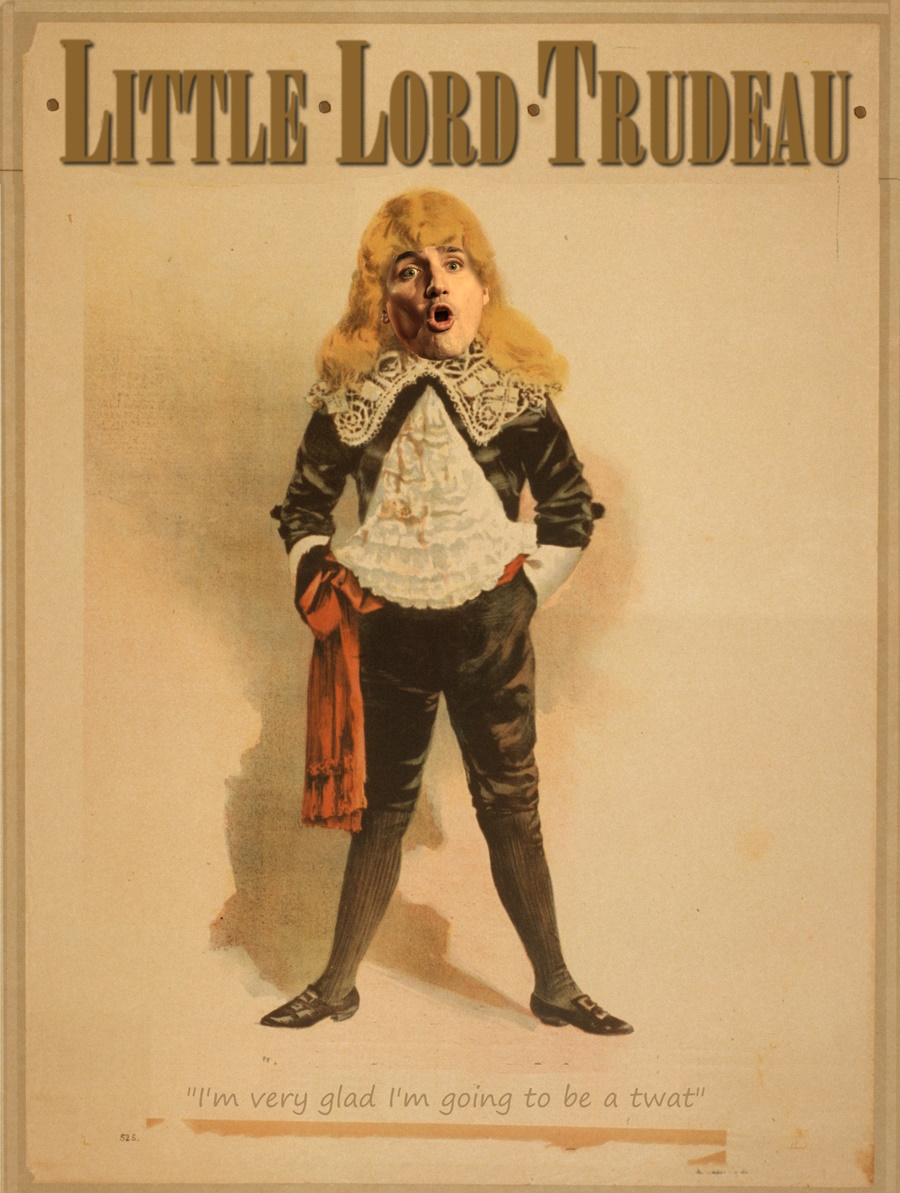
Image from Blazing Cat Fur
Interim federal Ethics Commissioner Konrad von Finckenstein authored a great moment in Canadian political accountability on Tuesday in explaining to a parliamentary committee when and why he might investigate a very generous gift to the prime minister from a friend. (Gifts from friends are explicitly allowed for in the Conflict of Interest Act.) The gift would have to be “really exceptional,” he suggested, like “a Ferrari,” or “$1 million,” to trigger an investigation.
You can get two Ferrari 296s for $1 million. Or a Daytona SP3 for around $2.5 million. It’s a very confusing standard.
Not rising to this “exceptional” level, apparently, is the free nine-day vacation in a luxury Jamaican villa the Trudeau clan enjoyed over the Christmas break, with a retail cost of around $84,000, courtesy of family friends who own the estate.
“This is a true friend, who has no relations with the government of Canada,” von Finckenstein told the committee (read: unlike the Aga Khan, whom von Finckenstein’s predecessor Mary Dawson found not to have been a real-enough friend to escape her wrath). “What we have here is clearly a generous gift, but it’s between people who are friends and I don’t see why, just because they’re well off, they can’t exchange gifts.”
Leaving aside what the prime minister is allowed to do with his truly rich true friends, it remains utterly astonishing to me that Justin Trudeau or someone with an ounce of sway in his office wouldn’t put a stop to this conspicuously consumptive behaviour as a matter of choice.
[…]
Hard cases make bad law, and it’s almost impossible to imagine a future prime minister luxuriating in his birthright lifestyle the way Trudeau does. In fact, so long as such gifts are disclosed — which the Aga Khan caper might well not have been, had the National Post not been tipped off — I think it’s probably better to let Canadians decide for themselves what they think of their PM’s behaviour when he’s unshackled by hard-and-fast rules.
It’s not as though the ethics commissioner’s findings of guilt have any real effect. There are no tangible consequences for politicians who violate ethics rules. The maximum fine is just $500. Former finance minister Bill Morneau was dinged just $200 for forgetting to disclose his villa in Provence. (I suspect La Villa Oubliée is unavailable to rent at any price.)
August 13, 2023
A Deep Dive Into Victorian Servants
J. Draper
Published 9 May 2022Content warning: mentions of sexual abuse, suicide.
Yes, it is awkward being next-door neighbours with THE ACTUAL SUN, thank you for asking.
(more…)
August 5, 2023
The rotten luck of the American Orient Express
Train of Thought
Published 5 May 2023In today’s video, we take a look at the American Orient Express, an attempt made by several businesses to replicate the charm and appeal of the real deal that just kept running into bad luck.
(more…)
May 29, 2023
The high-water mark of the Vegan cult?
In Spiked, Patrick West celebrates the passing of peak food puritanism:

“Welcome to Las Vegans and Vegetarian, Whole Foods fake meat section, Las Vegas, NV, USA” by gruntzooki is licensed under CC BY-SA 2.0 

 .
.
Over the past few years, there has been an explosion of vegan processed food appearing in supermarkets. A growing number of the population also claims to be vegan. But there are signs this trend could be going into reverse. Demand for animal-free food and drink products has collapsed over the past year. One casualty is Swedish oat-milk firm Oatly, which has recently withdrawn its dairy-free ice cream in the UK. Another is the Yorkshire sausage-making company, Heck, which has scaled-down its vegan-friendly range from 10 products to two. Smoothie-maker Innocent discontinued its dairy-free range earlier this year. Supermarket sales of meat-free products fell by £37.3million between September 2021 and September 2022, according to the consumer intelligence firm NielsenIQ.
There seems to be two main reasons. Rising inflation has been cited as one cause, as consumers have scaled back on branded and luxury eatables. Plant-based processed foods are generally more costly than the meat and dairy products they purport to replace. Another explanation is that producers of vegan food may have overestimated the size of the market for veganism, and now they are having to readjust to reality.
Whatever the reasons, we should welcome the retreat of the cult of veganism. And I use the word cult deliberately, because veganism greatly resembles not so much a lifestyle choice, but a way of life itself. It’s a faith that resonates with today’s puritanical and conformist mood.
And I should know, as someone who became a vegetarian in 1996 and has not eaten meat since. Sure, my decision aroused some mockery and derision back then, but vegetarianism had mostly stopped being regarded as weird by the mid-1990s. Ever since then, most of the opprobrium and scolding we vegetarians face comes from vegans, largely because we continue to eat eggs, cheese and milk.
For vegans, nothing must be consumed or worn that derives from animals or insects – even if there is no killing or discernible harm involved. Anything else is a feeble cop-out. Their way of thinking is absolute. In this respect, the best exemplars of the vegan movement are the animal-rights fundamentalists, PETA, whose members are well-known for their shrill, exhibitionist narcissism. Their message is simple: they are better people than you.
It’s no surprise that veganism was turbo-charged in the mid-2010s, when wokery captured the minds of so many – when absolutist, extreme thinking, and the competition to be purer than the next man or woman, took over. The trans movement echoes this rush to extremes. It demands the transformation of your entire body. Indeed, bodily self-mutilation and mortification of the flesh have long been practised by religious fundamentalists.
May 6, 2023
Coronation Weekend
Jago Hazzard
Published 5 May 2023For us train nerds, “Coronation” means something very different.
January 21, 2023
QotD: Farmers’ markets are a scam
Carefully navigating the Bugaboos, words leapt out at me from the stalls: “gluten free”, “vegan”, “no added sugar”, “no saturated fats”. It was more like advice from a doctor than things to eat. At the cheese stall I admit I was tempted by the chilli jam accompaniment, as it was described as “rich, tangy tomato with purple shallots and plump sultanas”, but all I needed to do was look at the price — a startling £10 for the small jar with a handwritten label — to decide that the Branston pickle sitting in my store cupboard would do just fine.
An older woman standing by the cheese stall looks as if she is about to pass out. It’s not the heat; rather she has just been informed by the vendor, a young woman with green hair and several face piercings, the price for a piece of Brie and a couple of small goat cheeses. And to add insult to injury, when the customer hands over the £20 to pay she is told, “We only take cards.”
So much for a local, friendly community space. The truth is, these markets are a rip-off, aimed at posturing fools with more money than sense, and food snobs that believe if food isn’t prohibitively expensive for the masses, it’s not good enough to take home and store in their gigantic Smeg fridge.
Julie Bindel, “Mugged by a mud-caked spud”, The Critic, 2022-10-15.
October 4, 2022
The History of the Wine Glass
Tasting History with Max Miller
Published 31 May 2022
(more…)
September 20, 2022
QotD: Why purple was such a rare colour in the flags of the pre-industrial era
Bret Devereaux, “Collections: Clothing, How Did They Make It? Part IVa: Dyed in the Wool”, A Collection of Unmitigated Pedantry, 2021-04-02.
August 30, 2022
QotD: The secret language of tattoos
We normal folks have the same problem when confronted with Leftists. Just to stick with a theme, consider tattoos. A quick googling suggests that something like 20% of Americans ages 18 and older have at least one tattoo. This Federalist piece doesn’t cite its source, but the claim that 40% (!!!) of those aged 18-29 are tatted up sure feels right — anecdotes aren’t data, of course, but I taught college for years; I’ve got lots of anecdotes. Kids these days are slathered in garish, gaudy ink.
Now, it’s probably safe to assume that those tats don’t mean anything criminal … but how would you know? Back when only sailors and military types had tattoos — you know, those dim dark days before about 1994 — tats had fairly obvious meanings. Globe and anchor — Semper Fi, buddy. But these days they seem entirely random. Which is the point — if you catch yourself wondering “What kind of idiot would get that permanently etched into his flesh?”, then by definition the message isn’t for you. But think about how much time, effort, and money is expended on tattoos. They mean something, I promise you.
Dealing with Liberals is like that. Every element of every tattoo is recognizable, but the meaning of the whole is utterly opaque. So it goes with Leftist language, Leftist gestures. We understand all the words that they say, and they do all the things normal people do, but not for any reason any normal person can figure out. We don’t live in their world.
Actually it’s worse than that. We think we know what they’re doing. We’ve got a cute label for it: “Virtue-signaling”. But that doesn’t go far enough. What virtue, specifically, are they signalling? Figure that out, and we might be able to find a way to break it.
I suggest that the key to understanding Leftism is: Conspicuous consumption. I think it’s the point of all those weird college-kid tattoos, too. The whole point of the exercise is to show that you have the resources — the money, tight young skin, and above all time — to undergo such a laborious process. Time is the most precious commodity of all. All the money in the world won’t buy you a single second more. Every second you spend worrying about your pronouns is a second you can’t spend doing anything productive … which is, I submit, the entire point of worrying about your pronouns. Only the young, or those stuck in permanent adolescence, can be so profligate with time.
Severian, “Skin in the Game”, Rotten Chestnuts, 2019-10-28.
April 19, 2022
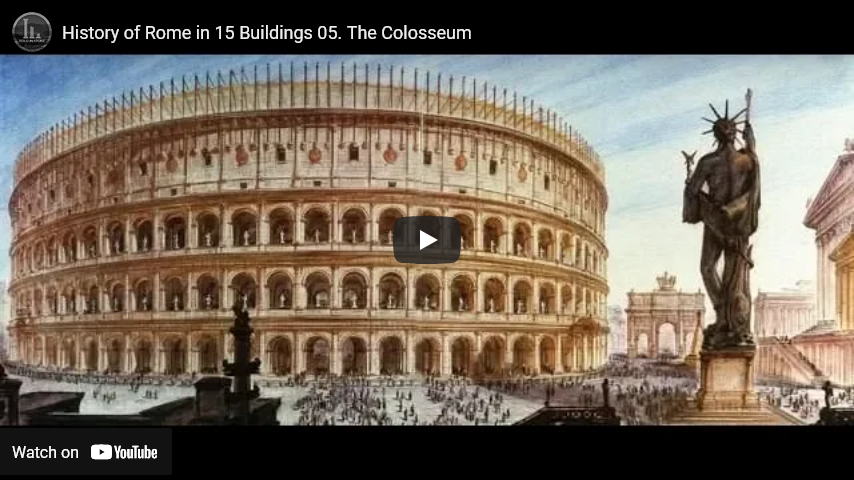
History of Rome in 15 Buildings 05. The Colosseum
toldinstone
Published 27 Sep 2018Six lions fighting eight tigers! A troupe of performing elephants! Executions, accompanied by a full orchestra! Twelve gladiatorial combats, guaranteed to the death! So might a day of games at the Colosseum, the subject of our fifth episode, be advertised. No monument better encapsulates Roman imperialism – or its costs.
If you enjoyed this video, you might be interested in my forthcoming book Naked Statues, Fat Gladiators, and War Elephants: Frequently Asked Questions about the Ancient Greeks and Romans. You can find a preview of the book here:
https://toldinstone.com/naked-statues…
If you’re so inclined, you can follow me elsewhere on the web:
https://www.reddit.com/r/AskHistorian…
https://www.instagram.com/toldinstone/To see the story and photo essay associated with this video, go to:
https://toldinstone.com/the-colosseum/Thanks for watching!
February 20, 2022
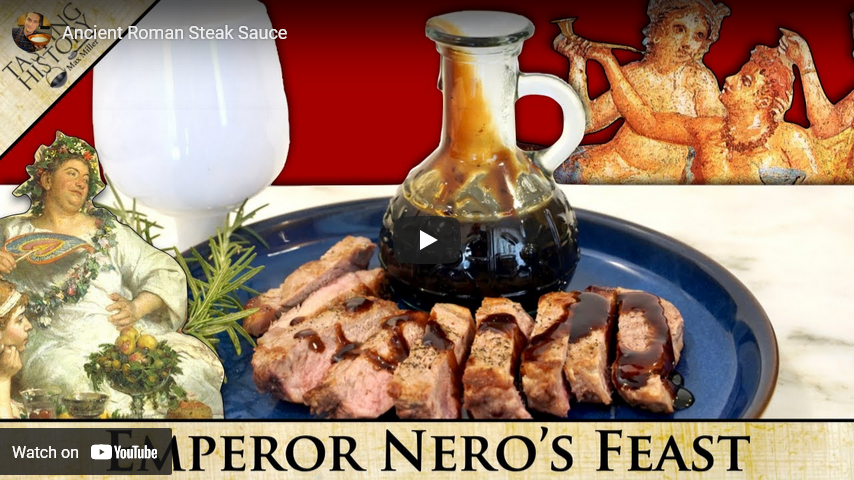
Ancient Roman Steak Sauce
Tasting History with Max Miller
Published 9 Nov 2021Support the Channel with Patreon ► https://www.patreon.com/tastinghistory
Merch ► crowdmade.com/collections/tastinghistory
Instagram ► https://www.instagram.com/tastinghist…
Twitter ► https://twitter.com/TastingHistory1
Tiktok ► TastingHistory
Reddit ► r/TastingHistory
Discord ► https://discord.gg/d7nbEpySend mail to:
Tasting History
PO Box 766
Burbank, CA 91503LINKS TO INGREDIENTS & EQUIPMENT**
Sony Alpha 7C Camera: https://amzn.to/2MQbNTK
Sigma 24-70mm f/2.8 Lens: https://amzn.to/35tjyoW
Flor de Garum: https://amzn.to/3EEXs27
Saba: https://amzn.to/3EHnz8G
Long Pepper: https://amzn.to/3EK3oqq
Juniper Berries: https://amzn.to/3GLB8FPLINKS TO SOURCES**
De re coquinaria (Apicius): https://amzn.to/3BIidI8
A Taste of Ancient Rome by Ilaria Giacosa: https://amzn.to/3nZ7PqV**Some of the links and other products that appear on this video are from companies which Tasting History will earn an affiliate commission or referral bonus. Each purchase made from these links will help to support this channel with no additional cost to you. The content in this video is accurate as of the posting date. Some of the offers mentioned may no longer be available.
Subtitles: Jose Mendoza – IG @worldagainstjose
PHOTO CREDITS
Apicius: By Bonho1962 – Own work, CC BY-SA 3.0, https://commons.wikimedia.org/w/index…
Domitian: By I, Sailko, CC BY 2.5, https://commons.wikimedia.org/w/index…
Cartwright, Mark. “Mushrooms, Roman Mosaic.” World History Encyclopedia, 23 Jan 2016. Web. 01 Nov 2021.
Agrippina crowning her young son Nero: By Carlos Delgado, CC BY-SA 3.0, https://commons.wikimedia.org/w/index…#tastinghistory
November 16, 2021
Pineapple: the King of Fruits
The History Guy: History Deserves to Be Remembered
Published 15 Nov 2021Pineapples are so culturally significant that pineapples adorn the tops of cathedrals, and serve as the domicile of one of the world’s most popular cartoon characters. An estimated 300 billion pineapples are farmed each year, and a 2021 YouGov poll lists pineapples as the sixth most favorite fruit, ahead of all varieties of apples and oranges.
This is original content based on research by The History Guy. Images in the Public Domain are carefully selected and provide illustration. As very few images of the actual event are available in the Public Domain, images of similar objects and events are used for illustration.
You can purchase the bow tie worn in this episode at The Tie Bar:
https://www.thetiebar.com/?utm_campai…All events are portrayed in historical context and for educational purposes. No images or content are primarily intended to shock and disgust. Those who do not learn from history are doomed to repeat it. Non censuram.
Find The History Guy at:
Patreon: https://www.patreon.com/TheHistoryGuy
Please send suggestions for future episodes: Suggestions@TheHistoryGuy.netThe History Guy: History Deserves to Be Remembered is the place to find short snippets of forgotten history from five to fifteen minutes long. If you like history too, this is the channel for you.
Awesome The History Guy merchandise is available at:
https://teespring.com/stores/the-hist…Script by THG
#history #thehistoryguy #Pineapple

November 5, 2021
The New York Times identifies the next big threat to humanity – “Muskism”
In Thursday’s NP Platformed newsletter, Colby Cosh outlines the “evidence” amassed in a recent New York Times essay blaming Elon Musk for, well, everything:
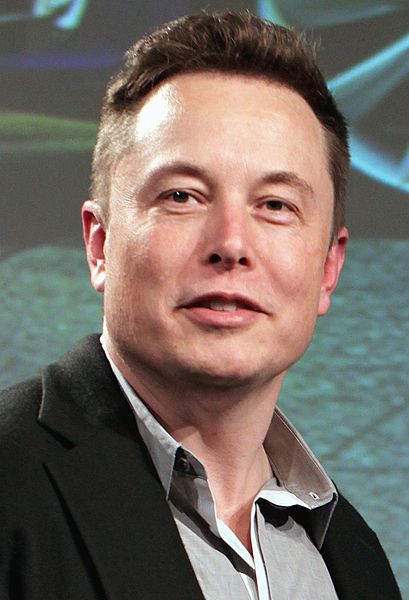
Elon Musk at the 2015 Tesla Motors annual meeting.
Photo by Steve Jurvetson via Wikimedia Commons.
Lepore commences by describing Bill Gates’s 66th birthday party, for which a bunch of rich people — including Amazon’s Jeff Bezos — were helicoptered to a private beach from a nearby yacht. Neither Elon Musk, thought to be the world’s richest person, or Mark Zuckerberg, founder of newly rebranded Facebook, were present at the party. Zuckerberg was busy illuminating plans for his “metaverse”, which Lepore describes as “a virtual reality,” wherein you wear “a headset and gear that closes out the actual world.”
Here’s where Lepore goes from this: “The metaverse is at once an illustration of and a distraction from a broader and more troubling turn in the history of capitalism. The world’s techno-billionaires are forging a new kind of capitalism: Muskism.”
In literally the next sentence, Lepore admits that the subject of her essay, Elon Musk, immediately and publicly made fun of the Facebook “metaverse” plans. We are on the third paragraph of the essay, and Lepore has already: a) blamed Elon Musk for an A-hole billionaire party he didn’t attend, because he was busy with his engineering and manufacturing projects; and b) applied the new coinage “Muskism” to a virtual reality project that actual Musk loudly criticized. Somehow this essay has severed its own hydrocephalic head twice over, within 500 words.
It gets worse from there as Lepore attempts to complete her mission of denouncing Muskism, which she describes as an “extreme extraterrestrial capitalism.” She quickly has to admit that Bill Gates, who is mostly spending a computing fortune on global philanthropy these days when he’s not lifting off from yachts in choppers, doesn’t have one single freaking thing to do with absolutely any of this. NP Platformed was an editor back in the day, so we notice that the intro of Lepore’s essay is at this point not only detached from its body, but has been left to rot several miles away. Gates-Musk-Bezos-Zuckerberg: they’re all tentacles of the same menacing Muskist octopus here, as in so much newspaper and magazine commentary, and abuse flung in their general direction will suffice to condemn all.
Lepore’s accusation against Musk turns out to be … that he likes some classic science fiction but doesn’t always concur with the politics of its authors. Musk has called himself a “utopian anarchist of the kind best described by Iain Banks,” but Banks was “an avowed socialist.” Gasp! Banks (1954-2013), the Scottish science fiction author best known for the Culture series, was a particular kind of U.K. “libertarian socialist” who believed strongly in spacefaring as a step toward post-scarcity life for sentient beings. His politics are easily misunderstood by Americans, who don’t have this particular kind of weirdo, and the interstellar “Culture” he envisioned was never intended to be admired unironically. In other words, that part of Lepore’s essay is as mangled and obtuse as the rest.


