Tom Scott
Published 2 Oct 2023The asterisk is important.
■ More on the ELT: @ESOobservatory https://eso.orgThe Extremely Large Telescope, in Paranal, Chile, is probably going to be the largest optical telescope that will ever be constructed. I was invited out there by the UK Science and Technology Facilities Council and the European Southern Observatory, and I wasn’t going to turn down a chance like that.
📰 DISCLAIMER
While the STFC and ESO invited me and arranged the logistics after arrival into the Antofagasta region, I was not paid for this (not even my travel costs) and I have sole editorial control over the video. This is not an advert.
(more…)
January 1, 2024
The largest telescope that will ever be built*
Comments Off on The largest telescope that will ever be built*
January 19, 2023
Tanks Chats #164 | M-50 Sherman | The Tank Museum
The Tank Museum
Published 23 Sep 2022In this episode of Tank Chats, David Willey discusses the history of the M-50 version of the Sherman.
(more…)
Comments Off on Tanks Chats #164 | M-50 Sherman | The Tank Museum
August 30, 2015
Argentina’s decaying armed forces
Argentina is, once again, suffering the consequences of populist-but-incompetent governance, and the state of the armed forces clearly reflect the economic woes of the country. Last year, Rowan Allport contrasted the Argentinian military in the late 1970s leading up to the Falkland War with the hollow shell of today:
It is difficult to believe from the vantage point of 2014, but in 1978, Argentina came within hours of invading Chile. The scheme arose as a result of a conflict between the two countries regarding the ownership of the Picton, Nueva and Lennox islands, which are situated at the western entrance to the Beagle Channel – a waterway running between the Pacific and Atlantic Oceans. The plan envisaged the seizure by the Argentine military of these and a number of other islands, to be followed shortly after by an invasion of mainland Chile, with the intent of capturing the capital Santiago and other key population centres. From this position, the Argentine leadership believed that it would be in an unassailable position to force Chile into a beggar’s peace regarding its territorial demands. Whilst the operation was ultimately aborted at the last minute, it was the then government’s belief that Buenos Ares had the ability to exercise hard power on a substantial scale – together the domestic economic crisis it was experiencing – that ultimately led it to once again travel down the path of aggression with the invasion of the British-governed Falkland Islands in 1982. Although Argentina did not expect the British to attempt to retake the territory and ultimately lost the conflict, its armed forces were – in addition to performing the initial amphibious assault which captured the islands – able to deploy a carrier group, surface action groups and submarines into the South Atlantic, and managed to inflict significant losses on the British using modern anti-ship weapons and a substantial fleet of jet aircraft.
Flashing forward over three decades, the Argentine Armed Forces find themselves in a calamitous state. The depleted Argentine Navy rarely puts to sea, is desperately short of spare parts, and much of the ordinance carried by its ships is past its expiration date. 2012 saw the training ship ARA Libertad seized in Ghana on the orders of a hedge fund seeking reparations from the Argentinian government [blogged here]. Shortly afterward, the corvette ARA Espora was stranded in South Africa for seventy-three days after the German company hired to repair a mechanical fault refused to carry out the work as a result of the Argentine government’s unpaid bills. Then, in a final indignity, 2013 saw the sinking of the decommissioned destroyer ARA Santísima Trinidad in port as a consequence of poor maintenance [blogged here]. The Argentine Air Force largely consists of a collection of obsolete aircraft mostly dating back to the 1970s, which are frequently grounded due to poor serviceability. The Argentine Army has deployed on operations without some of even the most basic equipment and rarely has the resources for training.
So how did this situation arise? As with most such calamities, the root causes are both financial and political. The story of Argentina’s economic fall from grace – both historical and contemporary – is well known. In 1914, Argentina was the tenth wealthiest country in the world, but a century later it has fallen to fifty-fourth place. The last three decades has seen the country careen from crisis to crisis. During the 1980s, Argentina was crippled by inflation and external debt. The free market reforms begun under President Carlos Menem allowed a short reprieve, but a succession of financial crises in Mexico, Brazil, Russia and South East Asia during the 1990s – combined with a failure to tackle numerous underlying domestic economic issues and corruption – sowed the seeds of further catastrophe. In 1998, Argentina’s economy fell into a depression, climaxing with the largest debt default in human history. Though a commodities boom and a currency devaluation allowed room for a brief recovery, the increasing use of interventionist economic policies by the government, along with the 2008 global financial crash and attempts by so-called ‘vulture funds’ to obtain payment for debts on which Argentina had previously defaulted led the country back into crisis, forcing another default in 2014.
So how bad is it now? Argentina is being forced to retire the last of their supersonic jet fighters because they can neither maintain nor replace them:
According to IHS Janes
“The Argentine Air Force is drastically cutting staff working hours and decommissioning its last fighter aircraft amid continuing budget issues.
A recently published daily agenda indicates that the service’s working hours have been significantly reduced, from 0800 to 1300; rationing of food, energy consumption, and office supplies has been directed headquarters staff and property residents; and only the minimum personnel required to staff headquarters, directorates, and commands are working.
These orders, issued on 11 August, take effect 18 August. A next step will cut Monday and Tuesday as working days. Moreover, air force officials said any aircraft taken out of service will not undergo maintenance for now.”
This leaves the Argentine military with just two types of jet aircraft A-4’s and IA-63’s and both are subsonic, decades old and barely serviceable. Argentina had looked into buying new Gripen’s from Sweden via Brazil but this was vetoed by the United Kingdom which makes a large number of internal components for the aircraft. They had also looked at JF-17’s from China, but the JF-17s proved too expensive to modify.
Comments Off on Argentina’s decaying armed forces
June 21, 2015
Chile’s red wine regions
Chile has emerged over the last decade or so as a dependable source of relatively inexpensive — and good value — red wine. Here is Wine Folly‘s brief overview of the distinctive wine regions of Chile:
It seems unlikely that the thin, long country of Chile is a larger producer of Cabernet Sauvignon than the US, but it’s true!
Chile’s vineyard area dedicated to Cabernet Sauvignon is second only to France. The country has become a winemaking hot spot due to the cooling effect Chile receives from the Pacific Ocean and the Humboldt Current. In other words, Chile has an ideal climate for wine. Chilean red wines have gone from good to exceptional in recent years and yet, they still offer good value.
Click to see full-sized image at WineFolly
Most of Chile’s vineyards are located in the Central Valley Region, which is a large region that contains several smaller valleys including Maipo, Colchagua and Maule Valley. Most of the Central Valley is wide and flat and this is where the bulk of Chilean wine is made. If you’re looking for age-worthy wine however, the fine wines of Chile tend to be found in the foothills (areas with higher elevations), especially the sub-regions of Puente Alto (in Alto Maipo or “High Maipo”) and Alto Cachapoal (“High Cachapoal”). Chilean Cabernet Sauvignon and Bordeaux blends have a signature tart-and-fruity style, typical of a cool-climate wine. The tartness (aka acidity) comes from cool ocean breezes being pulled inland by the incredibly tall Andes Mountains.

Comments Off on Chile’s red wine regions
November 1, 2014
November 1, 1914 – The Battle of Coronel
A hundred years ago today, the Royal Navy lost the Battle of Coronel to Vice Admiral Graf Maximilian von Spee’s squadron of armoured and light cruisers off the coast of Chile. Rear Admiral Sir Christopher Cradock was killed along with 1,570 men when HMS Monmouth and HMS Good Hope were sunk. Public reaction was furious: blame was cast on the Admiralty and especially on the First Lord of the Admiralty, Winston Churchill. The British public fiercely believed that any British ship was more than a match for any foreign vessel, and losing two ships while inflicting no serious damage on the enemy was scandalous.
In the Plymouth Herald, Tristan Nichols explains why Plymouth in particular took the news so badly:
TODAY the figure is hard to comprehend. On November 1, 1914, just months after the start of World War One, the Royal Navy lost two warships and nearly 1,600 lives in the South Atlantic.
The outcome of ‘The Battle of Coronel’, as it would become known, sent shockwaves across Britain, not least Plymouth.
HMS Monmouth was one of the two British cruisers involved in the battle 40 nautical miles off the coast of Chile.
She was Devonport-based and Plymouth-manned.
And every one of the 735 men on board the cruiser died on the cold and stormy seas.
Hundreds more were lost on the other Royal Navy vessel, the Portsmouth-based HMS Good Hope.
The German squadron saw just three men injured during the battle.
The build-up, battle, and ultimate demise of the 4th Cruiser Squadron during that fateful day reads like a film script.
Rear Admiral Sir Christopher (Kit) Cradock led the Royal Navy squadron to hunt down and destroy the feared German East Asia Squadron.
Both sides had reportedly only been expecting to meet a solitary cruiser – but fate would play its hand.
Rear Admiral Cradock, leading two British armoured cruisers, was up against two German armoured cruisers, and a further three light cruisers.
He was reportedly given orders to engage with the enemy, despite outlining his concerns at being outnumbered and outgunned.
According to the history books the two British armoured cruisers were inferior in every respect.
Follow orders he did, and it led to a devastating outcome for the proud British squadron.
It’s not quite as clear that Cradock followed all of his orders, as Churchill had specifically instructed him to keep the old battleship HMS Canopus with his squadron at all times until a modern armoured cruiser, HMS Defence, was able to join him (Defence, however, had been recalled part-way to the Falklands). Instead, Cradock had detached Canopus to defend the coaling station in the Falkland Islands before crossing into the Pacific, headed toward Valparaiso. Without Canopus, Cradock was totally out-gunned by von Spee’s ships.
Wikipedia reports a Canadian connection with the battle:
The Coronel Memorial Library at Royal Roads Military College, now Royal Roads University in Victoria, British Columbia, Canada was named in honour of the four Canadian midshipmen who perished in HMS Good Hope at the Battle of Coronel.
Update: The Royal Canadian Navy is marking the anniversary.
The Royal Canadian Navy (RCN) will mark the Battle of Coronel on November 1st. This battle saw the first Canadian military casualties of the First World War, and the first ever casualties in the history of the RCN. RCN personnel serving today salute the following shipmates from the past:
- Midshipman Malcolm Cann, 19, of Yarmouth, Nova Scotia;
- Midshipman John V. W. Hatheway, 19, of Fredericton, New Brunswick;
- Midshipman William Archibald Palmer, 20, of Halifax, Nova Scotia; and
- Midshipman Arthur Wiltshire Silver, 20, of Halifax, Nova Scotia.
All four RCN midshipmen died in the Battle of Coronel, which took place on November 1, 1914 off the coast of central Chile near the city of Coronel.
Comments Off on November 1, 1914 – The Battle of Coronel
October 15, 2011
Chile upgrades their amphibious capabilities
A brief item from the invaluable Strategy Page talks about Chile’s most recent naval acquisition:
Chile is buying the French amphibious ship Foudre, which is being replaced by a more recent design. The 12,000 ton Foudre has been in service for 21 years and could, with some refurbishment, serve another two decades or more. The 168 meter (521 feet) long ship has a crew of 160 and carries up to 70 vehicles. The well deck contains eight landing craft and there is a hangar that carries up to four helicopters. There are accommodations for 450 troops (or double that for short voyages). The Foudre can also be used as a command ship, which spaces for 150 headquarters personnel and their equipment.
Chile will use the Foudre to replace an 8,700 ton, 40 year old, American Newport class LPD. This ship was retired earlier this year, as it was considered too expensive to refurbish it. France has also offered Chile the second ship of the Foudre class, which is scheduled to retire from French service in a few years. The price of the Foudre to Chile has not been revealed. It will be cheap, and will depend on how much refurbishment French firms will undertake. Foudre undertook several long-distance operations during its career.
Comments Off on Chile upgrades their amphibious capabilities
April 26, 2011
Urban mountain biking – Valparaiso, Chile
VCA 2010 RACE RUN from changoman on Vimeo.
H/T to Cycling Tips Blog (and to Roger Henry, who provided the link).
Comments Off on Urban mountain biking – Valparaiso, Chile
March 3, 2010
Chilean earthquake damage may go above $30 billion
In addition to the deaths and injuries caused by the massive earthquake, Chile is still assessing the wider damage to the economy. The Guardian reports on the damage:
With the death toll unchanged at about 800 and aid flowing to southern cities, Chile today began to assess the industrial and economic cost of its earthquake.
After meeting business leaders, President Michelle Bachelet announced a grim summary of damaged industrial plants, ports and destroyed bridges. The cost could be as high as $30bn.
Significant amounts of damage impacted the grape growing areas, as they were in the middle of harvesting the grapes when the quake struck:
Southern ports were closed and inside dozens of bodegas, or wine stores, a river of wine soaked into the soil, raising concerns about damage to the industry. Initial estimates put the quantity of lost wine at 100m bottles, or roughly a sixth of the country’s annual export. Antonio Larrain, general manager of the Chilean Wine Corporation, estimated that 20% of Chile’s stored wine may have been lost. He calculated the value at $300m, which did not include the widespread damage to infrastructure ranging from underground irrigation tubing to warehouses.
Wines of Chile, an industry group, held an emergency meeting today and announced that 12% of the country’s wine production had been lost. Reports from individual wineries suggest that does not represent the true scale of the disaster. “Many wineries that lost 80% of their production are publicly saying just 15% was lost,” said one wine executive who asked not be named, citing the fear that distributors would terminate distribution contracts with wineries most heavily damaged. “This is an incredibly touchy subject,” he said.
The Chilean wine export trade has been a huge growth sector over the last twenty years, and the potential lost revenues could make recovery even more difficult.
Update, 4 March: Ironically, the LCBO’s latest issue of their Vintages magazine features Chilean wine:

Comments Off on Chilean earthquake damage may go above $30 billion
December 9, 2009
“There is no app for that”
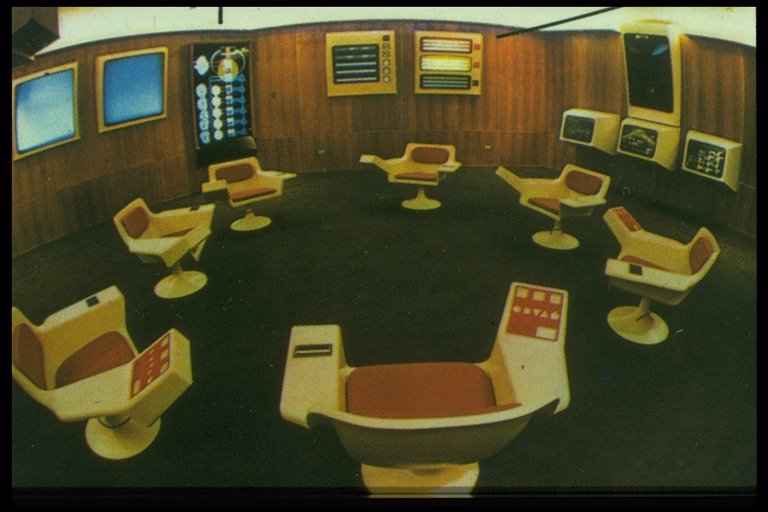
Alex Tabarrok looks at the Chilean “Cybersyn” project:
Cybersyn was a project of the socialist government of Salvador Allende (1970-1973) and British cybernetic visionary Stafford Beer; its goal was to control the Chilean economy in real-time using computers and “cybernetic principles.” The military regime that overthrew Allende dropped the project and probably for this reason when the project is periodically rediscovered it is often written about in a romantic tone as a revolutionary “socialist internet,” decades ahead of its time that was “destroyed” by the military because it was “too egalitarian” or because they didn’t understand it.
Although some sources at the time said the Chilean economy was “run by computer,” the project was in reality a bit of a joke, albeit a rather expensive one, and about the only thing about it that worked were the ordinary Western Union telex machines spread around the country. The IBM 360 two computers supposedly used to run the Chilean economy were IBM 360s (or machines on that order). These machines were no doubt very impressive to politicians and visionaries eager to use their technological might to control an economy [. . .] Today, our perspective will perhaps be somewhat different when we realize that these behemoths were far less powerful than an iPhone. Run an economy with an iPhone? Sorry, there is no app for that.
[. . .] The control room is like the bridge of the Starship Enterprise in another respect–both are stage sets. Nothing about the room is real, even the computer displays on the wall are simply hand drawn slides projected from the other side with Kodak carousels.